Scientists explain graphene mystery
Aug 23, 2010
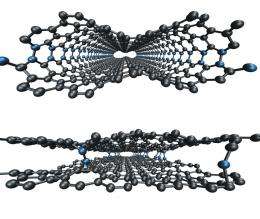
ORNL simulations demonstrate how loops (seen above in blue) between graphene layers can be minimized using electron irradiation (bottom).

Nanoscale simulations and theoretical research performed at the Department of Energy's Oak Ridge National Laboratory are bringing scientists closer to realizing graphene's potential in electronic applications.

A research team led by ORNL's Bobby Sumpter, Vincent Meunier and Eduardo Cruz-Silva has discovered how loops develop in , an electrically conductive high-strength low-weight material that resembles an atomic-scale honeycomb.

Structural loops that sometimes form during a graphene cleaning process can render the material unsuitable for electronic applications. Overcoming these types of problems is of great interest to the electronics industry.

"Graphene is a rising star in the materials world, given its potential for use in precise electronic components like transistors or other semiconductors," said Bobby Sumpter, a staff scientist at ORNL.

The team used quantum to simulate an experimental graphene cleaning process, as discussed in a paper published in . Calculations performed on ORNL supercomputers pointed the researchers to an overlooked intermediate step during processing.

Imaging with a transmission electron microscope, or TEM, subjected the graphene to electron irradiation, which ultimately prevented loop formation. The ORNL simulations showed that by injecting to collect an image, the electrons were simultaneously changing the material's structure.

"Taking a picture with a TEM is not merely taking a picture," Sumpter said. "You might modify the picture at the same time that you're looking at it."

The research builds on findings discussed in a 2009 Science paper (Jia et al.), where Meunier and Sumpter helped demonstrate a process that cleans graphene edges by running a current through the material in a process known as Joule heating. Graphene is only as good as the uniformity or cleanliness of its edges, which determine how effectively the material can transmit electrons. Meunier said the ability to efficiently clean graphene edges is crucial to using the material in electronics.

"Imagine you have a fancy sports car, but then you realize it has square wheels. What good is it? That's like having jagged edges on graphene," Meunier said.

Recent experimental studies have shown that the Joule heating process can lead to undesirable loops that connect different graphene layers. The PRL paper provides an atomistic understanding of how electron irradiation from a affects the graphene cleaning process by preventing loop formation.

"We can clean the edges, and not only that, we're able to understand why we can clean them," Meunier said.

Explore further: Researchers develop method to inkjet print highly conductive, bendable layers of graphene

Related Stories

Light-speed nanotech: Controlling the nature of graphene

Jan 21, 2009

Researchers at Rensselaer Polytechnic Institute have discovered a new method for controlling the nature of graphene, bringing academia and industry potentially one step closer to realizing the mass production ...

Polymer synthesis could aid future electronics

Jul 19, 2010

(PhysOrg.com) -- Tomorrow's television and computer screens could be brighter, clearer and more energy-efficient as a result of a process developed by a team of researchers from Canada and the Department of ...

Can graphene nanoribbons replace silicon?

Feb 18, 2010

(PhysOrg.com) -- "Graphene has been the subject of intense focus and research for a few years now," Philip Kim tells PhysOrg.com. "There are researchers that feel that it is possible that graphene could replac ...

A huge step toward mass production of graphene

Mar 10, 2010

Scientists have leaped over a major hurdle in efforts to begin commercial production of a form of carbon that could rival silicon in its potential for revolutionizing electronics devices ranging from supercomputers ...

Recommended for you

Kinks and curves at the nanoscale

May 19, 2013

One of the basic principles of nanotechnology is that when you make things extremely small—one nanometer is about five atoms wide, 100,000 times smaller than the diameter of a human hair—they are going ...

Snake's ultra-black spots may aid high-tech quest

May 16, 2013

Scientists have identified nanostructures in the ultra-black skin markings of an African viper which they said Thursday could inspire the quest to create the ultimate light-absorbing material.

User comments : 2

Adjust slider to filter visible comments by rank

Display comments: newest first

KronosDeret
not rated yet Aug 24, 2010
i want my graphene CPU and GPU mluticore pls... like right now :D and games on that level of detail... ooo i cant wait
genastropsychicallst
1 / 5 (5) Aug 24, 2010
Ever is uneven any graphasting but never was not even one graphastest unever, bey quadrate. Mean, all graphastes are always without theory because with practum is also not the real graphaste.

More news stories

Engineers' nanoantennas improve infrared sensing

(Phys.org) —A team of University of Pennsylvania engineers has used a pattern of nanoantennas to develop a new way of turning infrared light into mechanical action, opening the door to more sensitive infrared ...

Advance in nanotech gene sequencing technique

(Phys.org) —The allure of personalized medicine has made new, more efficient ways of sequencing genes a top research priority. One promising technique involves reading DNA bases using changes in electrical ...

Child maltreatment increases risk of adult obesity

Children who have suffered maltreatment are 36% more likely to be obese in adulthood compared to non-maltreated children, according to a new study by King's College London. The authors estimate that the prevention or effective ...

New immune system discovered

(Medical Xpress)—A research team, led by Jeremy Barr, a biology post-doctoral fellow, unveils a new immune system that protects humans and animals from infection.

Lab sets a new record for creating heralded photons

(Phys.org) —Entanglement, by general consensus of physicists, is the weirdest part of quantum science. To say that two particles, A and B, are entangled means that they are actually two parts of an inseparable ...