Researchers develop a better way to grow stem cells
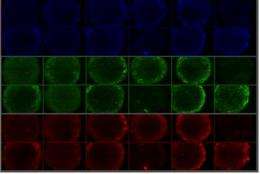
Human pluripotent stem cells, which can become any other kind of body cell, hold great potential to treat a wide range of ailments, including Parkinson's disease, multiple sclerosis and spinal cord injuries. However, scientists who work with such cells have had trouble growing large enough quantities to perform experiments -- in particular, to be used in human studies. Furthermore, most materials now used to grow human stem cells include cells or proteins that come from mice embryos, which help stimulate stem-cell growth but would likely cause an immune reaction if injected into a human patient.
To overcome those issues, MIT chemical engineers, materials scientists and biologists have devised a synthetic surface that includes no foreign animal material and allows stem cells to stay alive and continue reproducing themselves for at least three months. It's also the first synthetic material that allows single cells to form colonies of identical cells, which is necessary to identify cells with desired traits and has been difficult to achieve with existing materials.
The research team, led by Professors Robert Langer, Rudolf Jaenisch and Daniel G. Anderson, describes the new material in the Aug. 22 issue of Nature Materials. First authors of the paper are postdoctoral associates Ying Mei and Krishanu Saha.
Human stem cells can come from two sources — embryonic cells or body cells that have been reprogrammed to an immature state. That state, known as pluripotency, allows the cells to develop into any kind of specialized body cells.
It also allows the possibility of treating nearly any kind of disease that involves injuries to cells. Scientists could grow new neurons for patients with spinal cord injuries, for example, or new insulin-producing cells for people with type 1 diabetes.
To engineer such treatments, scientists would need to be able to grow stem cells in the lab for an extended period of time, manipulate their genes, and grow colonies of identical cells after they have been genetically modified. Current growth surfaces, consisting of a plastic dish coated with a layer of gelatin and then a layer of mouse cells or proteins, are notoriously inefficient, says Saha, who works in Jaenisch's lab at the Whitehead Institute for Biomedical Research.
"For therapeutics, you need millions and millions of cells," says Saha. "If we can make it easier for the cells to divide and grow, that will really help to get the number of cells you need to do all of the disease studies that people are excited about."
Previous studies had suggested that several chemical and physical properties of surfaces — including roughness, stiffness and affinity for water — might play a role in stem-cell growth. The researchers created about 500 polymers (long chains of repeating molecules) that varied in those traits, grew stem cells on them and analyzed each polymer's performance. After correlating surface characteristics with performance, they found that there was an optimal range of surface hydrophobicity (water-repelling behavior), but varying roughness and stiffness did not have much effect on cell growth.
They also adjusted the composition of the materials, including proteins embedded in the polymer. They found that the best polymers contained a high percentage of acrylates, a common ingredient in plastics, and were coated with a protein called vitronectin, which encourages cells to attach to surfaces.
Using their best-performing material, the researchers got stem cells (both embryonic and induced pluripotent) to continue growing and dividing for up to three months. They were also able to generate large quantities of cells — in the millions.
The MIT researchers hope to refine their knowledge to help them build materials suited to other types of cells, says Anderson, from the MIT Department of Chemical Engineering, the Harvard-MIT Division of Health Sciences and Technology, and the David H. Koch Institute for Integrative Cancer Research. "We want to better understand the interactions between the cell, the surface and the proteins, and define more clearly what it takes to get the cells to grow," he says.
More information: "Combinatorial development of biomaterials for clonal growth of human pluripotent stem cells" by Ying Mei, Krishanu Saha, Said R. Bogatyrev, Jing Yang, Andrew L. Hook, Z. Ilke Kalcioglu, Seung-Woo Cho, Maisam Mitalipova, Neena Pyzocha, Fredrick Rojas, Krystyn J. Van Vliet, Martyn C. Davies, Morgan R. Alexander, Robert Langer, Rudolf Jaenisch and Daniel G. Anderson. Nature Materials, 22 August, 2010.
Provided by Massachusetts Institute of Technology


