Bottled tea beverages may contain fewer polyphenols than brewed tea
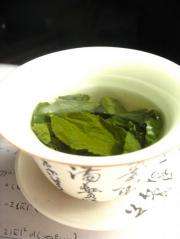
The first measurements of healthful antioxidant levels in commercial bottled tea beverages has concluded that health-conscious consumers may not be getting what they pay for: healthful doses of those antioxidants, or "poylphenols," that may ward off a range of diseases.
Scientists reported here today at the 240th National Meeting of the American Chemical Society (ACS) that many of the increasingly popular beverages included in their study, beverages that account for $1 billion in annual sales in the United States alone, contain fewer polyphenols than a single cup of home-brewed green or black tea. Some contain such small amounts that consumers would have to drink 20 bottles to get the polyphenols present in one cup of tea.
"Consumers understand very well the concept of the health benefits from drinking tea or consuming other tea products," said Shiming Li, Ph.D., who reported on the new study with Professor Chi-Tang Ho and his colleagues. "However, there is a huge gap between the perception that tea consumption is healthy and the actual amount of the healthful nutrients — polyphenols — found in bottled tea beverages. Our analysis of tea beverages found that the polyphenol content is extremely low."
Li pointed out that in addition to the low polyphenol content, bottled commercial tea contains other substances, including large amounts of sugar and the accompanying calories that health-conscious consumers may be trying to avoid. He is an analytical and natural product chemist at WellGen, Inc., a biotechnology company in North Brunswick, N.J., that discovers and develops medical foods for patients with diseases, including a proprietary black tea product that will be marketed for its anti-inflammatory benefits, which are due in part to a high polyphenol content.
Li and colleagues measured the level of polyphenols — a group of natural antioxidants linked to anti-cancer, anti-inflammatory, and anti-diabetic properties — of six brands of tea purchased from supermarkets. Half of them contained what Li characterized as "virtually no" antioxidants. The rest had small amounts of polyphenols that Li said probably would carry little health benefit, especially when considering the high sugar intake from tea beverages.
"Someone would have to drink bottle after bottle of these teas in some cases to receive health benefits," he said. "I was surprised at the low polyphenol content. I didn't expect it to be at such a low level."
The six teas Li analyzed contained 81, 43, 40, 13, 4, and 3 milligrams (mg.) of polyphenols per 16-ounce bottle. One average cup of home-brewed green or black tea, which costs only a few cents, contains 50-150 mg. of polyphenols.
After water, tea is the world's most widely consumed beverage. Tea sales in the United States have quadrupled since 1990 and now total about $7 billion annually. The major reason: Scientific evidence that the polyphenols and other antioxidants in tea may reduce the risk of cancer, heart disease, and other afflictions.
Li said that some manufacturers do list polyphenol content on the bottle label. But the amounts may be incorrect because there are no industry or government standards or guidelines for measuring and listing the polyphenolic compounds in a given product. A regular tea bag, for example, weighs about 2.2 grams and could contain as much as 175 mg. of polyphenols, Li said. But polyphenols degrade and disappear as the tea bag is steeped in hot water. The polyphenol content also may vary as manufacturers change their processes, including the quantity and quality of tea used to prepare a batch and the tea brewing time.
"Polyphenols are bitter and astringent, but to target as many consumers as they can, manufacturers want to keep the bitterness and astringency at a minimum," Li explained. "The simplest way is to add less tea, which makes the tea polyphenol content low but tastes smoother and sweeter."
Li used a standard laboratory technique, termed high-performance liquid chromatography (HPLC), to make what he described as the first measurements of polyphenols in bottled tea beverages. He hopes the research will encourage similar use of HPLC by manufacturers and others to provide consumers with better nutritional information.
Provided by American Chemical Society


