NASA satellites investigate: Tropical Depression 5 may rise again
Aug 16, 2010
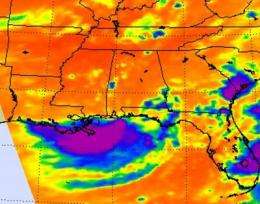
NASA's Atmospheric Infrared Sounder (AIRS) instrument on the Aqua satellite captured an infrared look at clouds from Tropical Depression 5's remnants on August 15 at 18:53 UTC (2:53 p.m. EDT) and noticed some strong convection in the southern side of circulation (purple) over the Gulf of Mexico. That area had strong thunderstorms with cloud tops as cold as -63 Fahrenheit. Credit: NASA JPL/Ed Olsen

Tropical Depression Five's remnants made a loop into southeastern Louisiana and coastal Mississippi this weekend and have again emerged in the Gulf of Mexico. Being back in the warm Gulf waters has given TD 5 a good chance for rebirth and NASA satellites are watching the storm's thunderstorms build.

The Atmospheric Infrared Sounder (AIRS) instrument on NASA's Aqua satellite captured an infrared look at TD5's clouds on August 15 at 18:53 UTC (2:53 p.m. EDT) and noticed some strong convection in the southern side of circulation over the Gulf of Mexico. That area had strong thunderstorms with cloud tops as cold as -63 Fahrenheit.

On Monday, August 16, the remnant low of TD5 was located over the northeastern Gulf of Mexico about 60 miles southwest of Panama City, Florida. The National Hurricane Center noted that " are forecast to be conducive for some development of this system as it moves generally westward and then west-northwestward over the northern Gulf of Mexico during the next day or so."

TD5's remnant low pressure area will continue to do what it's done over the weekend, bring heavy rainfall wherever it goes. So, coastal areas in portions of the north central will experience locally heavy rainfall and gusty winds through Tuesday. Meanwhile, TD5 has a 60 percent chance of being reborn as "Tropical Depression 5" again.

Explore further: NASA image: Pyrocumulus cloud billows from New Mexico fire

add to favorites email to friend print save as pdf

Related Stories

Recommended for you

Second Atlantic season tropical depression forms

8 hours ago

Tropical Depression 2 formed in the western Caribbean Sea during the early afternoon hours (Eastern Daylight Time) on June 17. NOAA's GOES-13 satellite captured an image of the storm as it consolidated enough ...

NASA image: Bushfires in north of Western Australia

16 hours ago

According to the Australian Government Bureau of Meterology, "In the warm, dry and sunny winter and spring, when grasses are dead and fuels have dried, northern Australia becomes most susceptible to bushfires. ...

User comments : 0

More news stories

Predators affect the carbon cycle, researchers show

A new study shows that the predator-prey relationship can affect the flow of carbon through an ecosystem. This previously unmeasured influence on the environment may offer a new way of looking at biodiversity management and ...

Final curtain for Europe's deep-space telescope

The deep-space telescope Herschel took its final bow on Monday, climaxing a successful four-year mission to observe the birth of stars and galaxies, the European Space Agency (ESA) said.

New language discovery reveals linguistic insights

A new language has been discovered in a remote Indigenous community in northern Australia that is generated from a unique combination of elements from other languages. Light Warlpiri has been documented by University of Michigan ...