Scientists post lower speed limit for cell-signaling protein assembly
Jul 29, 2010
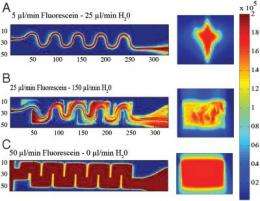
These are microscopic images of the serpentine-form mixing process for the Waldauer-Lapidus team's protein folding study. The different views show the effects of different flow rates. Panels at right show cross-section views. Credit: Waldauer/Lapidus/MSU

The apparently random self-assembly of molecular threads into the proteins that make the body work is far less frantic than previously thought, Michigan State University scientists say. That discovery could be a key to help unlock the nature of some diseases.

How proteins spontaneously "fold" from wiggling chains of into a wide variety of functional - or malfunctioning - three-dimensional molecules is one of the biggest mysteries in biochemistry.

"People thought they understood how protein diffusion worked, but now our data suggests they're wrong by a factor of 1,000," MSU physics and astronomy assistant professor Lisa Lapidus said. "Now we can start changing the models - we've been trying to solve protein folding for 50 years, and now we're advancing our fundamental understanding of what unfolded proteins do before they fold."

The findings were published online by the science journal . Lapidus was joined in the research by University of Zurich Institute of Physical Chemistry researcher Steven Waldauer, whose recent MSU doctoral dissertation formed the basis of the study, and University of California, Davis, scientist Olgica Bakajin.

Proteins, which do most of the work in the body's cells, are chain molecules composed of amino acids. The order in which the amino acids are assembled was charted by the , but the function of the protein depends on its shape, and how a protein folds is not yet understood. Much of the process is random and diffusive, like sugar moving through an unstirred cup of coffee.

Most proteins can fold in milliseconds, although there are so many possible combinations that left to chance it's physically impossible, scientists agree. So they speculate that there must be built-in folding pathways - but those remain unproved. Now physics is helping make sense of biology, posting a lower speed limit for proteins as they spontaneously assemble into their lowest-energy, so-called natural state - like a relaxed spring.

"In order to measure how quickly this random, unfolded state changes confirmations, we had to design an entirely new apparatus as well as design and fabricate a microfluidic chip capable of observing proteins within a fraction of a millisecond after being allowed to refold," Waldauer explained. Two lasers were employed to observe the formation of the immunoglobulin proteins.

"We found that the nature of the unfolded state is far from intuitive and that a protein will change from one random conformation to another much more slowly than previously thought," he said.

Scientists know that errors can occur in folding, and these are associated with a variety of diseases including Alzheimer's, ALS, cystic fibrosis and diabetes. Lapidus and colleagues speculate that the rate of the process could influence the outcome. Proteins that wiggle more rapidly, for example, may be more prone to sticking together and causing plaques such as those in Alzheimer's. The team's discovery may lead to new therapeutic strategies for this class of diseases.

"I believe this measurement of intramolecular diffusion is something that will be crucial for any subsequent studies of folding or mis-folding," Lapidus said.

Explore further: Protein study suggests drug side effects are inevitable

Related Stories

Unfolding 'nature's origami'

Mar 02, 2009

Sometimes known as "nature's origami", the way that proteins fold is vital to ensuring they function correctly. But researchers at the University of Leeds have discovered this is a 'hit and miss' process, with proteins potentially ...

'Snapshots' Shake Up Views about Proteins

Jun 14, 2006

In 2002, University of Maryland biochemist Victor Muñoz observed something about proteins that challenged the generally accepted theory about how proteins assume their biologically active states – a process called folding. ...

Researchers Provide Evidence of How Proteins Fold

Sep 01, 2006

Experimental evidence provided by a Cornell researcher and colleagues at the Scripps Research Institute in La Jolla, Calif., support a long-held theory of how and where proteins fold to create their characteristic ...

Recommended for you

Protein study suggests drug side effects are inevitable

14 hours ago

A new study of both computer-created and natural proteins suggests that the number of unique pockets – sites where small molecule pharmaceutical compounds can bind to proteins – is surprisingly small, meaning drug side ...

Attacking MRSA with metals from antibacterial clays

May 17, 2013

In the race to protect society from infectious microbes, the bugs are outrunning us. The need for new therapeutic agents is acute, given the emergence of novel pathogens as well as old foes bearing heightened antibiotic resistance.

Keeping fruit, vegetables and cut flowers fresh longer

May 15, 2013

New technology offers the promise of reducing billions of dollars of losses that occur each year from the silent, invisible killer of fruits, vegetables and cut flowers—a gas whose effects are familiar to everyone who has ...

Why don't beetles freeze in the winter?

May 14, 2013

For 37 years, Queen's University Biochemistry professor Peter Davies has been unraveling the mystery of why some organisms including insects and fish don't freeze in the winter. His research into insect antifreeze protein ...

User comments : 0

More news stories

Protein study suggests drug side effects are inevitable

A new study of both computer-created and natural proteins suggests that the number of unique pockets – sites where small molecule pharmaceutical compounds can bind to proteins – is surprisingly small, meaning drug side ...

Non-wetting fabric drains sweat

(Phys.org) —Waterproof fabrics that whisk away sweat could be the latest application of microfluidic technology developed by bioengineers at the University of California, Davis.

Beautiful 'flowers' self-assemble in a beaker

By simply manipulating chemical gradients in a beaker of fluid, materials scientists at Harvard have found that they can control the growth behavior of crystals to create precisely tailored structures—such ...

Attacking MRSA with metals from antibacterial clays

In the race to protect society from infectious microbes, the bugs are outrunning us. The need for new therapeutic agents is acute, given the emergence of novel pathogens as well as old foes bearing heightened antibiotic resistance.

No new H7N9 cases in China for a week

No new human cases of the H7N9 virus have been recorded in China for a week, national health authorities said, for the first time since the outbreak began in March.

Slow pokes: Acupuncture helps hypothermic turtles

Two endangered sea turtles that are shells of their former selves after getting stranded on Cape Cod during a cold spell are getting some help easing back into the wild—from an acupuncturist.