Europe's first mobile robotic bin-on-call
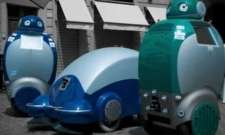
European researchers have built a robot for 'on-demand' rubbish collection - just make a call and it will soon arrive at your door. It's ideal for collecting waste in the narrow streets of many historical towns.
It is 6.30am, a beautiful sunny morning. But instead of awakening to the merry singing of birds, there are scrapes and bangs, a roar of an engine and the unmistakable grinding of the rubbish lorry as it crushes its load and moves on up the street.
Before you groan and roll over back to sleep, spare a thought for the many residents who do not have the luxury of door-to-door rubbish and recycling collections. In the historical centres of so many towns and cities in Europe, where the streets are narrow, pedestrianised or otherwise inaccessible to vehicles, residents usually have to deal with their own rubbish.
But an EU-funded project called DustBot has come up with an ingenious solution. A robot, about the size of a person, can navigate the narrowest of alleys, stop outside your door and take your rubbish away. And the best bit is this: the robotic service is 'on demand'. You don't have to remember when to put your bin out, but simply make a telephone call. Soon the robot, called DustCart, is waiting outside your door, ready to receive your rubbish.
Advanced robotics for rubbish
Professor Paolo Dario, the coordinator of DustBot, says the robot is essentially a mobile bin, but this description does this rotund little machine a disservice: it is bristling with state-of-the-art sense and control technologies.
“We've taken the very best and most advanced robotics components to build DustCart which solves a very real problem for waste authorities across Europe,” explains Dario. “Yes, it is a bin on wheels - there's the drawer in which you place your bag of rubbish or recycling - but there's a lot more to the robot than that.”
For a start, DustCart is safe to let loose on the street on its own. The robot is mounted with cameras and other sensors so it can 'see' where it is going. It scans the path ahead and processes the information to avoid stationary objects. It also picks out moving objects - pedestrians, bicycles, even stray dogs - quickly computes their trajectory and alters its course to avoid a collision. The visual images are also relayed to a control centre where human operators can check everything is OK and intervene if necessary.
To navigate its way to a resident's home, DustCart uses a clever triangulation system, interacting with a wireless network set up across the robot's area of operation. The network can pinpoint the robot, calculate optimal routes between pick-ups, and communicate this information to the robot.
“It is the dream of every robotics research to develop a fully automated and intelligent system,” says Dario, “but we have chosen a different approach. Here, we have a smart robot in a smart environment; the robot 'talks' to its surroundings and the surroundings communicate back. This means the robot has access to a lot more information and computing power.”
DustCart has three levels of intelligent control. First there are the autonomous, built-in systems including motion sensing, obstacle avoidance and user-interface functions including speech recognition. Then there is the ambient intelligent environment which supervises the robot, sends it commands and navigates it through the streets. Finally, a human control centre monitors operations, but only intervenes in an emergency or where the technology fails.
“The control centre also provides security for the robot,” Dario adds, “just in case anyone tries to steal or tamper with it!”
Waste no time
As part of the project DustCart performed demonstrations in six European locations, plus two in Japan and one in South Korea. “We have substantial information on the performance of the system and its safety. We have had no major failures yet and no safety breaches. The robot is supervised through CCTV. And we also have insurance, which basically means that the insurer is satisfied that the robot is safe to use on the streets.”
The DustBot project received funding from the Sixth Framework Programme for research and came to an end in December 2009. But two SMEs from the project and Professor Dario's research department at the Scuola Superiore Sant'Anna in Pisa are spearheading further development work.
In May, DustCart entered a two-month period of service in the small town of Peccioli in Italy - around 100 households being served by two DustCart robots. Crucially, during pilot trials like this, the houses do not receive their normal waste collection service.
“This is an excellent real-world trial where we can assess, most importantly, customer satisfaction. We've had interested from several municipalities, but investors need to know that there is a credible market for the system, that residents will favour the new approach.
“We have talked to numerous potential investors and could raise several million euros in investment, but there first needs to be more evaluation. If this trial is successful we will immediately work to raise the cash and hope to begin early development of a commercial system by the end of 2010,” he tells ICT Results.
Dario estimates that there could be a market for at least 100,000 of these robots across Europe. Moreover, the cost of using these robots would be comparable to door-to-door waste and recycling collections that most people have today, and a more convenient service should help to increase recycling rates.
“There's a really strong financial and environmental case for this 'on-demand' approach, which we think will also be more user-friendly and convenient,” says Dario.
Certainly those of us woken by the early morning bin round couldn't agree more.
More information: DustBot project - www.dustbot.org/
Provided by ICT Results


