Disposable cortisol biosensor developed
Jul 02, 2010 by Lin Edwards report
Image credit: Analyst, 2010, doi:10.1039/c0an00242a

(PhysOrg.com) -- Scientists in the US have developed a disposable, non-invasive new biosensor to monitor levels of the stress hormone, cortisol, and say the ultrasensitive electrochemical impedance technique it uses could transform the diagnosis of stress disorders.

Cortisol is a hormone that helps maintain blood pressure, , and carbohydrate metabolism within normal physiological limits. Abnormal levels of the hormone cortisol have been linked to stress-related disorders such as post-traumatic stress disorder, and .

The new sensor tests untreated saliva for cortisol levels, and produces results within 40 minutes. It could replace tests such as radioimmunoassays, enzyme-linked immunosorbent assays or liquid , all of which are lengthy and require the samples to be sent to a laboratory, and which often require pre-treatment of the saliva and the use of radioisotope labeling. The new biosensor gives comparable results to the laboratory assays but results can be obtained at the point of patient care. Cortisol levels in saliva correlate well with blood levels of the hormone.

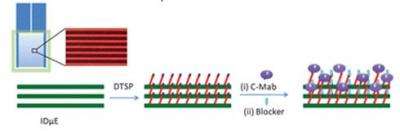
The was developed by a team led by Sunil Arya of the University of South Florida in Tampa, and measures cortisol down to levels as low as 1pM. It uses a technique called electrochemical impedance spectroscopy (EIS) with a series of parallel bands of electrodes with alternate bands connected together.

The technique offers rapid reaction kinetics and improved sensitivity and increased signal-to-noise ratio, according to Arya, and the method records the information directly at the electrode surfaces without the need for radioisotope labeling.

The device is calibrated by being incubated with a range of standards for cortisol. Cortisol is a natural insulator and binds to the electrode surface, insulating and increasing the resistance. Then a solution of ferrocyanide (Fe2+) and ferricyanide (Fe3+) is used as a redox probe to measure the resistance to charge transfer from the solution to the electrode, which is proportional to the amount of in the solution.

The new method has been validated with human saliva samples, but it is not yet commercially available. Arya and the team are now exploring commercialization options, and envision it becoming available in a system rather like glucose sensors. The cost of production of the sensors would be low enough to allow them to be disposable for use at point of care.

Explore further: Reading the unreadable

More information: Antibody functionalized interdigitated u-electrode (IDuE) based impedimetric cortisol biosensor, Sunil K. Arya, Analyst, 2010, DOI: 10.1039/c0an00242a

Related Stories

Stress hormone, depression trigger obesity in girls

Feb 22, 2010

(PhysOrg.com) -- Depression raises stress hormone levels in adolescent boys and girls but may lead to obesity only in girls, according to researchers. Early treatment of depression could help reduce stress and control obesity ...

Scientists study loneliness

Oct 31, 2006

A U.S. scientist studying physiological dynamics of day-to-day experiences say older adults who go to bed lonely have higher cortisol levels the next day.

Fatigue in women is reduced in stress-related cortisol study

Nov 13, 2006

A study of healthy women has harvested results involving fatigue and vigor that eventually may help researchers fine tune efforts to treat a multitude of illnesses and syndromes linked to low levels of the stress hormone ...

Recommended for you

New method for producing clean hydrogen

3 hours ago

Duke University engineers have developed a novel method for producing clean hydrogen, which could prove essential to weaning society off of fossil fuels and their environmental implications.

Making ice-cream more nutritious with meat left-overs

11 hours ago

Food industries are now turning meat left-over into high-protein content ingredients for food supplements, or to be added to processed food. But a EU-wide regulation covering them is still lacking.

Non-wetting fabric drains sweat

May 20, 2013

(Phys.org) —Waterproof fabrics that whisk away sweat could be the latest application of microfluidic technology developed by bioengineers at the University of California, Davis.

Protein study suggests drug side effects are inevitable

May 20, 2013

A new study of both computer-created and natural proteins suggests that the number of unique pockets – sites where small molecule pharmaceutical compounds can bind to proteins – is surprisingly small, meaning drug side ...

Attacking MRSA with metals from antibacterial clays

May 17, 2013

In the race to protect society from infectious microbes, the bugs are outrunning us. The need for new therapeutic agents is acute, given the emergence of novel pathogens as well as old foes bearing heightened antibiotic resistance.

User comments : 1

Adjust slider to filter visible comments by rank

Display comments: newest first

KALtt
not rated yet Jul 02, 2010
Chronic Fatigue Syndrome is classified by the World Health Organization in the ICD-10 under brain diseases (G93.3)along with myalgic encephalomyelitis and post viral syndrome. (A quick check of the 2006 alphabetical index on the WHO website.)

Whether stress is related to this neuroimmune disease is hotly debated since CFS has become an umbrella term with multiple conflicting research definitions and the usual conflicting bio vs. psychosocial war evidence. Cortisol has been found to be elevated or below normal levels depending on the CFS subgroup and no treatment for this conflicting results is given. Difficult to say what if any advantages would be correlated with this type of device.

More news stories

New method for producing clean hydrogen

Duke University engineers have developed a novel method for producing clean hydrogen, which could prove essential to weaning society off of fossil fuels and their environmental implications.

Protein study suggests drug side effects are inevitable

A new study of both computer-created and natural proteins suggests that the number of unique pockets – sites where small molecule pharmaceutical compounds can bind to proteins – is surprisingly small, meaning drug side ...

Beautiful 'flowers' self-assemble in a beaker

By simply manipulating chemical gradients in a beaker of fluid, materials scientists at Harvard have found that they can control the growth behavior of crystals to create precisely tailored structures—such ...

Attacking MRSA with metals from antibacterial clays

In the race to protect society from infectious microbes, the bugs are outrunning us. The need for new therapeutic agents is acute, given the emergence of novel pathogens as well as old foes bearing heightened antibiotic resistance.

Power of US tornado dwarfs Hiroshima bomb

Wind, humidity and rainfall combined precisely to create Monday's massive killer tornado in Oklahoma. The awesome amount of energy released dwarfed the power of the atomic bomb that leveled Hiroshima.

Amazon plans greenhouse-style headquarters

US online giant Amazon has unveiled plans for a futuristic greenhouse style headquarters "where employees can work and socialize in a more natural, park-like setting."