Aqua infrared satellite imagery sees Tropical Storm Darby form quickly
Jun 23, 2010
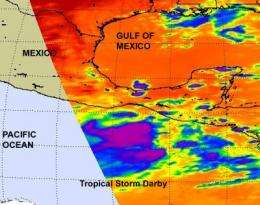
his infrared satellite image of Darby was captured from NASA's Aqua satellite on June 22 at 19:23 UTC (3:23 p.m. EDT). There is a large area of strong convection (purple) to the north of Darby's center where cloud tops were as cold as or colder than -63 degrees Fahrenheit. Credit: NASA JPL, Ed Olsen

The fifth tropical depression of the Eastern Pacific Ocean hurricane season developed and quickly strengthened into Tropical Storm Darby during the early morning hours of June 23. NASA's Aqua satellite captured a large area of strong convection that indicated that speedy strengthening.

Darby formed off the western Mexico coast south of the Gulf of Tehuantepec. At 5 p.m. EDT on June 22 Darby was located about 540 miles south-southeast of Salina Cruz, Mexico. That's near 11.5 North and 94.0 West.

Earlier on June 22, at 19:23 UTC (3:23 p.m. EDT), NASA's Aqua satellite flew over the low pressure area that became classified as Darby and provided forecasters with a look at the convection happening in the storm. Infrared satellite imagery from the Atmospheric Infrared Sounder (AIRS) instrument indicated a large area of strong convection to the north of Darby's center where cloud tops were as cold as or colder than -63 degrees Fahrenheit. data is helpful to forecasters in determining the convection (rapidly rising air that condenses and forms clouds and thunderstorms). Strong convection, like that seen in Darby is indicative of a strengthening tropical cyclone.

Darby's had increased to 40 mph with higher gusts by 5 a.m. EDT on June 23. Tropical storm-force winds extend outward up to 50 miles to the west of the center. Additional strengthening is also expected in the next 48 hours. Estimated minimum central pressure is 1005 millibars.

Darby is moving to the northwest near 9 mph, but is expected to turn toward the west-northwest and then west over the next day. Residents from Acapulco north to Manzanillo, Mexico should watch the track of Darby over the next several days.

Explore further: NASA's Landsat satellite looks for a cloud-free view

add to favorites email to friend print save as pdf

Related Stories

NASA eyes low in eastern Pacific for tropical development

May 27, 2010

The Atmospheric Infrared Sounder instrument onboard NASA's Aqua satellite captured an infrared image of a low pressure area called "90E" in the Eastern Pacific that forecasters are watching for tropical development. ...

Recommended for you

NASA's Landsat satellite looks for a cloud-free view

9 hours ago

For decades, Landsat satellites have documented the desiccation of the Aral Sea in Central Asia. Once one of the largest seas in the world, it shrunk to a tenth of its original volume after Russia diverted ...

Volcanoes cause climate gas concentrations to vary

17 hours ago

Trace gases and aerosols are major factors influencing the climate. With the help of highly complex installations, such as MIPAS on board of the ENVISAT satellite, researchers try to better understand the ...

Explainer: Why are tornadoes so destructive?

18 hours ago

Tornadoes are a part of life for people living in the Great Plains of the United States. In Oklahoma, a state that averages 62 tornadoes a year, people are prepared as best as they can be and are well warned.

User comments : 0

More news stories

Forecast for Titan: Wild weather could be ahead

(Phys.org) —Saturn's moon Titan might be in for some wild weather as it heads into its spring and summer, if two new models are correct. Scientists think that as the seasons change in Titan's northern hemisphere, ...

Theorists weigh in on where to hunt dark matter

(Phys.org) —Now that it looks like the hunt for the Higgs boson is over, particles of dark matter are at the top of the physics "Most Wanted" list. Dozens of experiments have been searching for them, but ...