Asian technology firms bet on a 3D future
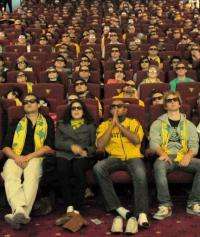
The Asian technology industry believes the future is not only bright but it's in three dimensions, as a string of manufacturers bring 3D products onto the market.
Most of Asia's big brand names from Panasonic to Samsung via Sharp, Mitsubishi and Toshiba will have 3D televisions out this year with some even offering 3D desktop computers and laptops.
Sony has launched eight 3D TVs in Japan starting at 200,000 yen (2,200 dollars) for a 40-inch (100-centimetre) screen, and is also planning 3D titles for its PlayStation 3 games console.
Akira Shimazu, Sony's senior general manager in charge of 3D projects, believes 2010 is the year that the immersive viewing experience will finally come of age.
"In terms of technology, it was impossible for television sets and video players at consumers' houses to play back 3D content appropriately," he told AFP.
But that has changed with a new high-speed LCD panel that allows 3D with full high definition, he says, and Blu-ray discs can store full-length HD-quality movies in 3D.
The quality of the content has also vastly improved with processors able to adjust 3D images digitally in post-production, tools that were not available in the past when most movies were made on film.
"Recently I saw a couple of very early 3D films created by Columbia Pictures in the 1950s," Shimazu said.
"The difference is apparent if you have seen a recent 3D film -- 3D is now being used as a strong tool of story-telling and being created to look natural and real."
James Cameron's blockbuster "Avatar" started a 3D wave in the movie industry -- followed by "Alice In Wonderland" and "Clash of the Titans", among others.
But as in the early days of cable and satellite TV, sport could determine 3D's success or failure in the home entertainment market.
The football World Cup now being played in South Africa is the first to be filmed and broadcast -- by Sony -- in 3D to fans at six FIFA viewing sites in cities around the world.
"Live broadcast of sport is one of the most promising genres of 3D content," Shimazu said.
Sports giant ESPN launched a new 3D network last Friday by airing the tournament's first game, hosts South Africa's 1-1 draw with Mexico, in 3D.
But the technology's glaring problem has not changed much since the 1950s "golden era" of 3D movies -- viewers still have to wear special glasses.
"Most analysts and commentators agree the glasses are a problem for mass adoption," said Paul O'Donovan, an analyst for global IT research company Gartner.
Glasses designed for permanent use in the home vary in price from 75 to 150 dollars, "which is not cheap -- especially if you sit on them", he said.
"Also there are issues with how many pairs are bundled with the 3D TV. Samsung offer two pairs but if you want some friends to come around to watch a movie or sports event with you, then who supplies the extra glasses?
"And you can't watch the TV without the glasses, as that will give you a definite headache."
Shimazu says that Sony, which reckons 10 percent of the TVs it sells this year will be 3D-compatible, is working on technology that does not require glasses. But he is not certain when such technology will be on the market.
O'Donovan does not believe there is a huge market -- people may buy a state-of-the-art plasma TV that happens to be 3D-compatible, not necessarily because they are keen on the 3D element.
"There is a 3D market, but it's small and is made up of early adopters keen to show off to their neighbours," he said. "I think it is a fad.
"Hollywood would love to extend the cinema success of 3D into the home market, but there is a real risk that successes like 'Avatar' will be few and far between, so even 3D in the cinema will be smaller than traditional 2D.
"The transition to the home market is definitely going to be a bumpy ride, if it ever takes off."
Ichiro Michikoshi, an analyst at Japanese research firm BCN, was marginally more hopeful.
"I think there is a market," he said. "But I think 3D TVs will not sell remarkably until it becomes usual to watch 3D without special glasses."
(c) 2010 AFP


