Superconductivity breakthrough could lead to more cost effective technologies
May 24, 2010
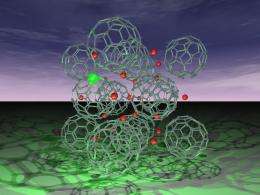
Muon implanted into face-centred cubic Cs3C60

Researchers from the Universities of Liverpool and Durham have fitted another piece into the superconductivity puzzle that could help in the quest to bring down the cost of technologies such as MRI scanners and some energy storage applications that rely on superconductors. The result is published online in the journal Nature (19th May 2010).

Using the ISIS and Diamond Facilities at the Science and Technology Facilities Council's Rutherford Appleton Laboratory (RAL) and the European Synchrotron Radiation Facility (ESRF) in Grenoble, scientists have demonstrated how a new material made from metal atoms and buckyballs (tiny carbon-60 molecules shaped like a football) becomes a high temperature superconductor when it is squashed. The applied pressure shrinks the structure and overcomes the repulsion between the electrons, allowing them to pair up and travel through the material without resistance.

The Liverpool and Durham researchers made the new material supported by funding from the Engineering and Physical Sciences Research Council for a program investigating ways of creating higher temperature superconductors, to reduce some of the costs involved with keeping them at their optimum temperature and broaden their applications. An for example, contains person-sized superconductive magnet that needs to be kept inside a bath of in order to regulate the superconductor's temperature at - 270 degrees Celcius. The ultimate aim is for a superconductor to operate at room temperature to eliminate the need for large and expensive cooling systems.

Dr Peter Baker, Muon instrument scientist at STFC's ISIS Facility6: "This research suggests that there is a universal trend in high temperature superconducting materials, which is a great step forward in understanding the fundamental nature of . Once we know how superconductivity works it will be easier to develop high temperature superconducting materials with specific properties, opening the door to new applications and ultra efficient energy transmission."

The advantage of investigating carbon-based superconducting materials is that they can be made with different structures that alter their properties; whereas the active components of other high high-temperature superconductors, such as copper oxide materials, are always arranged in one way. This structural flexibility offers a new way of looking at the mechanisms that drive high-temperature superconductivity, offering more insight into how to make higher temperature . It has also established a universal pattern in the superconductivity of carbon-based materials which can now be used to help guide future theoretical models of superconductivity.

Matthew Rosseinsky, Professor of Inorganic Chemistry, University of Liverpool said; "We've shown for the first time how controlling the arrangement of molecules in a controls its properties. This is possible because we have found two arrangements of the same basic molecular unit which have both superconducting and magnetic properties."

Kosmas Prassides, Professor of Chemistry, Durham University said; "This is important in the context of high-temperature superconductivity as it allowed us to see at which point superconductivity emerges out of the competing insulating state irrespective of the exact atomic structure - something that has not been possible before for any other known material".

Explore further: Study provides better understanding of water's freezing behavior at nanoscale

More information: Paper: 'Polymorphism control of Superconductivity and Magnetism in Cs3C60' can be found at www.nature.com

Provided by European Synchrotron Radiation Facility

4.3 /5 (21 votes)

Related Stories

Secrets behind high temperature superconductors revealed

Feb 22, 2009

(PhysOrg.com) -- Scientists from Queen Mary, University of London and the University of Fribourg (Switzerland) have found evidence that magnetism is involved in the mechanism behind high temperature superconductivity.

Superconductors on the nanoscale

Mar 15, 2010

Superconductors, materials in which current flows without resistance, have tantalizing applications. But even the highest-temperature superconductors require extreme cooling before the effect kicks in, so researchers want ...

Closing the 'Pseudogap' on Superconductivity

Mar 13, 2008

One of the biggest mysteries in studying high-temperature (Tc) superconductors - materials that conduct electrical current with no resistance below a certain transition temperature - is the origin of a gap in the energy level ...

Superconductivity in diamond

Apr 10, 2004

As well as holding pride of place as the most sought-after of all precious gemstones, diamond possesses a dazzling array of technologically useful properties. As well as being the hardest, most thermally conducting, ...

New material could help cut future energy losses

Mar 19, 2009

Scientists at the University of Liverpool and Durham University have developed a new material to further understanding of how superconductors could be used to transmit electricity to built-up areas and reduce global energy ...

Recommended for you

Making quantum encryption practical

15 hours ago

One of the many promising applications of quantum mechanics in the information sciences is quantum key distribution (QKD), in which the counterintuitive behavior of quantum particles guarantees that no one can eavesdrop on ...

Lab sets a new record for creating heralded photons

May 20, 2013

(Phys.org) —Entanglement, by general consensus of physicists, is the weirdest part of quantum science. To say that two particles, A and B, are entangled means that they are actually two parts of an inseparable ...

User comments : 8

Adjust slider to filter visible comments by rank

Display comments: newest first

xamien
5 / 5 (4) May 25, 2010
Okay... but what the new material's Tc?
kevinrtrs
3.7 / 5 (3) May 25, 2010
Yes, strange to loudly announce the magnificent material breakthru and then totally neglect to inform the reader of the tiny, piddling litle detail of critical temperature.
ZeroX
4.5 / 5 (4) May 25, 2010
The different lattice packings of C603- change Tc from 38 K in b.c.c. Cs3C60 to 35 K in f.c.c. Cs3C60. The article title is completely correct - it's just not relevant to the publication presented, which is solely of scientific interest only.

http://www.nature...120.html
ZeroX
2 / 5 (4) May 25, 2010
IMO this device could serve as a room temperature superconductor.

It consists of charged wire covered by material of high dielectric strength (bornitride, carborundum or synthetic diamond), to the surface of which charged particles (electrons or protons) are attached by electrostatic field in vacuum.

http://tinyurl.com/y8xtr7n

IMO the force, in which electrons will be attracted to the insulator surface could be so intensive, the electrons could form a dense superconductive phase around it.

Such simple device could be interesting with respect to possibility of cold fusion at the case, we would use the deuterons instead of electrons generated by discharge from sparse deuterium plasma.
in7x
3 / 5 (2) May 25, 2010
"IMO this device [...]"; "IMO the force [...]"

Opinions! Now there's some real science!
ZeroX
2 / 5 (4) May 25, 2010
Well, the number of theories, which are accepted universally inside of community of mainstream physics isn't so high.

For example, string theorists are fighting with loop quantum gravity theorists for validity of their theories, inflation cosmologists are fighting with ekpyrotic cosmologists, proponents of dark matter are fighting with MOND theorists, etc... - so I can assume, most of modern physics developed during the last forty years is based on personal opinions.
Sonhouse
5 / 5 (2) May 25, 2010
Well, the number of theories, which are accepted universally inside of community of mainstream physics isn't so high.

For example, string theorists are fighting with loop quantum gravity theorists for validity of their theories, inflation cosmologists are fighting with ekpyrotic cosmologists, proponents of dark matter are fighting with MOND theorists, etc... - so I can assume, most of modern physics developed during the last forty years is based on personal opinions.


Sure, personal opinions backed by solid math and then verifiable or refutable experiments giving evidence for predictions based on that person's 'opinion'. If peers reproduce the experiment and find the same thing it stops being an opinion. In these forums a lot of people produce opinions which are very cheap, you can have a million opinions to one verifiable prediction so what do you think YOUR opinion is worth?
Alizee
1 / 5 (2) May 25, 2010
..so what do you think YOUR opinion is worth...
Why it couldn't? Did you pay some money from your taxis for this proposal? If it's cheap, try to propose some alternative one - it shouldn't be such a problem for You, after then...

More news stories

Making quantum encryption practical

One of the many promising applications of quantum mechanics in the information sciences is quantum key distribution (QKD), in which the counterintuitive behavior of quantum particles guarantees that no one can eavesdrop on ...

Lab sets a new record for creating heralded photons

(Phys.org) —Entanglement, by general consensus of physicists, is the weirdest part of quantum science. To say that two particles, A and B, are entangled means that they are actually two parts of an inseparable ...

Encouraging signs for bee biodiversity

Declines in the biodiversity of pollinating insects and wild plants have slowed in recent years, according to a new study. Researchers led by the University of Leeds and the Naturalis Biodiversity Centre in the Netherlands ...

If you can remember it, you can remember it wrong

(Medical Xpress)—Native peoples in regions where cameras are uncommon sometimes react with caution when their picture is taken. The fear that something must have been stolen from them to create the photo ...

B vitamins could delay dementia

(Medical Xpress)—Despite spending billions of dollars on research and development, drug companies have been unable to come up with effective treatments for dementia and Alzheimer's Disease (AD). Now, A. ...

New method for producing clean hydrogen

Duke University engineers have developed a novel method for producing clean hydrogen, which could prove essential to weaning society off of fossil fuels and their environmental implications.