Resurrected mammoth blood very cool (w/ Video)
An illustration of the woolly mammoth by artist George Rinaldino Teichman
(PhysOrg.com) -- A team of international researchers has brought the primary component of mammoth blood back to life using ancient DNA preserved in bones from Siberian specimens 25,000 to 43,000 years old.
Studies of recreated mammoth haemoglobin, published today (Monday 3 May) in Nature Genetics, reveal special evolutionary adaptations that allowed the mammoth to cool its extremities down in harsh Arctic conditions to minimise heat loss.
"It has been remarkable to bring a complex protein from an extinct species, such as the mammoth, back to life," says Professor Alan Cooper, Director of the Australian Centre for Ancient DNA (ACAD) at the University of Adelaide, where the mammoth haemoglobin sequences were determined.
This video is not supported by your browser at this time.
"This is true palaeobiology, as we can study and measure how these animals functioned as if they were alive today."Professor Cooper is an Australian Research Council Future Fellow and a member of the University's Environment Institute.
"We've managed to uncover physiological attributes of an animal that hasn't existed for thousands of years," says team leader Professor Kevin Campbell of the University of Manitoba, Canada. "Our approach opens the way to studying the biomolecular and physiological characteristics of extinct species, even for features that leave no trace in the fossil record."
The project began over seven years ago when Professor Campbell contacted Professor Cooper, who was then based at the University of Oxford, to suggest resurrecting mammoth haemoglobin.
"At the time, I thought 'what a great idea' - but it's never going to work," says Professor Cooper. "Still, bringing an extinct protein back to life is such an important concept, we've got to try it."
The team converted the mammoth haemoglobin DNA sequences into RNA, and inserted them into modern-day E. coli bacteria, which then manufactured the authentic mammoth protein.
"The resulting haemoglobin molecules are no different than 'going back in time' and taking a blood sample from a real mammoth," says Professor Campbell.
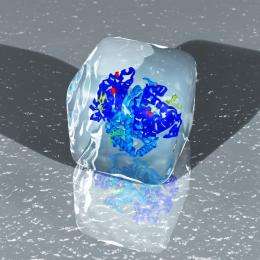
The structural model of the mammoth haemoglobin, with the three key changes to the protein highlighted in red. Illustration by Ansgar Philippsen.
The team used modern scientific physiological tests and chemical modelling to characterise the biochemical properties that confer mammoths with physiological cold tolerance.Team member Professor Roy Weber of the University of Aarhus, Denmark, who performed the physiological testing on the mammoth proteins, says the findings help show how the mammoth survived the extreme Arctic cold.
"Three highly unusual changes in the protein sequence allowed the mammoth's blood to deliver oxygen to cells even at very low temperatures, something that indicates adaptation to the Arctic environment," Professor Weber says.
"We can now apply similar approaches to other extinct species, such as Australian marsupials," says team member Dr Jeremy Austin, ACAD Deputy Director, who is currently using ancient DNA to study the evolution of the extinct thylacine and the endangered Tasmanian Devil.
Provided by
University of Adelaide
-
From lemons to lemonade: Reaction uses carbon dioxide to make carbon-based semiconductor,
33 comments
-
Thioridazine kills cancer stem cells in human while avoiding toxic side-effects of conventional cancer treatments,
3 comments
-
SpaceX private rocket blasts off for space station (Update),
42 comments
-
Landmark calculation clears the way to answering how matter is formed,
55 comments
-
Research team claims to have found evidence Lake Cheko is impact crater for Tunguska Event,
18 comments
-
osmotic pressure vs diffusion
4 hours ago
-
What would stain as translucent on light-coloured fabric?
May 26, 2012
-
How do I identify different bacteria on culture plates?
May 26, 2012
-
Why Do Dogs do Strange things...
May 25, 2012
-
What does exophillic and endophillic mean in terms of mosquito and their control?
May 24, 2012
-
Semen stains glows under black lights (uv light)?
May 23, 2012
- More from Physics Forums - Biology
More news stories
Manufacturing genes to attack flu virus
An international research team has manufactured a new protein that can combat deadly flu epidemics.
12 hours ago |
not rated yet |
0
|
Scientist: Evolution debate will soon be history
(AP) -- Richard Leakey predicts skepticism over evolution will soon be history. Not that the avowed atheist has any doubts himself.
May 26, 2012 |
3.4 / 5 (22) |
98
More plant species responding to global warming than previously thought
(Phys.org) -- Far more wild plant species may be responding to global warming than previous large-scale estimates have suggested.
May 22, 2012 |
4.6 / 5 (14) |
18
|
For monogamous sparrows, it doesn't pay to stray (but they do it anyway)
It's quite common for a female song sparrow to stray from her breeding partner and mate with the male next door, but a new study shows that sleeping around can be costly.
May 22, 2012 |
5 / 5 (2) |
8
|
Thousands of shellfish found dead in Peru
Thousands of crustaceans were found dead off the coast of Lima following the mystery mass death of dolphins and pelicans, the Peruvian Navy said Friday.
May 26, 2012 |
4.7 / 5 (7) |
7
Stunning image of smallest possible five-ringed structure
Scientists have created and imaged the smallest possible five-ringed structure about 100,000 times thinner than a human hair and you'll probably recognise its shape.
'Unzipped' carbon nanotubes could help energize fuel cells, batteries
Multi-walled carbon nanotubes riddled with defects and impurities on the outside could replace some of the expensive platinum catalysts used in fuel cells and metal-air batteries, according to scientists at ...
Change in developmental timing was crucial in the evolutionary shift from dinosaurs to birds: study
At first glance, it's hard to see how a common house sparrow and a Tyrannosaurus Rex might have anything in common. After all, one is a bird that weighs less than an ounce, and the other is a dinosaur that ...
Computer model used to pinpoint prime materials for efficient carbon capture
When power plants begin capturing their carbon emissions to reduce greenhouse gases and to most in the electric power industry, it's a question of when, not if it will be an expensive undertaking.
T cells 'hunt' parasites like animal predators seek prey, study shows
By pairing an intimate knowledge of immune-system function with a deep understanding of statistical physics, a cross-disciplinary team at the University of Pennsylvania has arrived at a surprising finding: T cells use a movement ...
Yale study concludes public apathy over climate change unrelated to science literacy
Are members of the public divided about climate change because they don't understand the science behind it? If Americans knew more basic science and were more proficient in technical reasoning, would public consensus match ...

May 03, 2010
Rank: not rated yet
May 03, 2010
Rank: 5 / 5 (2)
May 03, 2010
Rank: 3 / 5 (2)
May 03, 2010
Rank: 5 / 5 (1)
May 03, 2010
Rank: not rated yet
May 03, 2010
Rank: not rated yet
Except your probably still left with a food source problem...An animal that size requires a good many calories a day. The artic can be fairly scarce.
May 04, 2010
Rank: 3.3 / 5 (3)
May 06, 2010
Rank: not rated yet
Hey Gary, I think you might be jumping the gun a bit here. Wait till the animal is up and running first, then jump for joy!
May 10, 2010
Rank: not rated yet
May 16, 2010
Rank: 1 / 5 (1)
And the first wookie blood line was born
May 17, 2010
Rank: not rated yet
And the first wookie blood line was born
waaaaaaooouugh!