Mobile devices serve as own mice with optical sensing (w/ Video)
Apr 26, 2010

(PhysOrg.com) -- The same inexpensive, but high-quality optical sensors employed in the common computer mouse can enable small mobile phones and digital music players to be used as their own pointing and gestural input devices, say researchers at Carnegie Mellon University's Human-Computer Interaction Institute (HCII).

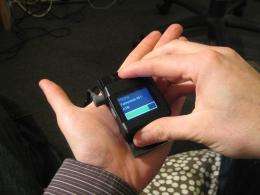
By installing a pair of optical sensors on the back of a mobile phone or mp3 player, the researchers found that the entire device could have many of the same benefits as that of a computer mouse when the device was placed against a surface, a piece of clothing or the palm of a hand. This new input method, called Minput, responds to up-down, and side-to-side motions, like a , but also to twisting and flicking motions.

"Minput turns out to be a fairly intuitive way to navigate through menus or photo galleries on a device's display without fumbling with tiny buttons or obscuring a small touchscreen with your fingers," said Chris Harrison, a third-year Ph.D. student who developed the method with his faculty adviser, HCII Professor Scott Hudson. "Because we use a pair of sensors, it can respond to a wide range of gestural commands, much like an or other multi-touch device."

This video is not supported by your browser at this time.

Twisting a Minput-equipped device — a gesture that proved particularly popular with beta testers — might allow a user to zoom in or out of a photo or document, while flicking the device against a surface enables the user, for instance, to switch between photos or between photo galleries. But Minput also permits high-precision positioning — such as selecting a sentence of text from a paragraph — that would be difficult to perform on a small touchscreen or with other types of gestural input, where the size of the finger might occupy a majority of the screen.

Harrison presented a paper on Minput earlier this month at CHI 2010, the Association for Computing Machinery's annual Conference on Human Factors in Computing Systems in Atlanta.
Minput didn't require developing any new sensor technology, Harrison said. "The hard part was done for us; optical sensors are already fantastically well-engineered. And at about a dollar apiece, they wouldn't add much to the cost of a mobile phone or music player," he noted. "We just use these sensors in a new and clever way."

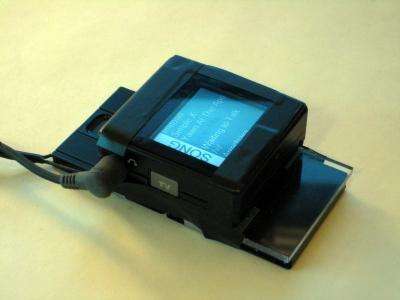
For their prototype, Harrison and Hudson mounted two optical sensors on the back of a wristwatch-size television with a 1.5-inch-diagonal display. Computer processing is performed off-board by a laptop computer. But Harrison said the Minput sensors and processors could be readily miniaturized to fit inside small mobile devices.

Explore further: With high-tech guns, users could disable remotely

More information: Project page: www.chrisharrison.net/projects/minput/

Related Stories

Skinput turns your arm into a touchscreen (w/ Video)

Mar 01, 2010

(PhysOrg.com) -- If you find yourself getting annoyed at the tiny touchscreens on today's mobile devices, you might be interested in a "new" yet overlooked input surface: yourself. A new skin-based interface ...

Sharp Releases Notebook PC with Optical Sensor LCD Pad

Apr 21, 2009

Sharp Corporation will release into the Japanese market a new notebook PC employing an optical sensor LCD for the touchpad. Its new touch-sensing recognition method allows handwritten input and intuitive direct-touch ...

Counterfeit euros are detected with an optical mouse

Nov 17, 2009

The sensor of some optical mice can be used to easily and cheaply detect counterfeit euros, according to a study published by Spanish researchers of the University of Lleida (UdL) in the scientific journal ...

Beyond -- way beyond -- WIMP interfaces

Jul 08, 2009

(PhysOrg.com) -- Human-computer interaction is undergoing a revolution, entering a multimodal era that goes beyond, way beyond, the WIMP (Windows-Icons-Menus-Pointers) paradigm. Now European researchers have ...

Recommended for you

Inventor creates Card Beams with 3D printer

1 hour ago

What are card beams, you may ask? They are the building toy that allows you to build gravity-defying houses of cards with the help of friction, gravity, and two types of beams - the cap and the connector.

With high-tech guns, users could disable remotely

May 21, 2013

A high-tech startup is wading into the gun control debate with a cellphone controller that would allow gun owners to know when their weapon is being moved—and disable it remotely.

Game system castAR debuts at Maker Faire

May 21, 2013

(Phys.org) —Two tech talents, formerly employees at video game publisher Valve, have been working on their own vision in the form of game-ready glasses. Their company, Technical Illusions, will seek to ...

China police billions spell profit opportunity

May 19, 2013

Mannequins in riot gear, armoured cars and drones line a police equipment and "anti-terrorism technology" trade fair in Beijing as vendors seek to profit from China's huge internal security budget.

User comments : 0

More news stories

Google Drive sports new view and scan enhancements

(Phys.org) —Google Drive has a new look and functions. The makeover in Google Drive features scanning and interface enhancements that put the user into "card" mode. The enhancements make it easy for the ...

Pandora posts in-line 1Q loss, upbeat sales

(AP)—Internet radio company Pandora reported higher-than-expected revenue in the latest quarter, with losses in line with analysts' forecasts, as the number of subscribers who pay for ad-free listening rose above 2.5 million.

Solar Kettle allows for boiling water off the grid

(Phys.org) —A company called Contemporary Energy has unveiled a new device it calls the Solar Kettle. It looks very much like a normal coffee thermos, but has flaps on one side that open to allow for collecting ...

Inventor creates Card Beams with 3D printer

What are card beams, you may ask? They are the building toy that allows you to build gravity-defying houses of cards with the help of friction, gravity, and two types of beams - the cap and the connector.

Controlling mood through the motions of mitochondria

(Medical Xpress)—Regulating the distribution of power in neurons is done by a system that makes the national electric grid look simple by comparison. Each neuron has several thousand mitochondria confined ...

Future doctors unaware of their obesity bias

Two out of five medical students have an unconscious bias against obese people, according to a new study by researchers at Wake Forest Baptist Medical Center. The study is published online ahead of print in the Journal of ...

WHO: Scientific red tape mars efforts vs. virus

International efforts to combat a new pneumonia-like virus that has now killed 22 people are being slowed by unclear rules and competition for the potentially profitable rights to disease samples, the head ...