More Proof of Outer Membrane Cytochrome Role in Electron Transfer
(PhysOrg.com) -- Another step toward improving understanding of electron exchange between microbes and minerals has been documented in the January 2010 issue of Geobiology. Bacteria such as the metal-reducing Shewanella oneidensis MR-1 exchange electrons with minerals in soil, sediment, and subsurface material. These interactions impact processes such as the reduction and stabilization of contaminants in groundwater.
Researchers from Pacific Northwest National Laboratory, the University of Wisconsin, Milwaukee, and the University of Guelph recently discovered that outer-membrane cytochromes MtrC and OmcA of S oneidensis MR-1 are key to reducing and transforming ferrihydrite, a widespread mineral that controls the mobility of metals in the environment. Their work is part of ongoing research to understand this most basic earth-life interaction that is fundamental to environmental contaminant migration, water quality, and soil fertility and trace metal availability.
Microbe-mineral interactions are central to biogeochemistry and the fundamental element cycling processes that shape earth's geology. One of the grand challenges of geomicrobiology is to understand the electron transfer processes driving the reductive transformations at the microbe-mineral interface. This has proven to be exceptionally difficult, as reactions at the interface are most likely regulated by biological adhesion mechanisms and chemical reactions. Multiple mechanisms have been proposed for extracellular electron transfer to solids by bacteria such as Shewanella, but the pathways are poorly understood, and few quantitative relationships have been established.
Using a suite of microscopic, spectroscopic, and biochemical techniques at the Department of Energy's EMSL, the scientists analyzed purified recombinant proteins and investigated genetic mutants unable to produce the outer-membrane cytochromes. They demonstrated that both cytochromes undergo rapid electron exchange with ferrihydrite in vitro, with MtrC displaying faster transfer rates than OmcA.
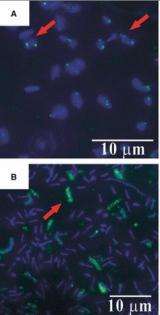
Immunomicroscopy with cytochrome-specific antibodies revealed that MtrC co-localizes with iron solids on the cell surface, while OmcA is distributed more diffusely over the cell surface. In the absence of both MtrC and OmcA, the cells' ability to reduce ferrihydrite was significantly hindered, and no mineral transformation products were detected. Collectively, these results highlight the importance of the outer-membrane cytochromes in reducing and transforming ferrihydrite and support a role for direct electron transfer from the outer-membrane cytochromes at the cell surface to the mineral.
More information: Reardon CL, A Dohnalkova, P Nachimuthu, DW Kennedy, D Saffarini, BW Arey, L Shi, Z Wang, DA Moore, JS McLean, DM Moyles, MJ Marshall, JM Zachara, JK Fredrickson, and AS Beliaev. 2010. "Role of Outer-Membrane Cytochromes MtrC and OmcA in the Biomineralization of Ferrihydrite by Shewanella oneidensis MR-1." Geobiology 8(1):56-68. doi:10.1111/j.1472-4669.2009.00226.x
Provided by Pacific Northwest National Laboratory


