Scientists develop environmentally friendly way to produce propylene oxide using silver nanoclusters
Apr 08, 2010
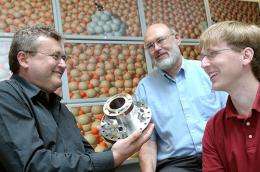
Argonne scientists (from left) Stefan Vajda, Larry Curtiss and Jeff Greeley have developed a new way of creating propylene that eliminates the many environmentally unfriendly by-products.

Scientists at the U.S. Department of Energy's Argonne National Laboratory have identified a new class of silver-based catalysts for the production of the industrially useful chemical propylene oxide that is both environmentally friendly and less expensive.

"The production of oxide has a significant amount of by-products that are harmful to the environment, including chlorinated or peroxycarboxylic waste," said chemist Stefan Vajda of Argonne's Materials Science Division and Center for . "We have identified nanoclusters of silver as a catalyst that produce this chemical with few by-products at low temperatures."

Propylene oxide is commonly used in the creation of plastics and propylene glycols for paints, household detergents and automotive brake fluids.

The study is a result of a highly collaborative team that involved five Argonne Divisions and collaborators from the Fritz-Haber-Institut in Berlin and from the University of Illinois in Chicago, including a collaboration between the experimental effort led by Stefan Vajda and the theoretical analysis led by materials chemist Larry Curtiss and nanoscientist Jeff Greeley.

Large silver particles have been used to produce propylene oxide from propylene, but have suffered from a low selectivity or low conversion to propylene oxide, creating a large amount of carbon dioxide. Vajda discovered that nanoscale clusters of silver, consisting of both three atoms as well as larger clusters of 3.5 in size, are highly active and selective catalysts for the production of propylene oxide.

Curtiss and Greeley then modeled the underlying mechanism behind why these ultrasmall of silver were so effective in creating propylene oxide. They discovered that the open shell of the silver catalysts was the impetus behind the nanoclusters selectivity.

"Propylene oxide is a building block in the creation of several other industrially relevant chemicals, but the current methods of creating it are not efficient," Curtiss said.

"This is basically a holy grail reaction," remarked Greeley. "The work opens a new chapter in the field of silver as a for propene epoxidation," added Curtiss.

A paper on this work will be published in the April 9 issue of the journal Science.

Explore further: Hybrid material as gold-leaf substitute

Related Stories

Argonne to study fuel cell catalysts

May 26, 2005

Argonne National Laboratory will receive $3 million over three years for basic science studies that may lead to improved catalysts for hydrogen fuel cells.

Recommended for you

Hybrid material as gold-leaf substitute

14 hours ago

(Phys.org) —A team of researchers headed by Professor Raffaele Mezzenga has created a hybrid material out of gold and milk proteins that looks like a wafer-thin gold leaf. Thanks to its properties, it could ...

Antioxidant with a long shelf life

Jun 17, 2013

(Phys.org) —Scientists from ETH Zurich have developed a nanomaterial that protects other molecules from oxidation. Unlike many such active substances in the past, the ETH-Zurich researchers' antioxidant ...

Fast pollutant degradation by nanosheets

Jun 17, 2013

(Phys.org) —Waste from textile and paint industries often contains organic dyes such as methylene blue as pollutants. Photocatalysis is an efficient means of reducing such pollution, and molybdenum trioxide ...

Unzipped nanotubes unlock potential for batteries

Jun 13, 2013

(Phys.org) —Researchers at Rice University have come up with a new way to boost the efficiency of the ubiquitous lithium ion (LI) battery by employing ribbons of graphene that start as carbon nanotubes.

Nanoparticle opens the door to clean-energy alternatives

Jun 13, 2013

(Phys.org) —Cheaper clean-energy technologies could be made possible thanks to a new discovery. Research team members led by Raymond Schaak, a professor of chemistry at Penn State University, have found ...

User comments : 0

More news stories

3D printing tiny batteries

(Phys.org) —3D printing can now be used to print lithium-ion microbatteries the size of a grain of sand. The printed microbatteries could supply electricity to tiny devices in fields from medicine to communications, ...

Future looks bright for carbon nanotube solar cells

(Phys.org) —In an approach that could challenge silicon as the predominant photovoltaic cell material, University of Wisconsin-Madison materials engineers have developed an inexpensive solar cell that exploits ...

Hybrid material as gold-leaf substitute

(Phys.org) —A team of researchers headed by Professor Raffaele Mezzenga has created a hybrid material out of gold and milk proteins that looks like a wafer-thin gold leaf. Thanks to its properties, it could ...

World's most powerful microscope ready for research

(Phys.org) —The world's most powerful microscope, which resides in a specially constructed room at the University of Victoria, has now been fully assembled and tested, and has a lineup of scientists and businesses eager ...

Origins of 'The Hoff' crab revealed (w/ Video)

The history of a new type of crab, nicknamed 'The Hoff' because of its hairy chest, which lives around hydrothermal vents deep beneath the Southern Ocean and Indian Ocean, has been revealed for the first ...