Yale Robots Dance, Gesture and, Hopefully, Spark Interest in Science
April 2, 2010 By Suzanne Taylor Muzzin

Yale Robots Dance, Gesture and, Hopefully, Spark Interest in Science

Enlarge

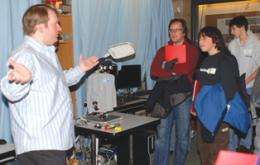
Justin Hart (left), a doctoral student in the Social Robotics Lab, introduces the students and their parents to Nico (center), a robot that plays rock-paper-scissors.

(PhysOrg.com) -- There were robotic dinosaurs, a robot that danced and one that played rock-paper-scissors. But all of the robots on display at the robotics workshop at Johns Hopkins University on March 28 had something to teach us about ourselves.

The robotics workshop — organized by the Center for Talented Youth at Johns Hopkins University in partnership with Yale — brought to campus 250 students in grades 7 through 10 and their parents from Connecticut, Massachusetts, New York and New Jersey to witness firsthand some of the different ways that Yale's engineers and use robots in their research.

"We want the kids to get the idea that science is approachable, that it's something exciting and that it can make a difference in their lives," said Brian Scassellati, an associate professor of computer science at Yale who helped organize the event.

Scassellati gave a presentation about how he uses robots to study human behavior. Using robots that include a small humanoid, a toy dinosaur and a flexible snowman, Scassellati and his students study how people develop social skills and how these skills impact human-machine interactions.

John Morrell, assistant professor of , gave a talk about his research on human-machine interfaces, while another assistant professor in that department, Aaron Dollar, spoke about his research on designing and developing a robotic hand that can grasp and manipulate objects.

The students and their parents also toured some of Yale's robotic labs, where they met Keepon, a little yellow puffball robot with some serious dance moves, and Nico, a who plays rock-paper-scissors. Researchers use Nico to understand how infants become self-aware, as well as how humans respond to and interact with robots.

For Nisha Ghayalod of Long Island, "The coolest thing was seeing a robot open a door. I never realized how complicated opening a door is." The 9th-grader was curious about robots in general and was thrilled with the chance to interact with ones being used for real research. "She's interested in bioengineering, and of course everyone's interested in Yale," said her father, Manoj, who woke up early Saturday morning in order to make the trip.

The students and parents also had an opportunity to ask the graduate and postdoctoral fellows giving the tours about the different routes to robotic research and what sort of courses they would need to take at the University if they wanted to follow in their footsteps.

While Scassellati was happy to see that level of interest, "If they leave here today having seen some interesting things and feeling excited, we've done our job," he said.

Provided by Yale University search and more info website


Rank not rated yet
Relevant PhysicsForums posts

More news stories

Browser wars flare in mobile space

The browser wars are heating up again, but this time the fight is for dominance of the mobile Internet.

Technology / Software

created 17 hours ago | popularity 4 / 5 (4) | comments 3

Probability of contamination from severe nuclear reactor accidents is higher than expected: study

Catastrophic nuclear accidents such as the core meltdowns in Chernobyl and Fukushima are more likely to happen than previously assumed. Based on the operating hours of all civil nuclear reactors and the number ...

Technology / Energy & Green Tech

created May 22, 2012 | popularity 3.6 / 5 (25) | comments 56 | with audio podcast

HyperSolar shows dirty water no barrier to power world

(Phys.org) -- The Santa Barbara, California, company, HyperSolar, is set to transparently share the ups and downs of its research experiences toward the company’s ultimate vision, successfully producing ...

Technology / Energy & Green Tech

created May 24, 2012 | popularity 4.8 / 5 (16) | comments 17 | with audio podcast report

SpotterRF debuts Radar Backpack Kit (w/ Video)

(Phys.org) -- SpotterRF has announced a special radar backpack kit designed to enhance situational awareness for soldiers on the ground. The company says its special radar is designed for warfighters as part ...

Technology / Hi Tech & Innovation

created May 26, 2012 | popularity 5 / 5 (5) | comments 13 | with audio podcast report

Tesla to launch electric sedan in US on June 22

Tesla Motors said Tuesday it would begin deliveries of "the world's first premium electric sedan" on June 22, slightly ahead of schedule.

Technology / Energy & Green Tech

created May 22, 2012 | popularity 4.5 / 5 (12) | comments 18


'Unzipped' carbon nanotubes could help energize fuel cells, batteries

Multi-walled carbon nanotubes riddled with defects and impurities on the outside could replace some of the expensive platinum catalysts used in fuel cells and metal-air batteries, according to scientists at ...

Change in developmental timing was crucial in the evolutionary shift from dinosaurs to birds: study

At first glance, it's hard to see how a common house sparrow and a Tyrannosaurus Rex might have anything in common. After all, one is a bird that weighs less than an ounce, and the other is a dinosaur that ...

Computer model used to pinpoint prime materials for efficient carbon capture

When power plants begin capturing their carbon emissions to reduce greenhouse gases – and to most in the electric power industry, it's a question of when, not if – it will be an expensive undertaking.

T cells 'hunt' parasites like animal predators seek prey, study shows

By pairing an intimate knowledge of immune-system function with a deep understanding of statistical physics, a cross-disciplinary team at the University of Pennsylvania has arrived at a surprising finding: T cells use a movement ...

Stunning image of smallest possible five-ringed structure

Scientists have created and imaged the smallest possible five-ringed structure – about 100,000 times thinner than a human hair – and you'll probably recognise its shape.

Land and sea species differ in climate change response: study

(Phys.org) -- Marine and terrestrial species will likely differ in their responses to climate warming, new research by Simon Fraser University and Australia’s University of Tasmania has found.