Cracking the plant-cell membrane code
Mar 22, 2010

(PhysOrg.com) -- To engineer better, more productive crops and develop new drugs to combat disease, scientists look at how the sensor-laden membranes surrounding cells control nutrient and water uptake, secrete toxins, and interact with the environment and neighboring cells to affect growth and development. Remarkably little is known about how proteins interact with these protective structures.

With National Science Foundation funding, researchers at the Carnegie Institution's Department of are using the first high-throughput screen for any multicellular organism to pinpoint these interactions using the experimental . They have analyzed some 3.4 million potential protein/membrane interactions and have found 65,000 unique relationships.

They made the preliminary data available today to the biological community by way of the Website www.associomics.org/search.php. Since proteins are similar in all organisms, the work is relevant to fields from farming to medicine.

"This is just the beginning," remarked Wolf Frommer director of Carnegie's Department of Plant Biology. "Arabidopsis shares many of its genes with other organisms including humans. As the library of interacting proteins grows, scientists around the world will be able to study the details of protein interactions to understand how they are affected by forces such as climate change and disease and how they can be harnessed to produce better crops and medicines more effectively."

All of a cell's internal machinery relies on the binding of proteins. Complementary shaped proteins dock with one another to start processes, such as turning on a gene or letting in the proper nutrient. These make up some 20-30% of the proteins in Arabidopsis, a relative of the .

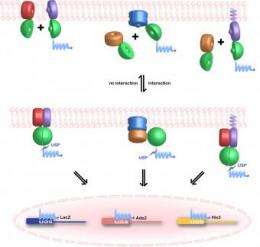
The team uses a screen called the mating-based protein complementation assay, or split ubiquitin system. Ubiquitin is a small protein. The scientists fuse candidate proteins onto a version of ubiquitin that is split in half. When the two candidates interact, the two halves of the ubiquitin reassemble, triggering a process that liberates a transcription factor—a that switches a gene on—which then goes to the nucleus. When genes are turned on in the nucleus, the researchers are alerted to the successful interaction. The ultimate goal is to test the 36 million potential interactions as well as the sensitivity of the interactions to small molecules with a high-throughput robotics system.

The group plans to start a second round of screening at the end of this month to test another 3.4 million interactions.

Explore further: Don't lose the organism in the excitement over its genes, biologists urge

Provided by Carnegie Institution

5 /5 (1 vote)
add to favorites email to friend print save as pdf

Related Stories

Carnegie donates landmark clones to biology

Aug 06, 2009

With the information explosion, it's remarkable that so little is known about the interactions that proteins have with each other and the protective membrane that surrounds a cell. These interactive, so-called membrane proteins ...

Midget plant gets makeover

Jun 22, 2009

A tiny plant with a long name (Arabidopsis thaliana) helps researchers from over 120 countries learn how to design new crops to help meet increasing demands for food, biofuels, industrial materials, and ne ...

MIT probe may help untangle cells' signaling pathways

Jun 27, 2008

MIT researchers have designed a new type of probe that can image thousands of interactions between proteins inside a living cell, giving them a tool to untangle the web of signaling pathways that control most of a cell's ...

Novel method to reveal drug targets

Feb 22, 2008

Wellcome Trust Sanger Institute scientists have developed a new large-scale method to identify the interactions between proteins that are a major target for therapeutic intervention. The novel method can identify the weak, ...

Recommended for you

Fast new, one-step genetic engineering technology

47 minutes ago

A new, streamlined approach to genetic engineering drastically reduces the time and effort needed to insert new genes into bacteria, the workhorses of biotechnology, scientists are reporting. Published in ...

100K Pathogen Genome Project maps first genomes

1 hour ago

(Phys.org) —Striking a blow at foodborne diseases, the 100K Pathogen Genome Project at the University of California, Davis, today announced that it has sequenced the genomes of its first 10 infectious microorganisms, including ...

New DNA cattle test beefs up dairy and meat quality

1 hour ago

(Phys.org) —A genomics technique developed at Cornell to improve corn can now be used to improve the quality of milk and meat, according to research published online May 17 in the journal PLOS ONE.

Strawberry fields forever and fungus-free

1 hour ago

(Phys.org) —Strawberries are one of the most economically important berry crops in the world, and a high value export crop for the Australian horticultural industry.For the first time, researchers at The ...

User comments : 0

More news stories

Drought makes Borneo's trees flower at the same time

Tropical plants flower at supra-annual irregular intervals. In addition, mass flowering is typical for the tropical forests in Borneo and elsewhere, where hundreds of different plant timber species from the ...

Fast new, one-step genetic engineering technology

A new, streamlined approach to genetic engineering drastically reduces the time and effort needed to insert new genes into bacteria, the workhorses of biotechnology, scientists are reporting. Published in ...

DNA damage: The dark side of respiration

(Phys.org) —Adventitious changes in cellular DNA can endanger the whole organism, as they may lead to life-threatening illnesses like cancer. Researchers at LMU now report how byproducts of respiration cause mispairing ...