Measuring material hotter than the sun
Mar 02, 2010 By David F. Salisbury
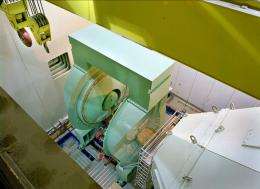
Top-down view of the PHENIX detector, which is about the size of a small house.

(PhysOrg.com) -- Three Vanderbilt physicists are members of the scientific team that have reported creating an exotic state of matter with a temperature of four trillion degrees Celsius. It's the hottest temperature ever achieved in a laboratory and 250,000 times hotter than the heart of the sun.

Scientists have produced this super-heated state of matter by accelerating gold nuclei to nearly the in opposite directions and then colliding them. They have done this in the Relativistic Heavy (RHIC) at Brookhaven National Laboratory, the largest in the world dedicated to nuclear physics research. The new temperature measurement has strengthened the physicists' conviction that they have managed to recreate the quark-gluon plasma (QGP), a state of matter that may have existed fractions of seconds after the Big Bang.

The three scientists are Victoria Greene, professor of physics and executive dean in the College of Arts and Science; Charles Maguire, professor of physics; and Julia Velkovska, associate professor of physics. For the last nine years, they have played a key role in the design and operation of PHENIX, the largest of the four detectors positioned around the accelerator's 2.4-mile-circumference. The new results were announced Feb. 15 at the annual meeting of the American Physical Society in New York.

"The temperature measurement was made at PHENIX by measuring the photons, the light particles, that were created with the plasma and escaped without interacting with other particles,” says Greene, who contributed to the paper reporting the result. To do this, the scientists figured out a clever way to separate the primordial photons from those coming from more mundane sources by comparing the produced in the collisions of the gold nuclei with those produced in simple collisions between two protons.
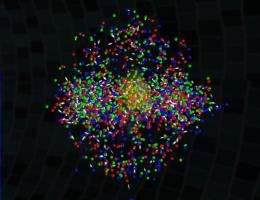
Simulation of the thousands of subatomic particles that are created when gold nuclei collide in the RHIC collider. Image: Brookhaven National Laboratory

RHIC scientists don't know the exact temperature at which the protons and in atoms "melt” into their constituent parts, quarks and gluons. But they do think it is considerably below four trillion degrees. So the new measurement increases their confidence that the matter they are creating and studying is indeed the sought-for QGP.

Their observations of the most primordial of all primordial soups is improving scientists' understanding of the "strong force,” the force that acts within the nucleus of the atom and holds it together. Originally, they had predicted that the QGP would act like a gas, with all the particles moving independently. They were surprised to find that the quarks appear to be bound together in a way similar to the molecules in a liquid. This is forcing theoreticians back to their drawing boards.

Increased knowledge about the nature of the QGP can also improve cosmologists' understanding of the origin of the universe. For the first few microseconds after the Big Bang, cosmologists calculate that temperatures were so hot that a quark-gluon plasma should have formed. However, the universe immediately began to expand and cool. As it cooled below the melting point of and neutrons, these particles began forming much like rain drops condensing out of steam.

A fundamental physics principle called charge-parity (CP) symmetry holds that when energy is converted to mass or mass is converted into energy equal numbers of particles and oppositely charged antiparticles must be created or annihilated. However, if that principle were followed after the Big Bang, the universe would be essentially empty because equal numbers of matter and antimatter particles would have totally annihilated one another as they come into contact. There would be no matter left over to form stars and planets and people.

That leads to the second new result, which was obtained by the scientists working on one of the other RHIC detectors. They found evidence that CP symmetry may be broken in the plasma. Although this effect is not strong enough to explain the predominance of ordinary matter in the universe, it may provide new insights into how symmetry violations of this sort occur.

Brookhaven officials have announced that they will be upgrading RHIC over the next five years to get better measurements of the QGP's temperature, viscosity and other basic properties. Greene, Maguire and Velkovska will continue to participate in the RHIC collaboration, but they have also joined the scientific team using one of the detectors (the Compact Muon Solenoid) on the new Large Hadron Collider, the world's most powerful particle accelerator operated by the European Organization for Nuclear Research (CERN) in Switzerland. Here they hope to study the behavior of the quark-gluon plasma at even more extreme temperatures. They are in the process of creating a control room at Vanderbilt that will allow them to monitor the quality of the data and analyze the results in near real time without leaving home.

Explore further: Physicists develop revolutionary low-power polariton laser

add to favorites email to friend print save as pdf

Related Stories

'Perfect' Liquid Hot Enough to be Quark Soup (w/ Video)

Feb 15, 2010

Recent analyses from the Relativistic Heavy Ion Collider (RHIC), a 2.4-mile-circumference "atom smasher" at the U.S. DOE's Brookhaven National Laboratory, establish that collisions of gold ions traveling at ...

eRHIC gets to the heart of the matter

Apr 26, 2006

At the U.S. Department of Energy's Brookhaven National Laboratory, scientists have proposed a new way of studying the structure of matter down to a level never before observed. Their proposal is the "eRHIC" ...

Ultracold gas mimics ultrahot plasma

Feb 15, 2009

Several years after Duke University researchers announced spectacular behavior of a low density ultracold gas cloud, researchers at Brookhaven National Laboratory have observed strikingly similar properties in a very hot ...

Jetting into the Quark-Gluon Plasma

Jan 15, 2010

After the quark-gluon plasma filled the universe for a few millionths of a second after the big bang, it was over 13 billion years until experimenters managed to recreate the extraordinarily hot, dense medium ...

Recommended for you

Physicists help design, build cargo X-ray scanners

2 hours ago

(Phys.org) —Two SLAC physicists with decades of particle accelerator experience helped a Silicon Valley company design and build X-ray devices that scan cargo containers for nuclear materials and other ...

Theorists weigh in on where to hunt dark matter

2 hours ago

(Phys.org) —Now that it looks like the hunt for the Higgs boson is over, particles of dark matter are at the top of the physics "Most Wanted" list. Dozens of experiments have been searching for them, but ...

Breakthrough calls time on bootleg booze

May 20, 2013

(Phys.org) —Using a laser, the St Andrews scientists can now carry out detailed analysis of a spirit sample no bigger than a teardrop and can even confirm whether it is toxic or not. It's hoped the testing ...

User comments : 4

Adjust slider to filter visible comments by rank

Display comments: newest first

frajo
2 / 5 (2) Mar 03, 2010
"The temperature measurement was made at PHENIX by measuring the photons, the light particles, that were created with the plasma and escaped without interacting with other particles,” says Greene, who contributed to the paper reporting the result. To do this, the scientists figured out a clever way to separate the primordial photons from those coming from more mundane sources by comparing the photons produced in the collisions of the gold nuclei with those produced in simple collisions between two protons.
This method seems to be quite tricky and taylored to get impressive numbers.
Temperature is a statistical thing and if you are eliminating the "coldest" components from your calculation you are changing the definition of temperature.
holoman
3 / 5 (1) Mar 03, 2010
Interesting, now what are the gluons and quarks made up of.
loreak
3 / 5 (2) Mar 03, 2010
Frajo, how is filtering backround noise changing the definition of temperature. Temperature is not relative and doesn't change definition for any reason.

I wonder what wavelength is given off at 4.5 trillion degrees, it's gotta be in the gamma range i would think.
frajo
not rated yet Mar 04, 2010
Frajo, how is filtering backround noise changing the definition of temperature. Temperature is not relative and doesn't change definition for any reason.

I wonder what wavelength is given off at 4.5 trillion degrees, it's gotta be in the gamma range i would think.
Exactly this unbelievable high number is what makes me wondering. The nuclear fusion temperatures are somewhere between 15 million and 150 million degrees.
So how do they define temperature in their experiment? Did they calculate partial temperatures only? Why don't they just tell the energy of the components in GeV?
I can't get rid of the impression that someone was pushing for artificial excitement here.

More news stories

Theorists weigh in on where to hunt dark matter

(Phys.org) —Now that it looks like the hunt for the Higgs boson is over, particles of dark matter are at the top of the physics "Most Wanted" list. Dozens of experiments have been searching for them, but ...

Physicists help design, build cargo X-ray scanners

(Phys.org) —Two SLAC physicists with decades of particle accelerator experience helped a Silicon Valley company design and build X-ray devices that scan cargo containers for nuclear materials and other ...

Hydrogen atoms under the magnifying glass

To describe the microscopic properties of matter and its interaction with the external world, quantum mechanics uses wave functions, whose structure and time dependence is governed by the Schrödinger equation. ...

How healthy are you for your age?

On May 22, JoVE will publish details of a technique to measure the health of human genetic material in relation to a patient's age. The method is demonstrated by the laboratory of Dr. Gil Atzmon at New York's Albert Einste ...

Addiction as a disorder of decision-making

New research shows that craving drugs such as nicotine can be visualized in specific regions of the brain that are implicated in determining the value of actions, in planning actions and in motivation. Dr. Alain Dagher, from ...