Artificial foot recycles energy for easier walking (w/ Video)
Feb 17, 2010
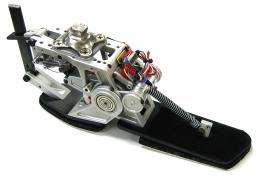
In this energy-recycling foot, the University of Michigan engineers put wasted walking energy to work enhancing the power of ankle push-off. Photo credit: Steve Collins.

(PhysOrg.com) -- An artificial foot that recycles energy otherwise wasted in between steps could make it easier for amputees to walk, its developers say.

"For , what they experience when they're trying to walk normally is what I would experience if I were carrying an extra 30 pounds," said Art Kuo, professor in the University of Michigan departments of Biomedical Engineering and .

Compared with conventional prosthetic feet, the new prototype device significantly cuts the spent per step.

This video is not supported by your browser at this time.
Energy Recycling with the Artificial Foot: High-speed video of the energy-recycling artificial foot, played back at 6% of actual speed. Camera rate was 500 frames per second. The foot proceeds through the phases described in cf. Figure 2, beginning prior to heel strike and ending at reset. The foot is worn by an able-bodied individual using a below-knee prosthesis simulator boot. This demonstration was performed overground and with less-curved versions of the crepe roll-over shapes of the artificial foot than used in testing. Developed by Steve Collins and Art Kuo at the University of Michigan. Video by Eno Yliniemi and Randall Ching

A paper about the device is published in the Feb. 17 edition of in the journal . The foot was created by Kuo and Steve Collins, who was then a U-M graduate student. Now Collins is an associate research fellow at Delft University of Technology in the Netherlands.

The human walking gait naturally wastes energy as each foot collides with the ground in between steps.

A typical doesn't reproduce the force a living ankle exerts to push off of the ground. As a result, test subjects spent 23 percent more energy walking with a conventional prosthetic foot, compared with walking naturally. To test how stepping with their device compared with normal walking, the engineers conducted their experiments with non-amputees wearing a rigid boot and prosthetic simulator.

In their energy-recycling foot, the engineers put the wasted walking energy to work enhancing the power of ankle push-off. The foot naturally captures the dissipated energy. A microcontroller tells the foot to return the energy to the system at precisely the right time.

Based on measurements, the test subjects spent 14 percent more energy walking in energy-recycling artificial foot than they did walking naturally. That's a significant decrease from the 23 percent more energy they used in the conventional prosthetic foot, Kuo says.

"We know there's an energy penalty in using an artificial foot," Kuo said. "We're almost cutting that penalty in half."

He explained how this invention differs from current technologies.

"All prosthetic feet store and return energy, but they don't give you a choice about when and how. They just return it whenever they want," Kuo said. "This is the first device to release the energy in the right way to supplement push-off, and to do so without an external power source."

Other devices that boost push-off power use motors and require large batteries.

Because the energy-recycling foot takes advantage of power that would otherwise be lost, it uses less than 1 Watt of electricity through a small, portable battery.

"Individuals with lower limb amputations, such as veterans of the conflicts in Iraq and Afghanistan or patients suffering from diabetes, often find a difficult task. Our new design may restore function and reduce effort for these users," Collins said. "With further progress, robotic limbs may yet beat their biological forerunners."

This paper demonstrates that the engineers' idea works. They are now testing the foot on amputees at the Seattle Veterans Affairs Medical Center. Commercial devices based on the technology are under development by an Ann Arbor company.

Explore further: Army ground combat systems adopts tool for choosing future warfighting vehicles

More information: Paper: dx.plos.org/10.1371/journal.pone.0009307

Related Stories

The spring in your step is more than just a good mood

Apr 23, 2008

Scientists using a bionic boot found that during walking, the ankle does about three times the work for the same amount of energy compared to isolated muscles---in other words, the spring in your step is very real and helps ...

The cost of being on your toes

Feb 12, 2010

Humans, other great apes and bears are among the few animals that step first on the heel when walking, and then roll onto the ball of the foot and toes. Now, a University of Utah study shows the advantage: ...

Study: Long legs are more efficient

Mar 12, 2007

Scientists have known for years that the energy cost of walking and running is related primarily to the work done by muscles to lift and move the limbs. But how much energy does it actually take to get around? Does having ...

Recommended for you

Student-built innovations to help improve and save lives

May 20, 2013

Nanyang Technological University (NTU) students have developed new and practical life-saving innovations inspired from everyday problems, including improving the safety of cyclists on the roads and keeping ...

GPS solution provides 3-minute tsunami alerts

May 17, 2013

Researchers have shown that, by using global positioning systems (GPS) to measure ground deformation caused by a large underwater earthquake, they can provide accurate warning of the resulting tsunami in ...

User comments : 1

Adjust slider to filter visible comments by rank

Display comments: newest first

jj2009
not rated yet Feb 17, 2010
or, a simpler solution is just not making wars all over the place, and also preventing diabetes

More news stories

Green conversion of heat to electricity

Soon, it will be possible to produce electricity from heat over 30 degrees emitted from a waste incinerator, refinery, or data processor. The start-up Osmoblue has just confirmed the feasibility of this new ...

Game system castAR debuts at Maker Faire

(Phys.org) —Two tech talents, formerly employees at video game publisher Valve, have been working on their own vision in the form of game-ready glasses. Their company, Technical Illusions, will seek to ...

If you can remember it, you can remember it wrong

(Medical Xpress)—Native peoples in regions where cameras are uncommon sometimes react with caution when their picture is taken. The fear that something must have been stolen from them to create the photo ...

B vitamins could delay dementia

(Medical Xpress)—Despite spending billions of dollars on research and development, drug companies have been unable to come up with effective treatments for dementia and Alzheimer's Disease (AD). Now, A. ...