Silicon-coated nanonets could build a better lithium-ion battery
Feb 16, 2010
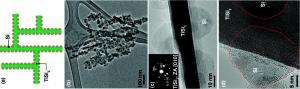
Frame (a) shows a schematic of the Nanonet, a lattice structure of titanium disilicide (TiSi2) coated with silicon (Si) particles to form the active component for Lithium-ion storage. A microscopic view (b) of the silicon coating on the Nanonets. The crystallinity (c) of the Nanonet core and the Si coating. The crystallinity of TiSi2 and Si (highlighted by the dotted red line) is shown in a lattice-resolved image (d) from transmission electron microscopy. Credit: Nano Letters

A tiny scaffold-like titanium structure of Nanonets coated with silicon particles could pave the way for faster, lighter and longer-lasting Lithium-ion batteries, according to a team of Boston College chemists who developed the new anode material using nanotechnology.

The web-like Nanonets developed in the lab of Assistant Professor of Chemistry Dunwei Wang offer a unique structural strength, more surface area and greater conductivity, which produced a charge/re-charge rate five to 10 times greater than typical Lithium-ion anode material, a common component in batteries for a range of consumer electronics, according to findings published in the current online edition of the American Chemical Society journal .

In addition, the Nanonets proved exceptionally durable, showing a negligible drop-off in capacity during charge and re-charge cycles. The researchers observed an average of 0.1% capacity fade per cycle between the 20th and the 100th cycles.

"As researchers pursue the next generation of re-chargeable Lithium-ion , a premium has been placed on increased power and a greater battery life span," said Wang. "In that context, the Nanonet device makes a giant leap toward those two goals and gives us a superior anode material."

Lithium-ion batteries are commonly used in consumer electronics devices. This type of rechargeable battery allows ions to move from the anode to the cathode when in use. When charged, the ions move from cathode back to the anode.

The structure and of the Nanonets improved the ability to insert and extract Lithium ions from the particulate silicon coating, the team reported. Running at a charge/discharge rate of 8,400 milliamps per gram (mA/g) - which is approximately five to 10 times greater than similar devices - the specific capacity of the material was greater than 1,000 milliamps-hour per gram (mA-h/g). Typically, laptop Lithium-ion batteries are rated anywhere between 4,000 and 12,000 mA/h, meaning it would only take between four and 12 grams of the Nanonet anode material to achieve similar capacity.

Wang said the capability to preserve the crystalline titanium silicon core during the charge/discharge process was the key to achieving the high performance of the Nanonet anode material. Additional research in his lab will examine the performance of the Nanonet as a cathode material.

Explore further: Researchers develop method to inkjet print highly conductive, bendable layers of graphene

More information: View the Nano Letters paper at pubs.acs.org/doi/abs/10.1021/nl903345f

Related Stories

Increasing Electric Car Battery Performance

Sep 23, 2009

(PhysOrg.com) -- Researchers have found that by replacing conventional graphite electrodes with silicon nanotube electrodes, lithium-ion batteries can store 10 times more charge.

Scientists Working Toward Better Batteries

Mar 09, 2006

As more and more people rely on cell phones, laptop computers, personal organizers, and even hybrid electric-gas vehicles, scientists are working to develop rechargeable batteries that are ever smaller, cheaper, ...

Recommended for you

Kinks and curves at the nanoscale

May 19, 2013

One of the basic principles of nanotechnology is that when you make things extremely small—one nanometer is about five atoms wide, 100,000 times smaller than the diameter of a human hair—they are going ...

Snake's ultra-black spots may aid high-tech quest

May 16, 2013

Scientists have identified nanostructures in the ultra-black skin markings of an African viper which they said Thursday could inspire the quest to create the ultimate light-absorbing material.

User comments : 1

Adjust slider to filter visible comments by rank

Display comments: newest first

theken101
5 / 5 (1) Feb 20, 2010
So at 3.6 volts nominal, this would be approximately 3.6 Kw/hr per Kg! Definitely a step up!

More news stories

How gold nanoparticles can help fight ovarian cancer

Positively charged gold nanoparticles are usually toxic to cells, but cancer cells somehow manage to avoid nanoparticle toxicity. Mayo Clinic researchers found out why, and determined how to make the nanoparticles effective ...

Radioactive nanoparticles target cancer cells

Cancers of all types become most deadly when they metastasize and spread tumors throughout the body. Once cancer has reached this stage, it becomes very difficult for doctors to locate and treat the numerous tumors that can ...

Coral reefs 'ruled by earthquakes and volcanoes'

(Phys.org) —Titanic forces in the Earth's crust explain why the abundance and richness of corals varies dramatically across the vast expanse of the Indian and Pacific Oceans, a world-first study from the ...

Coccoliths thrive despite ocean acidification

Ocean acidification is damaging some marine species while others thrive, say scientists. An international team studied the effect of ocean acidification on plankton in the North Sea over the past forty years, ...