Greenhouse surprise for red meat
Feb 03, 2010
Greenhouse surprise for red meat
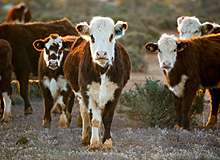
Carbon hoofprint... cattle in the Australian outback.

(PhysOrg.com) -- Beef produced in feedlots has a smaller carbon footprint than meat raised exclusively on pastures, according to the surprise results of a new study.

Beef produced in feedlots has a smaller than meat raised exclusively on pastures, according to the surprise results of a UNSW study of the environmental impacts of red meat production.

The study, published in the journal , also found that the greenhouse gas impact of Australian beef and sheep meat production is equal to or lower than that of many countries.

The life cycle analysis of Australian meat production, by the Sustainability Assessment Program at the UNSW Water Research Centre (WRC), found that feedlot beef production generated slightly less greenhouse gas per kilogram of meat than grass-fed beef. Results from one NSW supply chain studied showed feedlot production had a carbon footprint of 9.9kg of carbon dioxide equivalent (CO2e) per kilo of "hot standard carcass weight" (HSCW) - the unit of measure used in the industry. Grass-finished beef produced 12kg CO2e per kg/HSCW.

The study, commissioned by Meat and Livestock Australia, looked at three operations: a beef producer in NSW, a sheepmeat producer in WA and a Victorian organic beef producer. It found sheepmeat had a carbon footprint ranging from 7kg to 8kg CO2e per kg/HSCW.

Feedlot beef production, in which cattle are "finished" by being fed a diet of grain for the few months preceding slaughter, is often criticised for the resources and energy it consumes. However, study co-author Matthias Schulz said the feedlot had been found to produce meat more efficiently, effectively offsetting the greenhouse impact of the additional transport and feed production needed.

"Grain-finished cattle have a more efficient weight gain which completely offsets their higher individual carbon footprint," he said.

"The other main reason for the better greenhouse performance of grain-fed beef is the superior digestibility of the feed and the associated reduction in methane emissions, and these digestion-related methane emissions are the main source of from the livestock industry."

The study also compared data from Australian and sheep operations to studies conducted in Europe, the UK, the US, Africa and Japan, and found Australian operations compared favourably.

Explore further: Strong resistance to making people think green

add to favorites email to friend print save as pdf

Related Stories

Study shows consumers find grass-fed beef acceptable

Aug 04, 2008

High feed-grain prices and the growing interest in "natural" foods have spurred both consumers and farmers to consider grass-fed beef, and a recent study done by Penn State College of Agricultural Sciences researchers may ...

Ground beef in Michigan is recalled

Jul 23, 2007

The U.S. Food Safety and Inspection Service announced the voluntarily recall of about 26,669 pounds of ground beef products distributed in Michigan.

Recommended for you

Chinese, Indian airlines face EU pollution fines

53 minutes ago

Eight Chinese and two Indian airlines face fines of up to several million euros for not paying for their greenhouse gas emissions during flights within the bloc, the European Commission said on Friday.

Fracking risks to ground water assessed

21 hours ago

(Phys.org) —Extraction of "unconventional" gas from sedimentary rocks such as shale could provide a clean energy source and help some regions to become energy independent, but concerns have been raised ...

Caribbean talks conservation on Branson's island

22 hours ago

(AP)—Surrounded by a turquoise sea and a menagerie of exotic animals on a billionaire's private island, political and business leaders gathered Friday to back an initiative aimed at expanding protection ...

User comments : 0

More news stories

Chinese, Indian airlines face EU pollution fines

Eight Chinese and two Indian airlines face fines of up to several million euros for not paying for their greenhouse gas emissions during flights within the bloc, the European Commission said on Friday.

Alaska volcano shoots ash 15,000 feet into the air

(AP)—One of Alaska's most restless volcanoes has shot an ash cloud 15,000 feet into the air in an ongoing eruption that has drawn attention from a nearby community but isn't expected to threaten air traffic.

Fracking risks to ground water assessed

(Phys.org) —Extraction of "unconventional" gas from sedimentary rocks such as shale could provide a clean energy source and help some regions to become energy independent, but concerns have been raised ...

Bright explosion on the Moon

For the past 8 years, NASA astronomers have been monitoring the Moon for signs of explosions caused by meteoroids hitting the lunar surface. "Lunar meteor showers" have turned out to be more common than anyone ...

Earth's iron core is surprisingly weak, researchers say

The massive ball of iron sitting at the center of Earth is not quite as "rock-solid" as has been thought, say two Stanford mineral physicists. By conducting experiments that simulate the immense pressures deep in the planet's ...

US seizes Bitcoin operator accounts

US authorities seized the accounts of a Bitcoin digital currency exchange operator, claiming it was functioning as an "unlicensed money service business," court documents showed Friday.