Tropical Depression 11S forms in the southern Indian Ocean
Jan 28, 2010
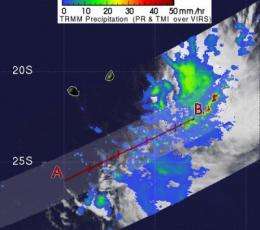
At 11:20 p.m. ET Jan. 27, the Tropical Rainfall Measuring Mission or TRMM satellite, captured Tropical Depression 11S's rainfall, as it was centered east of La Reunion Island. Although most of the rainfall was light to moderate (yellow and green) there were some areas of heavy rain of over 2 inches per hour (red). Credit: NASA/SSAI, Hal Pierce

The eleventh tropical depression formed today in the Southern Indian Ocean south of Port Louis. It will continue on a southeasterly track and move into open ocean.

At 4 a.m. ET (09:00 UTC) on January 28, 11S (TD 11S) had near 39 mph (35 knots). It was located about 180 nautical miles east of La Reunion, near 21.7 degree South latitude and 58.9 degrees East longitude. TD 11S is moving southward near 6 mph (5 knots).

La Reunion Island is a French island located in the Southern Indian Ocean, east of Madagascar and about 120 miles southwest of the island of Mauritius.

At 11:20 p.m. ET January 27, the Measuring Mission, or TRMM satellite captured 11S's rainfall, as it was centered east of La Reunion Island. Although most of the rainfall was light to moderate there were some areas of heavy rain of over 2 inches per hour. For more information on the TRMM satellite, go to: www.trmm.nasa.gov.

Despite being in an area of low wind shear, TD 11S has a fully exposed low-level circulation center, which opens the storm's circulation up to wind shear and dry air. Low wind shear helps a storm strengthen, while open circulation lends itself to weakening a storm.

Over the next day or two, however, TD 11S is expected to redevelop and convection (rapidly rising air that forms thunderstorms) and strengthen as it moves over warm sea surface temperatures. After it strengthens, then over the weekend, it is expected to become extra-tropical while remaining over open ocean.

Explore further: Russia evacuates drifting Arctic research station

add to favorites email to friend print save as pdf

Related Stories

NASA satellite sees rainfall in ebbing Edzani

Jan 12, 2010

NASA's Tropical Rainfall Measuring Mission satellite captured a clear picture of what's happening within Tropical Storm Edzani, including where the rainfall is happening and where the center of the storm has ...

Cyclone Anja hits wind shear, weakens drastically

Nov 17, 2009

This morning, Cyclone Anja was a powerful Category 4 cyclone on the Saffir-Simpson scale. Wind shear has now giving Anja a strong "punch in the gut" as the storm has weakened to a Category 1 cyclone.

Recommended for you

Russia evacuates drifting Arctic research station

2 hours ago

Russia has ordered the urgent evacuation of the 16-strong crew of a drifting Arctic research station after ice floe that hosts the floating laboratory began to disintegrate, officials said Thursday.

Bacterium from Canadian High Arctic and life on Mars

5 hours ago

(Phys.org) —The temperature in the permafrost on Ellesmere Island in the Canadian high Arctic is nearly as cold as that of the surface of Mars. So the recent discovery by a McGill University led team of ...

NASA's Landsat satellite looks for a cloud-free view

20 hours ago

For decades, Landsat satellites have documented the desiccation of the Aral Sea in Central Asia. Once one of the largest seas in the world, it shrunk to a tenth of its original volume after Russia diverted ...

User comments : 0

More news stories

A hidden population of exotic neutron stars

(Phys.org) —Magnetars – the dense remains of dead stars that erupt sporadically with bursts of high-energy radiation - are some of the most extreme objects known in the Universe. A major campaign using ...

Russia evacuates drifting Arctic research station

Russia has ordered the urgent evacuation of the 16-strong crew of a drifting Arctic research station after ice floe that hosts the floating laboratory began to disintegrate, officials said Thursday.

Century-old science helps confirm global warming

(Phys.org) —Ocean measurements taken more than 135 years ago during the scientific expedition of HMS Challenger have provided further confirmation of human-produced global warming over the past century.

Bacterium from Canadian High Arctic and life on Mars

(Phys.org) —The temperature in the permafrost on Ellesmere Island in the Canadian high Arctic is nearly as cold as that of the surface of Mars. So the recent discovery by a McGill University led team of ...

Review: Google music plan solid, serendipitous

Google's new music service offers a lot of eye candy to go with the tunes. The song selection of around 18 million tracks is comparable to popular services such as Spotify and Rhapsody, and a myriad of playlists ...