New research sheds light on Earth's coldest temperatures
Jan 12, 2010
New research sheds light on Earth's coldest temperatures
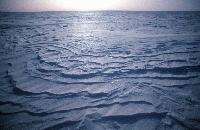
East Antarctic ice sheet

(PhysOrg.com) -- Results from the first detailed analysis of the lowest ever temperature recorded on the Earth's surface can explain why it got so cold and how cold it could possibly get.

During the Antarctic winter of 1983 (July) temperatures plunged to a record-breaking -89.2°C at the Russian Vostok research station — more than 30°C lower than the average winter temperature. Until this study scientists did not understand why or how the temperature on the vast East Antarctic plateau could hit such an extreme low.

Scientists at British Antarctic Survey (BAS) and the Arctic and Antarctic Research Institute (AARI) in Russia found that for a period of 10 days the air flow that is normally fed from the Southern Ocean on to the high Antarctic plateau almost stopped.

A flow of cold air circling Vostok was preventing the mixing of this warmer air from lower latitudes, isolating the station and causing near optimum cooling conditions. Adding to this was the absence of cloud cover and the layer of tiny particles of ice suspended in the air (known as diamond dust) allowing more heat from the ice surface to be lost to space.

The study was able to successfully simulate the rapid loss of heat over the 10 day period, which will aid the development of used to predict the future evolution of the Antarctic .

Lead author Professor John Turner at BAS says,

“The majority of Antarctica has not yet warmed to the same extent as the Arctic, but over the next century we expect to see this situation change as the effects of have an impact. Distinguishing between natural variability and human induced changes to the Earth’s atmospheric climate is at the heart of our research and we wanted to understand why this ‘normal’ weather system was thrown out of balance so severely. Our findings indicate that this was a natural event, but this is an important reminder of just how extreme Earth’s natural events can be and that we must always consider the potential for such anomalies to occur. The East Antarctic plateau is remote from the ocean and extremely cold, and we believe that Vostok, at an altitude of 3,488m could get even colder, possibly reaching −96°C if an extreme isolation period such as this occurred over a longer period of time. Temperatures may even drop to −100°C at the higher Dome A — the summit of the East Antarctic Ice Cap. By appreciating that such possibilities can occur and in turn striving to understand the processes that cause them we are better equipped to make predictions for how the planet might react to future changes in polar atmospheric climate.”

Explore further: Astonishing hi-resolution satellite views of the destruction from the Moore, Oklahoma tornado

add to favorites email to friend print save as pdf

Related Stories

Mysteriously warm times in Antarctica

Nov 18, 2009

(PhysOrg.com) -- A new study of Antarctica's past climate reveals that temperatures during the warm periods between ice ages (interglacials) may have been higher than previously thought. The latest analysis ...

Recommended for you

Strong earthquake at exceptional depth

16 hours ago

This morning at 05:45 CEST, the earth trembled beneath the Okhotsk Sea in the Pacific Northwest. The quake, with a magnitude of 8.2, took place at an exceptional depth of 605 kilometers. Because of the great ...

Marine forecasting on the horizon for Indian Ocean Rim

16 hours ago

Nearly all of the member countries of the Indian Ocean Rim Association for Regional Cooperation (IOR-ARC) will attend the week-long workshop to further cooperation and understanding on international ocean ...

Russia evacuates drifting Arctic research station

May 23, 2013

Russia has ordered the urgent evacuation of the 16-strong crew of a drifting Arctic research station after ice floe that hosts the floating laboratory began to disintegrate, officials said Thursday.

User comments : 15

Adjust slider to filter visible comments by rank

Display comments: newest first

yyz
5 / 5 (2) Jan 12, 2010
In a related story, scientists may have found a way to monitor the temperature of the ozone layer over Antarctica using the IceCube Neutrino Telescope: http://www.techno...v/24642/ .
defunctdiety
3 / 5 (12) Jan 12, 2010
over the next century we expect to see this situation change as the effects of greenhouse gas emissions have an impact

Good to know our buddies down in Vostok aren't biased at all...

Seriously there is no reason to make this comment.

"The majority of Antarctica has not yet warmed to the same extent as the Arctic. Distinguishing between natural variability and human induced changes to the Earth’s atmospheric climate is at the heart of our research..."

Is all they needed to say, but I thank them for demonstrating their personal bias, their forthrightness is admirable even if their objectivity is not.

I understand this was a rare phenomenon but why qualify that normal with quotes, they say themselves it was entirely natural. It's disgusting and terrifying that these are the types of people, all over the world, who do the science which politicians would like to base our policy upon.

Why are they like this? Because of how science is funded. i.e. special interest.
spdg
3.2 / 5 (10) Jan 12, 2010
"Our findings indicate that this was a natural event" does not equate to "it was entirely natural." The inevitable return of the ice age does not mean you can automatically discount any human induced atmospheric changes. That would be unscientific. Maybe you (Defunctdiety) are the biased one.
GrayMouser
3 / 5 (8) Jan 12, 2010
"Our findings indicate that this was a natural event" does not equate to "it was entirely natural." The inevitable return of the ice age does not mean you can automatically discount any human induced atmospheric changes. That would be unscientific. Maybe you (Defunctdiety) are the biased one.

How much energy does it take to raise the average temperature of the Earth 1 degree? More than the human race has produced? Maybe. But how do you measure the average temperature of the Earth? From what I've seen there is no basis for an "average temperature" and, if there was, it would have an error range measured in multiple degrees. Far more than AGW is worried about (ie. why worry about a increase of 0.1 degree when your error is plus or minus 4 degrees?)
defunctdiety
2.8 / 5 (9) Jan 12, 2010
"Our findings indicate that this was a natural event" does not equate to "it was entirely natural."

It would be really great if you would understand what I'm (and this article is) talking about before posting on it, thanks.

And if I understood the point of what you were blathering about, I'd respond but since it's mindless, well...

As for my bias, coming out of college I fully believed AGW was real, hook line and sinker. It was what I was told by science, it had to be true, right?

Then I started examining the principles and 'evidence' and presumptions and suppositions and discovered it simply doesn't hold water under scientific scrutiny.

My bias is that AGW has not been anywhere close to proven yet with actual science, that there is far more evidence to suggest what we are seeing is within the range of natural variability and further more, you will never convince me that a warming globe is an environmental problem, because it simply is not.
frajo
2.7 / 5 (12) Jan 13, 2010
It was what I was told by science, it had to be true, right?
This sentence shows that you are not a scientist.
Claudius
2.3 / 5 (6) Jan 13, 2010
It was what I was told by science, it had to be true, right?
This sentence shows that you are not a scientist.


Nonsense. What is shows is that he had faith in science. He believed that scientists are only looking for the truth and are not swayed by political or financial pressures. He found out otherwise. Welcome to the real world.
frajo
3 / 5 (8) Jan 13, 2010
It was what I was told by science, it had to be true, right?
This sentence shows that you are not a scientist.

Nonsense. What is shows is that he had faith in science.
Exactly. That's why he is not a scientist.
Someone who has faith in science can't be a scientist.
He believed that scientists are only looking for the truth
That's why he can't be a scientist. Scientist never claim the truth. Instead they use words like "theory", "hypothesis", or "to our best knowledge".
and are not swayed by political or financial pressures.
He thought they are holy? Why did he think so?
He found out otherwise. Welcome to the real world.
Don't confuse science with scientists.
defunctdiety
2 / 5 (4) Jan 13, 2010
That's why he is not a scientist.

Yes thats why I'm not a scientist, your logic is infallible. People never change and I do not revere and practice the scientific method as a part of my job.
Someone who has faith in science can't be a scientist.

Again your golden logic shines through. Certainly there is no scientist in the world who believes his discipline strives to represent reality as best it can.
Scientist never claim the truth.

Really? That's interesting, because I'm pretty sure that replicable results achieved through well documented procedure and approved via peer review are a truth, and claimed as such all the time.
He thought they are holy? Why did he think so?

You've obviously never been through a liberal arts collegiate institution.

Welcome to reality is right. College = idealist, reality = everything college wishes wasn't true.

frajo, please get a clue. Your posturing serves no purpose other than to make you look like an arrogant elitist.
Claudius
2.6 / 5 (5) Jan 13, 2010
Exactly. That's why he is not a scientist.
Someone who has faith in science can't be a scientist.
That's why he can't be a scientist. Scientist never claim the truth. Don't confuse science with scientists.


I did not say scientists claim to know the truth. If you read it again, you will note the key word "looking" for truth.

It is the search for truth that I as a scientist have faith in. The failings of those who have distorted science in the past and recently (the CRU, obviously) are good enough reason to doubt any scientific theory, no matter how much "evidence" is presented.

I know many in the scientific world who are sure they know the "truth" and refuse to alter their views even when presented with irrefutable contradictory evidence. They rely on things like "consensus" and peer review to form their opinions about the "truth."

This seems to be the state of affairs regarding those who have put themselves on the AGW bandwagon. So who's being unscientific now?
frajo
1 / 5 (2) Jan 15, 2010
People never change and I do not revere and practice the scientific method as a part of my job.
That's ok. But before that you used the word "faith". That was not ok.
Certainly there is no scientist in the world who believes his discipline strives to represent reality as best it can.
That's ok. But that's not the same as "faith" and "truth".
That's interesting, because I'm pretty sure that replicable results achieved through well documented procedure and approved via peer review are a truth, and claimed as such all the time.
At best, they are a commonly accepted standard. That's not the same as "truth".
You've obviously never been through a liberal arts collegiate institution.
Of course not as I'm not a US resident.
Your posturing serves no purpose other than to make you look like an arrogant elitist.
That's ok for me. Looks are in the eye of the beholder.
Claudius
2.3 / 5 (3) Jan 15, 2010
But before that you used the word "faith". That was not ok.


Instead of focusing on his "faith" in science, you should consider the issue of faith in the AGW hypothesis, which is as supported by evidence as much as belief in the afterlife. Maybe even less so, as there are near-death experiences to consider.
Claudius
2.3 / 5 (3) Jan 15, 2010
From the New York Times:
By EVAN LEHMANN of ClimateWire
Published: January 13, 2010

But Detlefsen's letter says the "e-mails show that a close-knit group of the world's most influential climate scientists actively colluded to subvert the peer-review process ... manufactured pre-determined conclusions through the use of contrived analytic techniques; and discussed destroying data to avoid government freedom-of-information requests."

"Viewed collectively, the CRU e-mails reveal a scientific community in which a group of scientists promoting what has become, through their efforts, the dominant climate-change paradigm are at war with other scientists derisively labeled as 'skeptics,' 'deniers,' and 'contrarians,'" he added.

http://www.nytime...554.html
frajo
2 / 5 (4) Jan 16, 2010
Instead of focusing on his "faith" in science, you should consider the issue of faith in the AGW hypothesis
That's not my playing field; I'm agnostic here. There are models, there are supercomputer simulations, there are falsifiable hypotheses. That's science.
It's not science to claim knowing the "truth" - neither for the proponents nor for the deniers.

Another point is the question how to act responsible. That's not a scientific question; it's a question of ethics.
Claudius
not rated yet Jan 17, 2010

It's not science to claim knowing the "truth" - neither for the proponents nor for the deniers.

Another point is the question how to act responsible. That's not a scientific question; it's a question of ethics.


Well, it may not be science to claim to possess the truth, but it is common practice among scientists, incorrect as it may be.

And if a certain group of scientists had acted responsibly (not to say legally) we wouldn't be wasting our time debating whether the AGW religion is valid or not.

More news stories

Galaxies fed by funnels of fuel

(Phys.org) —Computer simulations of galaxies growing over billions of years have revealed a likely scenario for how they feed: a cosmic version of swirly straws.

Dark, massive asteroid to fly by Earth on May 31

It's 1.7 miles long. Its surface is covered in a sticky black substance similar to the gunk at the bottom of a barbecue. If it impacted Earth it would probably result in global extinction. Good thing it is ...

Source of life running out: water scientists

The majority of people on Earth people will face severe water shortages within a generation or two if pollution and waste continues unabated, scientists warned at a conference in Bonn Friday.

Google eyes emerging markets networks

Google has become deeply involved in a series of projects to build and operate wireless networks in emerging markets including sub-Saharan Africa and Southeast Asia, a report said Friday.