Quantum simulation of a relativistic particle
Jan 06, 2010
Quantum simulation of a relativistic particle
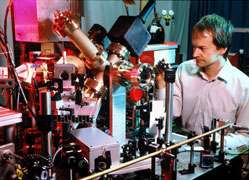
Christian Roos in the lab (Photo: Lackner)

(PhysOrg.com) -- Researchers of the Institute for Quantum Optics and Quantum Information (IQOQI) in Innsbruck, Austria used a calcium ion to simulate a relativistic quantum particle, demonstrating a phenomenon that has not been directly observable so far: the Zitterbewegung. They have published their findings in the current issue of the journal Nature.

In the 1920s was already established and in 1928 the British physicist showed that this theory can be merged with postulated by Albert Einstein. Dirac’s work made applicable to relativistic particles, which move at a speed that is comparable to the speed of light.

The Dirac equation forms the basis for groundbreaking new insights, e.g. it provides a natural description of the electron spin and predicts that each particle also has its antiparticle (anti matter).

In 1930, as a result of the analysis of the Dirac equation, the Austrian Nobel laureate Erwin Schrödinger first postulated the existence of a so called Zitterbewegung (quivering motion), a kind of fluctuation of the motion of a relativistic particle. “According to the Dirac equation such a particle does not move in a linear fashion in a vacuum but ‘jitters’ in all three dimensions,“ Christian Roos from the Institute for and (IQOQI) of the Austrian Academy of Sciences (ÖAW) explains. “It is not clear whether this Zitterbewegung can be observed in real systems in nature.“

Quantum simulation of a particle

Physical phenomena are often described by equations, which may be too complicated to solve. In this case, researchers use computer simulations to answer open questions. However, even for small quantum systems, classical computers have not enough power to manage the processing of the data; thus, scientists, such as Richard Feynman, proposed to simulate these phenomena in other quantum systems experimentally. The preconditions for doing this - detailed knowledge about the physics of these systems and an excellent control over the technology and set-up - have been set by the research group headed by Rainer Blatt by conducting experiments with quantum computers over the last few years; they are now able to carry out quantum simulations experimentally.

“The challenges with these experiments are to recreate the equations in the quantum system well, to have a high level of control over the various parameters and to measure the results,“ Christian Roos says. The experimental physicists of the IQOQI trapped and cooled a and in this well-defined state, a laser coupled the state of the particle and the state of the relativistic particle to be simulated. “Our quantum system was now set to behave like a free relativistic quantum particle that follows the laws of the Dirac equation,“ Rene Gerritsma explains, a Dutch Postdoc working at the IQOQI and first author of the work published in Nature. Measurements revealed the features of the simulated particle. “Thereby, we were able to demonstrate Zitterbewegung in the experimental simulation and we were also able to determine the probability of the distribution of a particle,“ Gerritsma says. In this very small quantum system the physicist simulated the Dirac equation only in one spatial dimension. ”This simulation was a proof-of-principle experiment,“ Roos says, “which, in principle, can also be applied to three-dimensional dynamics if the technological set-up is adjusted accordingly.“

Simulation of antiparticles

Due to the extremely high level of control over the physical regime of the simulated particle, the scientists were able to modify the mass of the object and to simulate antiparticles. “In the end, our approach was very simple but you have to come up with the idea first,“ says Christian Roos, whose team of scientists was inspired by a theoretical proposal of a Spanish group of researchers. The work was supported by the Austrian Science Funds (FWF) and the European Commission.

Explore further: A quantum simulator for magnetic materials

More information: Quantum simulation of the Dirac equation. Gerritsma R, Kirchmair G, Zähringer F, Solano E, Blatt R, Roos CF. Nature January 7, 2010.

Provided by Austrian Academy of Sciences

4.9 /5 (22 votes)

Related Stories

Quantum measurements: Common sense is not enough

Jul 22, 2009

(PhysOrg.com) -- In comparison to classical physics, quantum physics predicts that the properties of a quantum mechanical system depend on the measurement context, i.e. whether or not other system measurements ...

Quantum Mechanical Con Game

May 05, 2008

For the first time, physicists have come up with a scheme that would allow a quantum mechanical expert to win every time in a con game with a victim who only knows about classical physics. Prior quantum cons have typically ...

Physicists study remote quantum networks

Nov 01, 2006

U.S. physicists say the operations of two remote quantum systems can be synchronized so changes in one system are conditional on what occurs in the other.

Opposites interfere

Jul 26, 2007

In a classic physics experiment, photons (light particles), electrons, or any other quantum particles are fired, one at a time, at a sheet with two slits cut in it that sits in front of a recording plate. For photons, a photographic ...

Recommended for you

A quantum simulator for magnetic materials

16 hours ago

Physicists understand perfectly well why a fridge magnet sticks to certain metallic surfaces. But there are more exotic forms of magnetism whose properties remain unclear, despite decades of intense research. ...

Researchers forward quest for quantum computing

21 hours ago

Research teams from UW-Milwaukee and the University of York investigating the properties of ultra-thin films of new materials are helping bring quantum computing one step closer to reality.

Hydrogen atoms under the magnifying glass

May 22, 2013

To describe the microscopic properties of matter and its interaction with the external world, quantum mechanics uses wave functions, whose structure and time dependence is governed by the Schrödinger equation. ...

Making quantum encryption practical

May 21, 2013

One of the many promising applications of quantum mechanics in the information sciences is quantum key distribution (QKD), in which the counterintuitive behavior of quantum particles guarantees that no one can eavesdrop on ...

Lab sets a new record for creating heralded photons

May 20, 2013

(Phys.org) —Entanglement, by general consensus of physicists, is the weirdest part of quantum science. To say that two particles, A and B, are entangled means that they are actually two parts of an inseparable ...

Competition in the quantum world

May 20, 2013

Innsbruck physicists led by Rainer Blatt and Peter Zoller experimentally gained a deep insight into the nature of quantum mechanical phase transitions. They are the first scientists that simulated the competition ...

User comments : 2

Adjust slider to filter visible comments by rank

Display comments: newest first

flaredone
not rated yet Jan 10, 2010
It is not clear whether this Zitterbewegung can be observed in real systems in nature

Why not? Neutrino oscillation is an effect of the same category.
frajo
1 / 5 (1) Jan 10, 2010
It is not clear whether this Zitterbewegung can be observed in real systems in nature

Why not? Neutrino oscillation is an effect of the same category.
But only if we assume that the three spatial dimensions and lepton flavors are of the same category.

More news stories

A quantum simulator for magnetic materials

Physicists understand perfectly well why a fridge magnet sticks to certain metallic surfaces. But there are more exotic forms of magnetism whose properties remain unclear, despite decades of intense research. ...

Engineers pioneer flat spray-on optical lens

A University of British Columbia engineer and a team of U.S. researchers have made a breakthrough utilizing spray-on technology that could revolutionize the way optical lenses are made and used.

Researchers forward quest for quantum computing

Research teams from UW-Milwaukee and the University of York investigating the properties of ultra-thin films of new materials are helping bring quantum computing one step closer to reality.

How do cold ions slide

Things not always run smoothly. It may happen, actually, that when an object slides on another, the advancement may occur through a 'stop and go' series in the characteristic manner which scientists call ...

Controlling mood through the motions of mitochondria

(Medical Xpress)—Regulating the distribution of power in neurons is done by a system that makes the national electric grid look simple by comparison. Each neuron has several thousand mitochondria confined ...

Hormone replacement therapy—clarity at last

The British Menopause Society and Women's Health Concern have today released updated guidelines on Hormone Replacement Therapy (HRT) to provide clarity around the role of HRT, the benefits and the risks. The new guidelines ...

A hidden population of exotic neutron stars

(Phys.org) —Magnetars – the dense remains of dead stars that erupt sporadically with bursts of high-energy radiation - are some of the most extreme objects known in the Universe. A major campaign using ...