NASA's TRMM satellite measures Cyclone Laurence's heavy rainfall
Jan 04, 2010
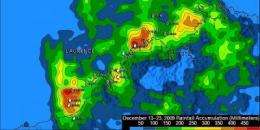
Tropical Rainfall Measuring Mission (TRMM) satelite rainfall analysis of Cyclone Laurence from Dec. 13-23, 2009, revealed that the heaviest rainfall totals of over 17.72 inches occurred in the Timor Sea near Cape Bougainville, Australia. Credit: SSAI/NASA, Hal Pierce

Tropical Cyclone Laurence dropped heavy rainfall over Northwest Australia last week, and NASA and the Japanese Space Agency's Tropical Rainfall Measuring Mission, or TRMM satellite measured that rainfall from its orbit in space.

The TRMM-based, near-real time Multi-satellite Precipitation Analysis (TMPA) at the Goddard Space Flight Center in Greenbelt, Md. monitors over the global Tropics. A TMPA analysis of rainfall was made during the period from December 13-23, 2009 when tropical cyclone Laurence was affecting northwest Australia.

The TMPA analysis revealed that the heaviest rainfall totals of over 450 mm (~17.72 inches) occurred in the Timor Sea near Cape Bougainville and in an area well off the coast west of Roebuck Bay in the Indian Ocean. The analysis indicates that the Australian coast had many areas along the coast where Laurence caused rainfall totals to exceed 150 mm (~5.9 inches). Laurence was briefly classified as a category 5 tropical cyclone but few people were nearby at that time.

Laurence had weakened to a category 1 tropical cyclone before making its final early on December 22, 2009 (local time).

Explore further: Professor argues Earth's mantle affects long-term sea-level rise estimates

add to favorites email to friend print save as pdf

Related Stories

Tropical Cyclone Laurence menaces Northern Australia

Dec 16, 2009

Laurence is still a tropical cyclone even though the storm has made landfall in northern West Australia and is moving over land. The Tropical Rainfall Measuring Mission (TRMM) satellite noticed some powerful ...

Recommended for you

Russia evacuates drifting Arctic research station

9 hours ago

Russia has ordered the urgent evacuation of the 16-strong crew of a drifting Arctic research station after ice floe that hosts the floating laboratory began to disintegrate, officials said Thursday.

Bacterium from Canadian High Arctic and life on Mars

12 hours ago

(Phys.org) —The temperature in the permafrost on Ellesmere Island in the Canadian high Arctic is nearly as cold as that of the surface of Mars. So the recent discovery by a McGill University led team of ...

User comments : 0

More news stories

Hubble reveals the ring nebula's true shape

(Phys.org) —The Ring Nebula's distinctive shape makes it a popular illustration for astronomy books. But new observations by NASA's Hubble Space Telescope of the glowing gas shroud around an old, dying, ...

NASA head views progress on asteroid lasso mission

Surrounded by engineers, NASA chief Charles Bolden inspected a prototype spacecraft engine that could power an audacious mission to lasso an asteroid and tow it closer to Earth for astronauts to explore.

A hidden population of exotic neutron stars

(Phys.org) —Magnetars – the dense remains of dead stars that erupt sporadically with bursts of high-energy radiation - are some of the most extreme objects known in the Universe. A major campaign using ...

Controlling mood through the motions of mitochondria

(Medical Xpress)—Regulating the distribution of power in neurons is done by a system that makes the national electric grid look simple by comparison. Each neuron has several thousand mitochondria confined ...

Google Drive sports new view and scan enhancements

(Phys.org) —Google Drive has a new look and functions. The makeover in Google Drive features scanning and interface enhancements that put the user into "card" mode. The enhancements make it easy for the ...