Modern behavior of early humans found half-million years earlier than previously thought
Dec 22, 2009
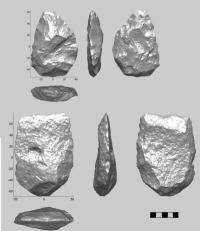
These are stone tools discovered at the Gesher Benot Ya'aqov archaeological site in Israel. Credit: Photos by Gonen Sharon for the Hebrew University of Jerusalem

Evidence of sophisticated, human behavior has been discovered by Hebrew University of Jerusalem researchers as early as 750,000 years ago - some half a million years earlier than has previously been estimated by archaeologists.

The discovery was made in the course of excavations at the prehistoric Gesher Benot Ya'aqov site, located along the rift in the southern Hula Valley of northern Israel, by a team from the Hebrew University Institute of Archaeology. Analysis of the spatial distribution of the findings there reveals a pattern of specific areas in which various activities were carried out. This kind of designation indicates a formalized conceptualization of living space, requiring social organization and communication between group members. Such organizational skills are thought to be unique to modern humans.

Attempts until now to trace the origins of such behavior at various prehistoric sites in the world have concentrated on spatial analyses of Middle Paleolithic sites, where activity areas, particularly those associated with hearths, have been found dating back only to some 250,000 years ago.
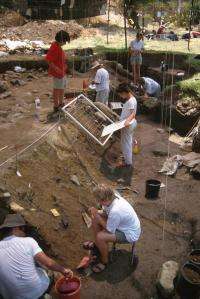
This photo shows workers digging at the Gesher Benot Ya'aqov site archaeological site in Israel. Credit: Gonen Sharon for the Hebrew University of Jerusalem

The new Hebrew University study, a report on which is published this week in Science magazine, describes an Acheulian (an early culture) layer at Gesher Benot Ya'aqov that has been dated to about 750,000 years ago. The evidence found there consists of numerous stone tools, animal bones and a rich collection of botanical remains.

Analyses of the spatial distribution of all these finds revealed two activity areas in the layer: the first area is characterized by abundant evidence of flint tool manufacturing. A high density of fish remains in this area also suggests that the processing and consumption of many fish were carried out in this area -- one of the earliest evidences for fish consumption by prehistoric people anywhere.

In the second area, identified evidence indicates a greater variation of activities - all of which took place in the vicinity of a hearth. The many wood pieces found in this area were used as fuel for the fire. Processing of basalt and limestone was spatially restricted to the hearth area, where activities indicate the use of large stone tools such as hand axes, chopping tools, scrapers, and awls. The presence of stone hammers, and in particular of pitted anvils (used as nutting stones), suggest that nut processing was carried out near the hearth and may have involved the use of nut roasting. In addition, fish and crabs were probably consumed near the hearth.

Explore further: Actor Johnny Depp immortalized in ancient fossil find

add to favorites email to friend print save as pdf

Related Stories

Exploring the Stone Age pantry

Dec 17, 2009

The consumption of wild cereals among prehistoric hunters and gatherers appears to be far more ancient than previously thought, according to a University of Calgary archaeologist who has found the oldest example ...

French find puts humans in Europe 200,000 years earlier

Dec 15, 2009

Experts on prehistoric man are rethinking their dates after a find in a southern French valley suggested our ancestors may have reached Europe 1.57 million years ago: 200,000 years earlier than we thought.

Prehistoric tools discovered at Isles of Shoals

Aug 27, 2009

(PhysOrg.com) -- Summer students in Cornell's new Archaeology Field School at Shoals Marine Laboratory, Cornell's marine field station, have discovered the first prehistoric archaeological site in the Isles ...

Ancient tombs discovered by Kingston University-led team

Jun 09, 2009

A prehistoric complex including two 6,000-year-old tombs representing some of the earliest monuments built in Britain has been discovered by a team led by a Kingston University archaeologist. Dr Helen Wickstead and her colleagues ...

Recommended for you

The eloquence of the otoliths

May 16, 2013

Fish fossils that are about 23 million years old give unprecedented insight into the evolutionary history of the gobioid order, one of the most species-rich groups among the modern bony fishes.

Light cast on lifestyle and diet of first New Zealanders

May 16, 2013

(Phys.org) —A University of Otago-led multidisciplinary team of scientists have shed new light on the diet, lifestyles and movements of the first New Zealanders by analysing isotopes from their bones and teeth.

mtDNA study shows Minoans came from Europe not Africa

May 15, 2013

(Phys.org) —A new study conducted by a team of American and Greek researchers has found that the people of the ancient Minoan civilization living on the island of Crete most likely came from Europe. In ...

User comments : 0

More news stories

Evolution of lying

(Phys.org) —Ultimately, our ability to convincingly lie to each other may have evolved as a direct result of our cooperative nature.

US seizes Bitcoin operator accounts

US authorities seized the accounts of a Bitcoin digital currency exchange operator, claiming it was functioning as an "unlicensed money service business," court documents showed Friday.

Alaska volcano shoots ash 15,000 feet into the air

(AP)—One of Alaska's most restless volcanoes has shot an ash cloud 15,000 feet into the air in an ongoing eruption that has drawn attention from a nearby community but isn't expected to threaten air traffic.

Chinese, Indian airlines face EU pollution fines

Eight Chinese and two Indian airlines face fines of up to several million euros for not paying for their greenhouse gas emissions during flights within the bloc, the European Commission said on Friday.