Don't Blame Cows for Climate Change
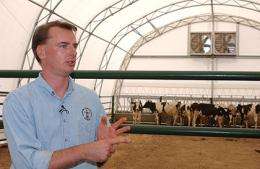
Frank Mitloehner, air quality specialist with Animal Science at UC Davis, measures the gases produced by livestock. (UC Davis photo)
(PhysOrg.com) -- Despite oft-repeated claims by sources ranging from the United Nations to music star Paul McCartney, it is simply not true that consuming less meat and dairy products will help stop climate change, says a University of California authority on farming and greenhouse gases.
UC Davis Associate Professor and Air Quality Specialist Frank Mitloehner says that McCartney and the chair of the U.N.'s Intergovernmental Panel on Climate Change ignored science last week when they launched a European campaign called "Less Meat = Less Heat." The launch came on the eve of a major international climate summit, which runs today through Dec. 18 in Copenhagen.
McCartney and others, such as the promoters of "meatless Mondays," seem to be well-intentioned but not well-schooled in the complex relationships among human activities, animal digestion, food production and atmospheric chemistry, says Mitloehner.
"Smarter animal farming, not less farming, will equal less heat," Mitloehner said. "Producing less meat and milk will only mean more hunger in poor countries."
Mitloehner traces much of the public confusion over meat and milk’s role in climate change to two sentences in a 2006 United Nations report, titled "Livestock's Long Shadow." Printed only in the report's executive summary and nowhere in the body of the report, the sentences read: “The livestock sector is a major player, responsible for 18 percent of greenhouse gas emissions measured in CO2e (carbon dioxide equivalents). This is a higher share than transport.”
These statements are not accurate, yet their wide distribution through news media have put us on the wrong path toward solutions, Mitloehner says.
"We certainly can reduce our greenhouse-gas production, but not by consuming less meat and milk.
"Rather, in developed countries, we should focus on cutting our use of oil and coal for electricity, heating and vehicle fuels."
Mitloehner said leading authorities agree that, in the U.S., raising cattle and pigs for food accounts for about 3 percent of all greenhouse gas emissions, while transportation creates an estimated 26 percent.
"In developing countries, we should adopt more efficient, Western-style farming practices, to make more food with less greenhouse gas production," Mitloehner continued. In this he agrees with the conclusion of "Livestock’s Long Shadow," which calls for “replacing current suboptimal production with advanced production methods — at every step from feed production, through livestock production and processing, to distribution and marketing.”
"The developed world's efforts should focus not on reducing meat and milk consumption," said Mitloehner, "but rather on increasing efficient meat production in developing countries, where growing populations need more nutritious food."
Mitloehner particularly objects to the U.N.'s statement that livestock account for more greenhouse gases than transportation, when there is no generally accepted global breakdown of gas production by industrial sector.
He notes that "Livestock's Long Shadow" produced its numbers for the livestock sector by adding up emissions from farm to table, including the gases produced by growing animal feed; animals' digestive emissions; and processing meat and milk into foods. But its transportation analysis did not similarly add up emissions from well to wheel; instead, it considered only emissions from fossil fuels burned while driving.
"This lopsided 'analysis' is a classical apples-and-oranges analogy that truly confused the issue," Mitloehner said.
Most of Mitloehner's analysis is presented in a recent study titled "Clearing the Air: Livestock’s Contributions to Climate Change," published in October in the peer-reviewed journal Advances in Agronomy. Co-authors of the paper are UC Davis researchers Maurice Piteskey and Kimberly Stackhouse.
-
From lemons to lemonade: Reaction uses carbon dioxide to make carbon-based semiconductor,
32 comments
-
Thioridazine kills cancer stem cells in human while avoiding toxic side-effects of conventional cancer treatments,
3 comments
-
SpaceX private rocket blasts off for space station (Update),
42 comments
-
Climate scientists say they have solved riddle of rising sea,
31 comments
-
SpaceX capsule has 'new car' smell, astronauts say (Update),
4 comments
-
Hypothetical desert earth
May 26, 2012
-
More human population = greater mass?
May 25, 2012
-
Conversion from aircraft bearing to normal degrees
May 23, 2012
-
Interpretation/Analysis of the Lab results(HEPA filter)
May 22, 2012
-
Has anyone here attended the The Urbino Summer School in Paleoclimatology?
May 22, 2012
-
Earthquakes: Mag 6 N. Italy and Mag 5.6 W. Bulgaria
May 21, 2012
- More from Physics Forums - Earth
More news stories
Land and sea species differ in climate change response: study
(Phys.org) -- Marine and terrestrial species will likely differ in their responses to climate warming, new research by Simon Fraser University and Australia’s University of Tasmania has found.
8 hours ago |
4 / 5 (5) |
6
|
Yale study concludes public apathy over climate change unrelated to science literacy
Are members of the public divided about climate change because they don't understand the science behind it? If Americans knew more basic science and were more proficient in technical reasoning, would public consensus match ...
10 hours ago |
4.8 / 5 (6) |
24
|
10 million years needed to recover from mass extinction
It took some 10 million years for Earth to recover from the greatest mass extinction of all time, latest research has revealed.
Space & Earth / Earth Sciences
10 hours ago |
4 / 5 (4) |
1
|
Sophisticated simulations predict future warming
The chances of our planet being hit by a global warming of 3 degrees Celsius by 2050 is as likely as it being hit by an increase of 1.4 degrees, new research shows. Presented in the journal Nature Geoscience, the British study ...
Space & Earth / Earth Sciences
May 22, 2012 |
3.8 / 5 (11) |
51
Aliens don't want to eat us, says former SETI director
Alien life probably isnt interested in having us for dinner, enslaving us or laying eggs in our bellies, according to a recent statement by former SETI director Jill Tarter.
Space & Earth / Space Exploration
May 25, 2012 |
4.4 / 5 (15) |
41
'Unzipped' carbon nanotubes could help energize fuel cells, batteries
Multi-walled carbon nanotubes riddled with defects and impurities on the outside could replace some of the expensive platinum catalysts used in fuel cells and metal-air batteries, according to scientists at ...
Change in developmental timing was crucial in the evolutionary shift from dinosaurs to birds: study
At first glance, it's hard to see how a common house sparrow and a Tyrannosaurus Rex might have anything in common. After all, one is a bird that weighs less than an ounce, and the other is a dinosaur that ...
Computer model used to pinpoint prime materials for efficient carbon capture
When power plants begin capturing their carbon emissions to reduce greenhouse gases and to most in the electric power industry, it's a question of when, not if it will be an expensive undertaking.
T cells 'hunt' parasites like animal predators seek prey, study shows
By pairing an intimate knowledge of immune-system function with a deep understanding of statistical physics, a cross-disciplinary team at the University of Pennsylvania has arrived at a surprising finding: T cells use a movement ...
Stunning image of smallest possible five-ringed structure
Scientists have created and imaged the smallest possible five-ringed structure about 100,000 times thinner than a human hair and you'll probably recognise its shape.
Browser wars flare in mobile space
The browser wars are heating up again, but this time the fight is for dominance of the mobile Internet.
Dec 08, 2009
Rank: 5 / 5 (3)
Sorry but this article is as far off as the UN study. Cattle do cause GHG emissions in quantity. More than 3% but far less than 26%. And you need to add farm CO2 of feed just as you need to add gas/oil production to transport fuels.
Luckily both can be cut by a lot.
Dec 08, 2009
Rank: 1 / 5 (1)
Dec 09, 2009
Rank: 1 / 5 (1)
http://en.wikiped...oduction
Therefore the consumption of poutry may sound like inefective waste of water for someone - but the content of proteins in rice is ten times lower, then in chicken meat! This explains, why people from deserts in Chad or Mongolia are living from pasturage, instead of farming.
Dec 09, 2009
Rank: 5 / 5 (1)
If you read the article, the co2 of feed was included. That's why not adding the production of fuels is deceptive. Mr. Frank Mitloehner has presented the numbers to back up his claims, the "farm animals cause massive amounts of greenhouse gases" folks are reporting and re-reporting news media hype.