Flying MAV Navigates Without GPS (w/ Video)
Nov 02, 2009 by Lisa Zyga weblog
MIT MAV
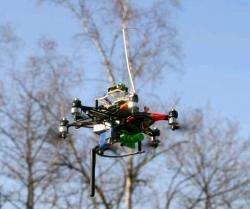
The MAV uses lasers and new algorithms to estimate its relative position, build a map, and locate a clear path. Image credit: MIT Robust Robotics Group.

(PhysOrg.com) -- During the last several years, researchers have been building micro air vehicles (MAVs) that can autonomously fly through different environments by relying on GPS for navigation. Recently, a team of researchers has designed an MAV that can navigate unknown environments without GPS, which could enable it to overcome several limitations of GPS-dependent vehicles.

The new MAV is being designed by the Robust Robotics Group at MIT's and Artificial Intelligence Laboratory. Their work is motivated by the fact that, in some places, such as dense urban environments or indoors, is noisy and maps are unavailable, which can cause MAVs to get lost, fly into dangerous regions, or collide with obstacles. Providing MAVs with a tool other than GPS to navigate these environments could help the vehicles avoid these problems.

This video is not supported by your browser at this time.

More information and videos: MIT's Robust Robotics Group

© 2009 PhysOrg.com

Explore further: Four microphones, computer algorithm enough to produce 3-D model of simple, convex room

add to favorites email to friend print save as pdf

Related Stories

New robot skier takes to the slopes (w/ Video)

Oct 23, 2009

(PhysOrg.com) -- A new robot skier has been invented that can be fitted with off-the-shelf skis. This is not the first skiing robot, since Japanese scientists have produced their own (see PhysOrg.com article here), but is bigger and heavie ...

BlackBerry Storm 2 coming soon (w/ Video)

Oct 20, 2009

(PhysOrg.com) -- RIM are soon to release their updated BlackBerry, the Storm 2 smart phone, with a more streamlined design and touch-sensitive buttons instead of the hardware buttons of the first version.

Two Robot Chefs Make Omelets

Dec 04, 2008

(PhysOrg.com) -- No "house of the future" is complete without a household robot to do the cooking and cleaning. Although today´s robots still have a ways to go before substituting for a real live-in maid, ...

Recommended for you

Faster, more precise airstrikes within reach

17 hours ago

Air-ground fire coordination—also known as Close Air Support or CAS—is a dangerous and difficult business. Pilots and dismounted ground agents must ensure they hit only the intended target using just ...

How smart technology could change public transit

17 hours ago

Joseph Chow has an ambitious goal: to transform how urban transportation systems are managed and designed, using mobile computing, information technology and the analysis of massive data sets.

Nanoparticles helping to recover more oil

18 hours ago

When petroleum companies abandon an oil well, more than half the reservoir's oil is usually left behind as too difficult to recover. Now, however, much of the residual oil can be recovered with the help of ...

User comments : 2

Adjust slider to filter visible comments by rank

Display comments: newest first

antialias_physorg
not rated yet Nov 02, 2009
Impressive. Can it cope with mirrors in the hallways? Can it handle moving objects (dangling pipes, clouds of steam, moving animals/humans)? If it can this would make a great search/rescue bot in environments that might collapse and are deemed unsafe for human recue personell.
anonperson
not rated yet Dec 16, 2009
I can see the military clamoring for thousands of these... yesterday!

More news stories

New language discovery reveals linguistic insights

A new language has been discovered in a remote Indigenous community in northern Australia that is generated from a unique combination of elements from other languages. Light Warlpiri has been documented by University of Michigan ...