Improved Electric Propulsion Could Boost Satellite Lifetimes
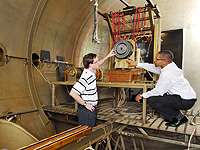
(PhysOrg.com) -- Researchers at the Georgia Institute of Technology have won a $6.5 million grant to develop improved components that will boost the efficiency of electric propulsion systems used to control the positions of satellites and planetary probes.
Focusing on improved cathodes for devices known as Hall effect thrusters, the research would reduce propellant consumption in commercial, government and military satellites, allowing them to remain in orbit longer, be launched on smaller or cheaper rockets, or carry larger payloads. Sponsored by the U.S. Defense Advanced Research Projects Agency Defense Sciences Office (DARPA-DSO), the 18-month project seeks to demonstrate the use of propellant-less cathodes with Hall effect thrusters.
"About 10 percent of the propellant carried into space on satellites that use an electric propulsion system is essentially wasted in the hollow cathode that is part of the system," said Mitchell Walker, an assistant professor in Georgia Tech's School of Aerospace Engineering and the project's principal investigator. "Using field emission rather than a hollow cathode, we are able to pull electrons from cathode arrays made from carbon nanotubes without wasting propellant. That will extend the life of the vehicle by more efficiently using the limited on-board propellant for its intended purpose of propulsion."
To maintain their positions in space or to reorient themselves, satellites must use small thrusters that are either chemically or electrically powered. Electrically-powered thrusters use electrons to ionize an inert gas such as xenon. The resulting ions are then ejected from the device to generate thrust.
In existing Hall effect thrusters, a single high-temperature cathode generates the electrons. A portion of the propellant—typically about 10 percent of the limited supply carried by the satellite—is used as a working fluid in the traditional hollow cathode. The DARPA-funded research would replace the hollow cathode with an array of field-effect cathodes fabricated from bundles of multi-walled carbon nanotubes. Powered by on-board batteries and photovoltaic systems on the satellite, the arrays would operate at low power to produce electrons without consuming propellant.
Walker and collaborators at the Georgia Tech Research Institute (GTRI) have already demonstrated field-effect cathodes based on carbon nanotubes. This work was presented at the 2009 AIAA Joint Propulsion Conference held in Denver, Colo. The additional funding will support improvements in the devices, known as carbon nanotube cold cathodes, and lead to space testing as early as 2015.
"This work depends on our ability to grow aligned carbon nanotubes precisely where we want them to be and to exacting dimensions,"ť said Jud Ready, a GTRI senior research engineer and Walker's collaborator on the project. "This project leverages our ability to grow well-aligned arrays of nanotubes and to coat them to enhance their field emission performance."
In addition to reducing propellant consumption, use of carbon nanotube cathode arrays could improve reliability by replacing the single cathode now used in the thrusters.
"Existing cathodes are sensitive to contamination, damaged by the ionized exhaust of the thruster, and have limited life due to their high-temperature operation," Ready noted. "The carbon nanotube cathode arrays would provide a distributed cathode around the Hall effect thruster so that if one of them is damaged, we will have redundancy."
Before the carbon nanotube cathodes developed by Georgia Tech can be used on satellites, however, their lifetime will have to be increased to match that of a satellite thruster, which is typically 2,000 hours or more. The devices will also have to withstand the mechanical stresses of space launches, turn on and off rapidly, operate consistently and survive the aggressive space environment.
Part of the effort will focus on special coating materials used to protect the carbon nanotubes from the space environment. For that part of the project, Walker and Ready are collaborating with Lisa Pfefferle in the Department of Chemical Engineering at Yale University.
The researchers are testing their cathodes with the same Busek Hall effect thruster that flew on the U.S. Air Force's TacSat-2 satellite. In addition, the cathodes will be operated with Hall effect thrusters developed by Pratt & Whitney and donated to Georgia Tech. The researchers are also collaborating with L-3 ETI on the electrical power system and with American Pacific In-Space Propulsion on flight qualification of the hardware.
The ability to control individual cathodes on the array could provide a new capability to vector the thrust, potentially replacing the mechanical gimbals now used.
The use of carbon nanotubes to generate electrons through the field-effect process was reported in 1995 by a research team headed by Walt de Heer, a professor in Georgia Tech's School of Physics. Field emission is the extraction of electrons from a conductive material through quantum tunneling that occurs when an external electric field is applied.
The improved carbon nanotube cathodes should advance the goals of reducing the cost of launching and maintaining satellites.
"Thrust with less propellant has been one of the major goals driving research into satellite propulsion,"ť said Walker, who is director of Georgia Tech's High-Power Electric Propulsion Laboratory. "Electric propulsion is becoming more popular and will benefit from our innovation. Ultimately, we will help improve the performance of in-space propulsion devices."
Provided by Georgia Institute of Technology


