New study resolves the mysterious origin of Merkel cells
Sep 28, 2009
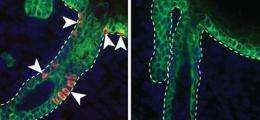
Merkel cells (red) fail to differentiate from epidermal stem cells in mouse skin lacking Atoh1 (right). The study appears in the October 5, 2009, issue of the Journal of Cell Biology. Credit: Van Keymeulen, A., et al. 2009. J. Cell Biol. doi:10.1083/jcb.200907080.

A new study resolves a 130-year-old mystery over the developmental origin of specialized skin cells involved in touch sensation. The findings will appear in the October 5, 2009 issue of the Journal of Cell Biology.

First described in 1875, Merkel are neuroendocrine cells that reside in the vertebrate epidermis, passing mechanical stimuli on to sensory neurons. In mice, they are mainly found in the paws and around the whiskers but, because they express proteins characteristic of both epithelial and neuronal cells, scientists have long debated whether Merkel cells develop from the epidermis or neural crest.

Van Keymeulen et al. traced the lineage of Merkel cells by fluorescently labeling cells derived from either epidermal or neural crest . This revealed that Merkel cells originally emerge from the embryonic epidermis. In addition, epidermal stem cells in adult mouse replenish the Merkel cell population as they slowly die off over time. The researchers also found that a transcription factor called Atoh1 is required for epidermal progenitors to differentiate into Merkel cells--mice lacking Atoh1 in their skin failed to develop any of the mechanotransducing cells.

Atoh1 acts as a tumor suppressor to prevent an aggressive skin cancer called Merkel cell , says senior author Cédric Blanpain. His team now wants to investigate the precise function of the transcription factor in Merkel cell differentiation, as well as the signaling pathways that regulate the process.

More information: Van Keymeulen, A., et al. 2009. J. Cell Biol. doi:10.1083/jcb.200907080

Source: Rockefeller University (news : web)

Explore further: What the smallest infectious agents reveal about evolution

add to favorites email to friend print save as pdf

Related Stories

Suppressing cancer with a master control gene

Feb 23, 2009

Starting with the tiny fruit fly and then moving into mice and humans, researchers at VIB and K. U. Leuven show that expression of the same gene suppresses cancer in all three organisms. Reciprocally, switching off the gene ...

Epigenetic mark guides stem cells toward their destiny

Mar 19, 2009

(PhysOrg.com) -- Not all stem cells are completely blank slates. Some, known as adult stem cells, have already partially embraced their fates and are capable of becoming only cells of a particular type of ...

Recommended for you

What the smallest infectious agents reveal about evolution

9 hours ago

Radically different viruses share genes and are likely to share ancestry, according to research published in BioMed Central's open access journal Virology Journal this week. The comprehensive phylogenomic analysis compar ...

Wound healing: 'See-saw' switch sends cells on the march

20 hours ago

Many genes are transcribed into messenger RNA (mRNA) molecules that provide instructions for protein synthesis. Other genes encode regulatory RNAs known as 'microRNAs', which can block protein translation ...

User comments : 0

More news stories

Theorists weigh in on where to hunt dark matter

(Phys.org) —Now that it looks like the hunt for the Higgs boson is over, particles of dark matter are at the top of the physics "Most Wanted" list. Dozens of experiments have been searching for them, but ...