Dark Matter May be Easier to Detect than Previously Thought
August 10, 2009 By Lisa Zyga
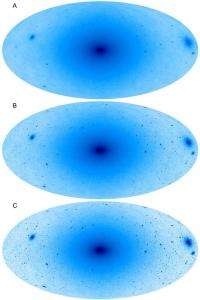
Simulated all-sky maps of the Sommerfeld-enhanced annihilation surface brightness: In (A), there is no Sommerfeld enhancement, while in (B) and (C), the enhancement increases. Image credit: Kuhlen, Madau, and Silk.
(PhysOrg.com) -- The Milky Way, like many other galaxies, is thought to be embedded in massive, lumpy amounts of dark matter that release gamma rays and other emissions. Although at first these emissions seem too faint to detect, recent observations have shown that they may be stronger than previously thought. In a new study, scientists have developed a model that predicts that gamma rays from hundreds of dark matter clumps should be detectable by the Fermi satellite that was launched in June 2008.
In their study published in a recent issue of Science Express, Michael Kuhlen of the Institute for Advanced Study in Princeton, Piero Madau of the University of California, Santa Cruz, and Joseph Silk of the University of Oxford have investigated how the luminosity from cold dark matter annihilations can be enhanced by orders of magnitude by the Sommerfeld effect. While previous calculations have shown that only a handful of the most massive dark matter halos should emit gamma rays detectable by satellites, accounting for the Sommerfeld effect suggests otherwise.
“Annihilation is a quantum mechanical process that can occur whenever a particle and its antiparticle collide,” Kuhlen told PhysOrg.com. “It turns out that in many promising particle physics models the dark matter particle is its own antiparticle. In that case you only need to get to sufficiently high densities for dark matter particles to have a reasonable chance to collide with each other and hence to annihilate. It turns out that the predicted dark matter densities at the centers of subhalos are high enough that a large enough number of annihilation events might occur for Fermi to have a chance to detect the resulting radiation. Especially if the Sommerfeld effect is important.”
As the researchers explain, the Sommerfeld effect is the result of a long-range attractive force between dark matter particles that effectively increases the dark matter annihilation rate. When analyzing the experimental results of other satellites, researchers discovered a surprisingly large amount of electron and antimatter emissions. The Sommerfeld effect, they suggest, might explain these puzzling signals.
To explore this possibility, the researchers applied the Sommerfeld correction to simulations that use more than one billion particles to model the formation of a dark matter halo the size of the Milky Way. They found that, after they applied the corrections, smaller subhalos (and even smaller “subclumps”) are much more clearly visible than in previous predictions. When compared to expected backgrounds, the researchers predict that, even in conservative cases, ten or more subhalos should be discovered after five years of searching by the Fermi satellite. They also predict that Fermi should be able to detect some of these subhalos in its first year of observation, a prediction that will soon be tested.
If the researchers are correct, dark matter detections could open up the door to interesting possibilities such as non-gravitational dark matter interactions and new particle physics.
“That would be a spectacular confirmation of the particle nature of dark matter [if the Fermi satellite does detect dark matter annihilation],” Kuhlen said. “It would certainly result in a Nobel Prize for someone on the Fermi team. Don't forget that we have no direct evidence of dark matter. Over the last 70-80 years astronomers have amassed numerous independent observational pieces of evidence for its existence, and particle physics theory provides many plausible particle candidates. As a result, dark matter is a firm part of the standard paradigm of cosmological structure formation. Nonetheless, it would be great to get some more direct confirmation of this hypothesis. Detecting the products of dark matter annihilation would provide such evidence. Furthermore it would shed light on the nature of the dark matter particle: its mass and its annihilation cross section, for example.”
More information: Michael Kuhlen, Piero Madau, Joseph Silk. “Exploring Dark Matter with Milky Way Substructure.” Science Express. 10.1126/science.1174881.
Copyright 2009 PhysOrg.com.
All rights reserved. This material may not be published, broadcast, rewritten or redistributed in whole or part without the express written permission of PhysOrg.com.
-
Thioridazine kills cancer stem cells in human while avoiding toxic side-effects of conventional cancer treatments,
5 comments
-
Landmark calculation clears the way to answering how matter is formed,
59 comments
-
Social welfare cuts ultimately come with heavy price, researchers say,
203 comments
-
SpaceX capsule has 'new car' smell, astronauts say (Update),
4 comments
-
Teenager reportedly finds solution to 350 year old math and physics problem,
48 comments
-
Effects of Acoustic Impedance
3 hours ago
-
Is speed of sound constant and cannot be varied?
5 hours ago
-
coil of supraconductor properties.
6 hours ago
-
Time Space and Physics
6 hours ago
-
Electron traveling in air
9 hours ago
-
Relative Permitttivity & Relative Permeability Dependency
10 hours ago
- More from Physics Forums - General Physics
More news stories
Research group creates longer lived and more efficient quantum memory
(Phys.org) -- One of the main sticking points to creating a true quantum computer capable of performing meaningful work, is the problem of storing quantum state information in memory. Recent efforts have resulted in highly ...
Cricket swing theory does not hold water: study
The widely-held belief that moisture in the air during humid conditions helps make a cricket ball swing has been clean bowled in a scientific study.
9 hours ago |
not rated yet |
2
New lab turns SD gold town into scientific hub
(AP) Nestled nearly 5,000 feet beneath the earth in the gold boom town of Lead, S.D., is a laboratory that could help scientists answer some pretty heavy questions about life, its origins and the universe.
8 hours ago |
not rated yet |
0
Lower energy could lead to more biological imaging at LCLS
While SLAC's Linac Coherent Light Source was designed to push the limits as a high-energy X-ray laser, users' requests have led staff at the facility to successfully step it back to a lower minimum energy ...
4 hours ago |
not rated yet |
0
Physicists store short movies in an atomic vapor
The storage of light-encoded messages on film and compact disks and as holograms is ubiquitous---grocery scanners, Netflix disks, credit-card images are just a few examples. And now light signals can be stored ...
22 hours ago |
4 / 5 (5) |
3
|
Tomato genome fully sequenced
For the first time, the genome of the tomato, Solanum lycopersicum, has been decoded, and it becomes an important step toward improving yield, nutrition, disease resistance, taste and color of the tomato and ...
Handful of genetic changes led to huge changes to human brain
Changes to just three genetic letters among billions led to evolution and development of the mammalian motor sensory network, and laid the groundwork for the defining characteristics of the human brain, Yale University researchers ...
Researchers develop nanodevice manufacturing strategy using DNA 'building blocks'
Researchers at the Wyss Institute for Biologically Inspired Engineering at Harvard University have developed a method for building complex nanostructures out of short synthetic strands of DNA. Called single-stranded ...
Mars missions may learn from meteor Down Under
A discovery about the make-up of the atmosphere of Mars could help inform future missions searching for life there.
Despite less play, children's use of imagination increases over two decades
Children today may be busier than ever, but Case Western Reserve University psychologists have found that their imagination hasn't suffered in fact, it appears to have increased.
Light-induced delivery of nitric oxide eradicates drug-resistant bacteria
Researchers at the University of California, Santa Cruz, have developed a novel approach for eradicating drug-resistant bacteria from wounds and skin infections, using light to trigger the controlled release of nitric oxide. ...
Aug 10, 2009
Rank: 4.9 / 5 (14)
|
i am sorry WTF are you talking about?
Aug 10, 2009
Rank: 4.9 / 5 (9)
Aug 10, 2009
Rank: 4.9 / 5 (9)
Aug 10, 2009
Rank: 4.8 / 5 (6)
No, but I speak jibber jabber and I really pity him.
Aug 10, 2009
Rank: 4.6 / 5 (5)
Aug 10, 2009
Rank: 4.5 / 5 (4)
At any rate, whether this is or is not true is not the point. The question is... how could the possibility be eliminated?
Aug 10, 2009
Rank: 4.4 / 5 (7)
Aug 10, 2009
Rank: 5 / 5 (2)
Aug 10, 2009
Rank: 3.5 / 5 (4)
Aug 10, 2009
Rank: 5 / 5 (27)
Aug 10, 2009
Rank: 1 / 5 (1)
Aug 10, 2009
Rank: 2.3 / 5 (3)
Aug 11, 2009
Rank: 4 / 5 (4)
Aug 11, 2009
Rank: not rated yet
Aug 11, 2009
Rank: 4.8 / 5 (5)
Just a note: dark matter does not have to be some mysterious exotic substance. It could be as simple as "stuff our instruments have a hard time detecting" which could easily be our every-day matter/antimatter.
Although, most times when I read or hear the phrase "Dark matter", the writer/orator is meaning the exotic flavor.
Aug 11, 2009
Rank: not rated yet
Photons are their own anti-particle. As long as they have opposite spin, that is.
It was proposed somewhere (sorry I have no reference for you) that exotic dark matter could be composed of photons behaving in a strange and never-before-detected way. Not sure about that proposition (there is an issue with mass), but it would be interesting to investigate.
Aug 11, 2009
Rank: 4.4 / 5 (8)
Dark matter and dark energy very well could just be the effects of normal gravity in an unknown situation.
Secondly, if Dark matter produces gamma radiation on annihilation, and it's omnipresent (or close to it) in the Solar system, one would think that any Gamma detection device, of sufficient sensitivity, would detect something akin to the microwave background radiation detected by the first radio telescopes.
I can't speak to the referenced paper as I haven't read it yet, but to build such a large and tenuously understood theory upon an unknown framework such as dark matter is akin to stating there's a pink elephant in the room that no one can see.
I remain unimpressed with dark matter theory.
Aug 11, 2009
Rank: 5 / 5 (2)
....just erroneous thinking...
Aug 11, 2009
Rank: 1 / 5 (3)
I agree with that, if they dont know what it is they have to make it ezotic. why dont they just say " we are too stupid to understand"
Aug 11, 2009
Rank: 5 / 5 (4)
Aug 11, 2009
Rank: 2.8 / 5 (4)
By naming something unknown "dark matter" the not-so-well informed public is mislead to rule out all thinkable explanations based on "non-matter" like strings, branes, advanced gravity concepts etc.
Aug 11, 2009
Rank: 5 / 5 (3)
I'm just trying to turn the argument around to see if it makes more sense that way. Something I've been thinking about for a while and thought I'd throw it out there. Maybe it's already been proposed and tossed out as junk.
Aug 11, 2009
Rank: 5 / 5 (3)
Yes, but one that demonstrates a testable hypothesis as to how dark matter might be detected. If the hypothesis proves to be false, then we know more about the Sommerfeld effect and possibly the nature of dark matter itself. Not much of a consolation prize, mind you, but it's still more than we know today.
If the hypothesis is correct... we'll finally have a way to detect dark matter. And in doing, we'll finally be able to unlock a whole lot of information about its nature and by extension the nature of the Universe itself.
Aug 11, 2009
Rank: 4.8 / 5 (4)
Vacuum energy postulate. It's a good concept and rather well understood in a mathematical sense. Vacuum annihilation is one of the leading candidates explaining the accelerating expansion. As the "vacuum" grows, the surface area affected by vacuum annihilation interactions causes an energetic reaction with space-time.
The only issue is you have ot understand and accept quite a few relative unknowns in the realm of the really really small to believe in it affecting the really really big.
Aug 12, 2009
Rank: 5 / 5 (2)
Aug 12, 2009
Rank: 4.7 / 5 (3)
Basically a particle and antiparticle come into existence and annihilate each other resulting in a relase of energy. The difficult portion is where to the particles come from? Right now the best answer is they're borrowed from the future or past through manipulation of quantum probability for particle existence within that space at that time.
It doesn't get extraordinarily hairy until you include the potential for "Hawking Radiation" which is when these particle-antiparticle pairs come into existence near or within the event horizon of a black hole where the anti-particle is pulled into the black hole annihilating a particle that was part of the black hole, (hence the term "evaporation"). This is tricky because it leaves a particle in place that either joins the mass of the black hole, is ejected from the black hole at near light or light speed, or the particle simply ceases to exist. The latter of these 3 violating the conservation of energy postulate as you've witnessed the creation of an antiparticle from nothing.
Aug 12, 2009
Rank: 3 / 5 (4)
Aug 12, 2009
Rank: 1 / 5 (1)
Aug 12, 2009
Rank: 1 / 5 (2)
You mention universal expansion. Are you sure it is expansion and not growth? The effect would appear the same but the effects dramatically different. in the last 20 years of reading I have seen two articles which suggest that the so called expansion is not constant but happens in steps which suggests that modification is growth rather than streching of the universe. Sorry I have no reference to either of these articles the second was some years ago but after I joined physorg.
Aug 12, 2009
Rank: 1 / 5 (1)
Aug 12, 2009
Rank: 5 / 5 (3)
If distance is measured in units of time (light years) at cosmic scales, how do we know if it's a physical expansion vs. time simply "speeding up"? Many people imagine some sort of "edge" to the Universe, after all there was a big bang, they think, so what's outside that? My thought is that we're at the edge (so to speak) at this very second. The concept of "now" is already gone the moment you think of it/thought of it. But "now" as a dimension of time, is occurring everywhere, all at once in all directions and we're riding on it like a wave. If it were to speed up we wouldn't notice it, but we might see some affect of it.
Aug 12, 2009
Rank: 3 / 5 (2)
Exactly my point.
Aug 14, 2009
Rank: 1 / 5 (7)
ARE WE RELUCTANT TO SEE PHENOMENA TO DAWN UPON ???
PURPOSE OF INTERLINKS:
1.The Science of Philosophy:Divinity,Vedas,Upanishads,Temples and cosmosYoga
2. Philosophy of Science : Plasmas, Electro-magnetic fields and Cosmology
3. Resource : Reflectors,3-Tier Consciousness, Source, Fields and Flows
4. Noble Cause : Human-Being, Environment, Divine Nature and Harmony
http://www.scribd...ORMATION
http://www.portal...iew/368/
Vidyardhi Nanduri
Aug 14, 2009
Rank: not rated yet
Which makes me wonder if a fast/powerful enough magnetic wave front would be able to cause the effect intentionally. Doubtful you could get energy out of it, but you might be able to prove/disprove the hypothesis.
Aug 14, 2009
Rank: 3.7 / 5 (3)
Equations can't tell us what something is. We don't know what an electron is, but we can observe it. The same goes for dark matter.
Aug 14, 2009
Rank: 3.3 / 5 (3)
Yes; it's the other way round: you've gotta know or at least assume what something is before you can insert it into an equation.
No - the electron holds a very solid position in the particle physicists' standard model; DM holds no position at all in that model.
Aug 15, 2009
Rank: 3.5 / 5 (2)
The self-annihilation events of DM particles meeting in the dark are not "the same" as electron/positron encounters. The bandwidth of gamma emission possibilities and signals is immense; I'm sure they will be distinct.
Aug 16, 2009
Rank: 5 / 5 (3)
Aug 17, 2009
Rank: 1 / 5 (1)
Aug 22, 2009
Rank: 1 / 5 (1)
Computer simulations can produce whatever outcomes their designers want.
What intrigues me is why so much effort is being put into searching for so-called dark matter and dark energy when it is all simply an effort to patch up an unworkable Big Bang theory.
If any other theory were put forward where 80% of the matter needed to support it was missing it would be disregarded by all.
Why not devote all this time, effort and money on new more provable better supported ideas.
Or the big bang enthusiasts could advance to the past and adopt the "ether" as their solution.
If they care to recall the "ether" was supposed to fill all of space and all spaces between everything and to be the means by which all things were propagated.
Surely it would be easier to revive this as their answer.
I mean there are still people who believe that the Earth is flat so why not accept the "ether" as the solution to all the big bang problems.
Aug 23, 2009
Rank: 3 / 5 (2)
Aether concept is indeed adhoced in the same way, like Flat Earth hypothesis - but Flat Earth cannot explain so much problems and questions of contemporary physics, like the dense Aether concept. In fact, dense Aether introduces logical solution of "small problem" (how Universe got into small singularity and why it exploded) by substantially large problem (where we got infinitely hot and dense Aether from?) at the price.
Aug 24, 2009
Rank: 4.5 / 5 (2)
I think we're all just about fed up with AWH.
Math or GTFO.
Aug 25, 2009
Rank: 3 / 5 (2)
Aug 25, 2009
Rank: 5 / 5 (2)
Not seeing any math there Alexa/Slotin/Alizee.