An easy way to find a needle in a haystack by removing the haystack
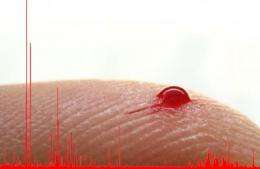
Researchers at the Max Planck Institute for Chemical Ecology in Jena and their colleagues from the Czech Academy of Sciences in Prague have developed a new method to quickly and reliably detect metabolites, such as sugars, fatty acids, amino acids and other organic substances from plant or animal tissue samples. One drop of blood -- less than one micro liter -- is sufficient to identify certain blood related metabolites.
The new technique, called MAILD, is based on classical mass spectrometry (MALDI-TOF/MS) and enables researchers to measure a large number of metabolites in biological samples, opening doors for targeted and high-throughput metabolomics. Because of its versatile applications, also in medical diagnostics, the invention is protected by patent.
Mass spectrometry is an analytical technique used to elucidate the molecular composition and structure of chemical compounds. In the last two decades mass spectrometry found vast applications in biology, especially for analyzing of large biomolecules. Matrix-Assisted Laser Desorption/Ionization (MALDI), wherein bio-molecules (e.g. proteins) are co-crystallized with a chemical substance called a matrix subsequently irradiated with a laser leads to the formation of protein ions which can be analyzed and detected.
However, matrices used in the MALDI technique have a substantial disadvantage: the laser beam not only forms ions from the substances of interest; it also forms low-mass ions (<500 da) originating from the matrix. "because of these small interfering ions we were not able to analyze small molecules that play crucial roles in the metabolism of organisms," explains aleš svatoš, head of the mass spectrometry/proteomics research group at the max planck institute. "the ions that originated from conventional matrices were like a haystack in which we wanted to find a few and important needles." therefore the maldi technique found only limited application in the field of "metabolomics".
Instead of improving the search for the "needles", i.e. metabolites such as sugars, fatty acids, amino acids, and other organic acids, the scientists began to alter the matrices with which the samples were applied so that no more interfering matrix-related ions were generated. In other words: they tried to remove the haystack to make the needles visible. The researchers succeeded with the help of physical and organic chemistry, based on the Brønsted-Lowry acid-base theory, and formulated conditions for rational selection of matrices that did not generate interfering ions but provided rich mass spectra of particular kinds of metabolites in real samples.
With the new experimental protocols they called "Matrix-Assisted Ionization/Laser Desorption - MAILD", the scientists were able to quickly and reliably determine more than 100 different analytes from single and small-sized samples. "The analysis of a very small plant leaf sample from Arabidopsis thaliana, in fact a circle area with a radius of just about 0.5 millimeter, revealed over a hundred analyte peaks, among which 46 metabolites could be identified. Interestingly, among them were eight of a total of eleven intermediates of the citric acid cycle, which is vital for most organisms," says Rohit Shroff, a native of India, who was a PhD student at the "International Max Planck Research School" and conducted the experiments.
The new MAILD method allows measurements from diverse biological and medical materials. Apart from plant and insect samples the scientists also studied a clinical sample: they were able to determine a wide range of blood-specific organic acids in one drop of human blood, smaller than a micro liter. In medical diagnostics such measurements are still conducted with intricate methods. If the scientists succeed in not only identifying, but also quantifying the metabolites, MAILD could develop into a fast method for medical and biological diagnostics.
Source: Max Planck Institute for Chemical Ecology


