Mini beamer in a cellphone or PDA
Jun 02, 2009
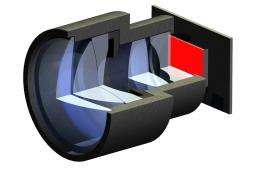
Model of the mini beamer: the OLED display can be seen to the right at the back. The lens system projects the image onto a wall. © Fraunhofer IOF

(PhysOrg.com) -- Looking at photos on a cellphone display can be somewhat arduous. A new mini beamer will make it easier. The beamer is so small that it can be integrated in a cellphone or a PDA. As it does not need an extra light source it also conserves the battery.

A summer barbecue by the lake - as the sausages sizzle on the grill some of the party would like to watch the soccer on TV. Today, a choice has to be made whether to stay by the lake or watch the match on a big public screen or the TV set at home. In future, barbecue enthusiasts and football fans will be able to enjoy both at the same time. Cellphone TV is coming closer and with an innovative mini beamer it will be possible to create a public viewing event on a small scale - for example on a white bathing towel by the side of a lake.

The mini projector was developed by research scientists at the Fraunhofer Institute for Applied Optics and Precision Engineering IOF in Jena in cooperation with their partners in the EU project HYPOLED. Unlike conventional beamers it does not need an additional illumination system. Because the beamer can operate without an extra light source it offers a number of advantages: Firstly, it takes up little space. The prototype is 2.5 centimeters long, has a diameter of 1.8 centimeters and can be easily integrated in a cellphone or a PDA. Secondly, the device needs very little energy and therefore does not overtax the battery.

“The key component of the projector is an organic display, or OLED, developed by our colleagues at the Fraunhofer Institute for Photonic Microsystems IPMS in Dresden,” says Dr. Stefan Riehemann, group manager at the IOF. Currently the OLED display produces a monochrome image with a brightness of 10,000 candelas per square meter; for color images the brightness is about half that level. By way of comparison, a computer monitor generates about 150-300 candelas per square meter. A lens system projects the image produced by the OLED onto a wall or other flat surface. The lenses are made of glass but the research scientists are already developing an optical system which uses plastic lenses. As plastic lenses can be embossed, they can be produced in larger quantities more simply and cheaply than glass lenses.

At the Laser World of Photonics trade show from June 15 to 18 in Munich, the researchers are exhibiting a monochrome prototype.

Provided by Fraunhofer-Gesellschaft (news : web)

Explore further: Sensitive bomb detector to rove in search of danger

add to favorites email to friend print save as pdf

Related Stories

Measuring in 3-D

Apr 16, 2008

Today, complex optical free-form geometries are used primarily in car headlamps and in optics for cameras and digital projectors. These optical components are expensive to manufacture and to test. At Hannover-Messe ...

A projector the size of a sugar cube

Sep 12, 2006

No larger than a sugar cube, the video projector is ready to hand at all times. Instead of the conventional microarrays, it contains just a single mirror which can be rotated around two axes. This makes it ...

Soldered lenses

May 13, 2008

Lenses in optical devices are kept in place by adhesives. This can cause problems when the microscopes and cameras are employed inside a vacuum, as the adhesives may release gases that contaminate the lenses. ...

Vest-pocket beamer

Dec 08, 2004

The vest-pocket projector could soon become reality. It is based on a tilting micromirror that builds up the picture line by line. The designers of a laboratory prototype have managed to raise its operating ...

Recommended for you

Sensitive bomb detector to rove in search of danger

15 hours ago

European researchers have developed and tested a light-weight device capable of detecting extremely minute quantities of explosives from up to 20 metres away, providing an invaluable law-enforcement tool ...

How soon could car seats enter the 3-D comfort zone?

May 23, 2013

New 3D textiles made of recyclable polyester fibres could contribute help cars be easier to recycle. But recycling technology has yet to progress in separating seat material from other car components.

NASA: Austin, calling Austin. 3-D pizzas to go

May 22, 2013

(Phys.org) —The idea of living with 3-D printed food is neither unthinkable nor new; designers and futurists have been looking to 3-D printing as food's next frontier. In 2012, there was news that the Thiel ...

User comments : 2

Adjust slider to filter visible comments by rank

Display comments: newest first

Fazer
not rated yet Jun 02, 2009
Interesting, but hard to believe that it would be more visible, or have the power to cover a larger area, than, say, the screen on a typical smart phone.
dan42day
1 / 5 (1) Jun 03, 2009
According to the HYPOLED website, the expected target, or viewing screen is only 12.4cmX9.3cm with a brightness of 100cd/m2 with the device drawing 100mw.


The active display area of the device is only about 44.25mm/2

More news stories

Google eyes emerging markets networks

Google has become deeply involved in a series of projects to build and operate wireless networks in emerging markets including sub-Saharan Africa and Southeast Asia, a report said Friday.

Facial-recognition technology proves its mettle

(Phys.org) —In a study that evaluated some of the latest in automatic facial recognition technology, researchers at Michigan State University were able to quickly identify one of the Boston Marathon bombing ...

Drones may violate international law

(Phys.org) —As President Obama gives a speech on national security—including defending U.S. use of drones to combat terrorism—Leila Sadat, JD, international law expert and professor of law at Washington University in ...

Galaxies fed by funnels of fuel

(Phys.org) —Computer simulations of galaxies growing over billions of years have revealed a likely scenario for how they feed: a cosmic version of swirly straws.