Using high-precision laser tweezers to juggle cells
May 15, 2009

Using high-precision laser tweezers to juggle cells

Enlarge

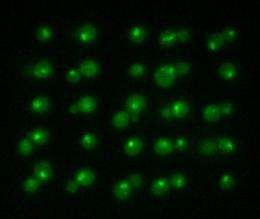
The picture shows yeast cells tagged with a green fluorescent protein that has been stressed with sodium chloride. Credit: Emma Eriksson & Elzbieta Petelenz

Researchers at the University of Gothenburg, Sweden, have developed a new method to study single cells while exposing them to controlled environmental changes. The unique method, where a set of laser tweezers move the cell around in a microscopic channel system, allows the researchers to study how single cells react to stress induced by a constantly changing environment.

Studies on how react to changes in their environment, such as reduced availability of nutrients, have traditionally used cultures consisting of millions of cells. While such studies show how cells on average react to a new environment, they say nothing about individual variation, for example how quickly a single cell responds.

PhD Emma Eriksson and her colleagues at the Department of Physics, University of Gothenburg, Sweden, developed a method where laser tweezers are used to catch a cell the size of about one micrometer, or 0.001 of a mm, and then move the cell between different environments.

Placing the cell in a system of channels made of silicone, in which each channel is finer than a human hair, enables the researchers to add and remove substances so that the environment surrounding a single cell changes in a split second - while at the same time watching the reactions through a .

The channels in the so-called microfluidic system can be likened to tiny water pipes. In a channel, a single cell can be exposed to tests and various substances for very exact time periods, which enables the researchers to repeatedly add and remove a substance to see how it affects the behaviour of the cell. This new method gives researchers information that would not be possible to obtain with traditional methods.

In its first stage, the new method has been tested on yeast cells. One of the cells' proteins was tagged with a (GFP), enabling researchers to trace the movements of the within the cell while it adjusts to a new environment.

'The method can be used to reveal how a cell reacts to stress induced by a change in its environment. The information gained from this may eventually lead to a better understanding of how cells work and what they do to stay alive and healthy in a constantly changing environment', says Eriksson.

Source: University of Gothenburg (news : web)


Rank 3 /5 (2 votes)
Relevant PhysicsForums posts

More news stories

Is a classical electrodynamics law incompatible with special relativity?

(Phys.org) -- The laws of classical electromagnetism that were developed in the 19th century are the same laws that scientists use today. They include Maxwell’s four equations along with the Lorentz la ...

Physics / General Physics

created May 24, 2012 | popularity 4.7 / 5 (18) | comments 43 | with audio podcast feature

Landmark calculation clears the way to answering how matter is formed

(Phys.org) -- An international collaboration of scientists, including Thomas Blum, associate professor of physics, is reporting in landmark detail the decay process of a subatomic particle called a kaon – ...

Physics / General Physics

created May 25, 2012 | popularity 4.3 / 5 (22) | comments 53 | with audio podcast

Lying in wait for WIMPs: Researchers seek to dramatically increase sensitivity of Large Underground Xenon detector

Although it's invisible, dark matter accounts for at least 80 percent of the matter in the universe. No one knows what it is, but most scientists would bet on weakly interacting massive particles, or WIMPs.

Physics / General Physics

created May 23, 2012 | popularity 4 / 5 (7) | comments 18 | with audio podcast

Hawaii lab turns laser-powered bubbles into microrobots

(Phys.org) -- A team of scientists from the University of Hawaii are working on microrobots created from bubbles of air in a saline solution. The bubbles take on their title of “robots” as a laser ...

Physics / General Physics

created May 23, 2012 | popularity 5 / 5 (4) | comments 2 | with audio podcast weblog

Sound increases the efficiency of boiling

Scientists at the Georgia Institute of Technology achieved a 17-percent increase in boiling efficiency by using an acoustic field to enhance heat transfer. The acoustic field does this by efficiently removing vapor bubbles ...

Physics / Soft Matter

created May 24, 2012 | popularity 5 / 5 (2) | comments 2


'Unzipped' carbon nanotubes could help energize fuel cells, batteries

Multi-walled carbon nanotubes riddled with defects and impurities on the outside could replace some of the expensive platinum catalysts used in fuel cells and metal-air batteries, according to scientists at ...

Change in developmental timing was crucial in the evolutionary shift from dinosaurs to birds: study

At first glance, it's hard to see how a common house sparrow and a Tyrannosaurus Rex might have anything in common. After all, one is a bird that weighs less than an ounce, and the other is a dinosaur that ...

Stunning image of smallest possible five-ringed structure

Scientists have created and imaged the smallest possible five-ringed structure – about 100,000 times thinner than a human hair – and you'll probably recognise its shape.

Computer model used to pinpoint prime materials for efficient carbon capture

When power plants begin capturing their carbon emissions to reduce greenhouse gases – and to most in the electric power industry, it's a question of when, not if – it will be an expensive undertaking.

T cells 'hunt' parasites like animal predators seek prey, study shows

By pairing an intimate knowledge of immune-system function with a deep understanding of statistical physics, a cross-disciplinary team at the University of Pennsylvania has arrived at a surprising finding: T cells use a movement ...

Land and sea species differ in climate change response: study

(Phys.org) -- Marine and terrestrial species will likely differ in their responses to climate warming, new research by Simon Fraser University and Australia’s University of Tasmania has found.