Molecular Alignment Gives Monolayers the Edge in Bendable Semiconductor
(PhysOrg.com) -- Reprogrammable product tags, bendable displays and flexible solar cells--the field of organic semiconductor research is advancing these possibilities toward reality. By layering hydrocarbon molecules on thin plastic sheets, scientists can make flexible electronics on the cheap.
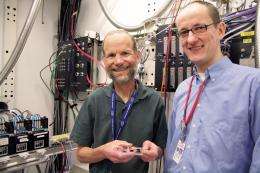
A team of researchers at SLAC National Accelerator Laboratory's Stanford Synchrotron Radiation Lightsource has recently shed new light on how organic semiconductors function as transistors. Staff scientists Stefan Mannsfeld and Michael Toney and Zhenan Bao of Stanford University used SSRL's bright X-rays to determine how pentacene molecules, chains of five interlinked hydrocarbon rings, are organized in a monolayer--a layer only one molecule thick. Their results were published online March 19 in Advanced Materials.
"If you want to understand why pentacene performs so well, or differently when deposited on one kind of surface versus another kind, you would need to know the packing in the first few molecular layers," Mannsfeld said.
Pentacene is one of the best candidates for making transistors for bendable electronics, and is therefore considered a reference point in organic semiconductor research. Though it's no match for silicon when it comes to computing speeds, it is inexpensive, reliable and easy to process. It has been thoroughly studied, but one of its properties has remained a mystery: why don't electrons flow as well through a pentacene crystal as they do through a thin film, layered on a surface?
"This was a question that had not been solved," Mannsfeld said. "It seems counterintuitive, because for almost all materials, the crystal, for its purity and structural quality, outperforms a thin film."
The group deposited single-molecule layers of pentacene and patches of pentacene on a silicon substrate, then used a technique called Grazing Incidence X-ray Diffraction to peer into the structure of the layer. Here they faced a challenge--the technique could reveal how far apart the molecules were from each other, but not how they were oriented.
"If you want to discuss how easy it is to move charges through this arrangement of molecules, it's absolutely insufficient to know just the spacing," Mannsfeld said. "You need to know the angles and tilt, how the molecules are twisted."
Mannsfeld wrote new software algorithms for extracting information about the molecules' orientation from the intensity of the scattered X-rays. The group found that pentacene molecules in a monolayer are aligned in a special way--one that differs significantly from the arrangement in a crystal.
"It turns out that the more upright the molecules are with respect to the surface they're on, and the closer they are to each other, the better current can flow," Mannsfeld said. "So we find that in the monolayer the molecules were much more perpendicular to the surface, much more vertical, than [they would be] if you put a crystal on a surface."
The new result is a crucial step toward understanding how charge flows in these promising materials.
"Now that the tools are in place, we can study a lot more materials using a scheme that already works," Mannsfeld said. "Using the same approach, same algorithms, the same software, we can now go and ask interesting questions."
Armed with new knowledge of the structure of pentacene films, and the computational tools to analyze them, Mannsfeld and Toney are collaborating with Bao to answer questions such as why films of pentacene perform so differently when layered on different substrates. Finding the right substrate might be the key to making pentacene and other organic semiconductor materials viable competitors with traditional silicon.
"Pentacene is a great molecule for understanding the fundamentals," Mannsfeld said. "The real world applications are just starting to emerge for this class of materials."
More information: www3.interscience.wiley.com/jo … l/122267092/abstract
Provided by SLAC National Accelerator Laboratory (news : web)


