Self-Programming Hybrid Memristor/Transistor Circuit Could Continue Moore's Law
Feb 26, 2009 By Lisa Zyga feature
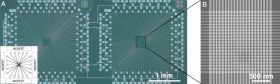
(A) An optical micrograph image of two connected nanocrossbar/transistor circuits. Inset is an illustration of a single nanocrossbar device. (B) A scanning electron microscope image of one nanocrossbar region. Image credit: Copyright 2009 National Academy of Sciences, U.S.A.

(PhysOrg.com) -- As researchers strive to increase the density and functionality of circuit elements onto computer chips, one newer option they have is a memory resistor (or “memristor”), the fourth passive circuit element. First predicted to exist in 1971 and fabricated in 2008, memristors are two-terminal devices that change their resistance in response to the total amount of current flowing through them.

By dynamically changing the doping profile inside the memristive materials, scientists can control the current-voltage relationship of the device, thus controlling the “memristance.” Since they don’t lose their state when the electrical power is turned off, memristors also have nonvolatile memory.

However, memristors are passive elements, meaning they cannot introduce energy into a circuit. In order to function, memristors need to be integrated into circuits that contain active elements, such as transistors, which can amplify or switch electronic signals. A circuit containing both memristors and transistors could have the advantage of providing enhanced functionality with fewer components, in turn minimizing chip area and power consumption.

In a recent study, a team of researchers from Hewlett-Packard Laboratories in Palo Alto, California, have fabricated and demonstrated a hybrid memristor/transistor circuit for the first time. The team demonstrated conditional programming of a nanomemristor by the hybrid circuit, showing that the same elements in a circuit can be configured to act as logic, signal routing, and memory. By routing a logic operation’s output signal back onto a memristor, the circuit could even reconfigure itself, opening the doors to a variety of self-programming circuits.

“It actually takes at least a dozen transistors to mimic the electrical properties of a single memristor,” Stan Williams of HP told PhysOrg.com. “Thus, for circuits that require some type of latching or other function performed by a memristor, it is at least conceivable for a designer to replace several active transistors with one passive memristor, which is much smaller than a single transistor. This maintains the capability of the chip while decreasing the number of transistors, which saves both silicon area and power. Thus, it may be possible to continue the equivalent of Moore's law for a couple of generations not by making transistors smaller, but by replacing some subset of them with memristors.”

The HP team’s memristor design consisted of two sets of 21 parallel 40-nm-wide wires crossing over each other to form a crossbar array, fabricated using nanoimprint lithography. A 20-nm-thick layer of the semiconductor titanium dioxide (TiO2) was sandwiched between the horizontal and vertical nanowires, forming a memristor at the intersection of each wire pair. An array of field effect transistors surrounded the memristor crossbar array, and the memristors and transistors were connected to each other through metal traces.

Then the researchers tested the device by performing a basic logic function (AB + CD) from four voltage inputs representing the four values. The operations were performed on two different rows of the memristor crossbar, and the results were routed through the transistors, which amplified the signals and fed the corresponding signal back to the memristor crossbars for programming purposes. In other words, the output signal from the simple logic function of the memristor circuits could be used to reprogram a memristor for a new operation.

“Self-programming is a form of learning,” Williams explained. “Thus, circuits with memristors may have the capacity to learn how to perform a task, rather than have to be programmed to do it.”

As the researchers explained, the basis of the memristor is that the resistance of the device can be changed and be remembered, which is physically manifested by the movement of positively charged oxygen vacancies, which are dopants in a semiconducting TiO2 film. A positive bias voltage can push the vacancies away from an electrode and increase the resistance, whereas a negative bias will attract the vacancies and decrease the resistance. If left alone, the programmed state will remain as it is for at least one year.

The researchers hope that this prototype of a hybrid memristor/transistor circuit will lead to further integrations of memristors with conventional CMOS circuits. In addition, the demonstration of a system that can alter its own programming could lead the way toward a variety of new architectures, such as adaptive synaptic circuits.

More information: Borghetti, Julien; Li, Zhiyong; Straznicky, Joseph; Li, Xuema; Ohlberg, Douglas A. A.; Wu, Wei; Stewart, Duncan R.; and Williams, R. Stanley. “A hybrid nanomemristor/transistor logic circuit capable of self-programming.” PNAS, February 10, 2009, vol. 106, no. 6, 1699-1703.

Copyright 2009 PhysOrg.com.
All rights reserved. This material may not be published, broadcast, rewritten or redistributed in whole or part without the express written permission of PhysOrg.com.

Explore further: Sensitive bomb detector to rove in search of danger

add to favorites email to friend print save as pdf

Related Stories

Making frequency-hopping radios practical

May 15, 2013

The way in which radio spectrum is currently allocated to different wireless technologies can lead to gross inefficiencies. In some regions, for instance, the frequencies used by cellphones can be desperately ...

Perfectly designed microelectronics

May 15, 2013

Microchips play an important role in industrial and household electronics. Their miniaturized circuits must not only function faultlessly but also consume as little energy as possible. Researchers are now ...

Recommended for you

Sensitive bomb detector to rove in search of danger

May 24, 2013

European researchers have developed and tested a light-weight device capable of detecting extremely minute quantities of explosives from up to 20 metres away, providing an invaluable law-enforcement tool ...

How soon could car seats enter the 3-D comfort zone?

May 23, 2013

New 3D textiles made of recyclable polyester fibres could contribute help cars be easier to recycle. But recycling technology has yet to progress in separating seat material from other car components.

NASA: Austin, calling Austin. 3-D pizzas to go

May 22, 2013

(Phys.org) —The idea of living with 3-D printed food is neither unthinkable nor new; designers and futurists have been looking to 3-D printing as food's next frontier. In 2012, there was news that the Thiel ...

User comments : 8

Adjust slider to filter visible comments by rank

Display comments: newest first

DGBEACH
1 / 5 (1) Feb 26, 2009
So they've made an analog memory chip.
moj85
2 / 5 (4) Feb 26, 2009
The chips can self-program? Hello, cyber-dyne. Hello, judgement day!
holoman
1 / 5 (2) Feb 26, 2009
Yawn, HP. Carly F. got rid of all the great
scientist at HP years ago. Now just have a
bunch of low paid foreign hacks.
El_Nexus
2 / 5 (3) Feb 26, 2009
This will be excellent for things like space probes, that need to last a long time and can't be repaired by people. The ability to adapt themselves to compensate for damage and degradation could be a massive benefit.
Arikin
2.3 / 5 (3) Feb 27, 2009
moj85... They reprogram themselves according to the programming put into them by humans... not by the chip itself. Here is a graph to help:
Hollywood < -------------------------------------- > Science

But yes your comment is kinda amusing.
Au-Pu
not rated yet Feb 27, 2009
"If left alone, the programmed state will remain as it is for at least one year".

Does this mean that it cannot retain memory for much more than one year?

In other words it suffers from short term memory loss.

This could be a serious flaw!!!!!!
laserdaveb
4.5 / 5 (2) Feb 27, 2009
au-pu..the memory in your pc "forgets" in about eight milliseconds..constantly needing refresh. Once a year refresh...not so bad..

The only thing interesting here is the behavour of the material but they say nothing about how fast it switches,or what voltages are necessary,etc. the rest is as old hat as a telephone patchboard.
HP (invents?)
BrianH
not rated yet Mar 04, 2009
"If left alone, the programmed state will remain as it is for at least one year".

Does this mean that it cannot retain memory for much more than one year?

In other words it suffers from short term memory loss.

This could be a serious flaw!!!!!!

Uh, no, that would be long-term memory loss. Short-term refers to hours or days.

More news stories

Yahoo, pay-TV operators among Hulu bidders

Online video site Hulu is again up for sale, with Yahoo and pay TV operators DirecTV and Time Warner Cable among the seven bidders, according to a person with direct knowledge of the matter.

Radiation leak at Japan lab; small impact expected

An atomic research lab in northern Japan has reported a radiation leak that may have affected about 50 people, though none were hospitalized and no impact was expected outside the facility, the lab's operator ...

Drones may violate international law

(Phys.org) —As President Obama gives a speech on national security—including defending U.S. use of drones to combat terrorism—Leila Sadat, JD, international law expert and professor of law at Washington University in ...

Google eyes emerging markets networks

Google has become deeply involved in a series of projects to build and operate wireless networks in emerging markets including sub-Saharan Africa and Southeast Asia, a report said Friday.

Heart failure accelerates male 'menopause'

Heart failure accelerates the aging process and brings on early andropausal syndrome (AS), according to research presented today at the Heart Failure Congress 2013. AS, also referred to as male 'menopause', was four times ...

Feds fight morning-after pill age ruling in NY

(AP)—Department of Justice lawyers have again asked a federal appeals court in New York to delay lifting age restrictions and prescription requirements on an emergency contraceptive popularly known as the morning-after ...