Physicists tweak quantum force, reducing barrier to tiny devices
Jul 14, 2008
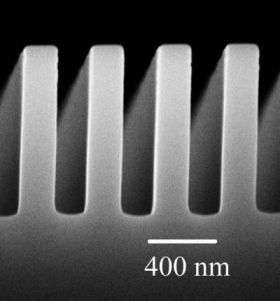
A scanning electron micrograph, taken with an electron microscope, shows the comb-like structure of a metal plate at the center of newly published University of Florida research on quantum physics. UF physicists found that corrugating the plate reduced the Casimir force, a quantum force that draws together very close objects. The discovery could prove useful as tiny "microelectromechanical" systems -- so-called MEMS devices that are already used in a wide array of consumer products -- become so small they are affected by quantum forces. Credit: Yiliang Bao and Jie Zoue/University of Florida

Cymbals don't clash of their own accord – in our world, anyway. But the quantum world is bizarrely different. Two metal plates, placed almost infinitesimally close together, spontaneously attract each other.

What seems like magic is known as the Casimir force, and it has been well-documented in experiments. The cause goes to the heart of quantum physics: Seemingly empty space is not actually empty but contains virtual particles associated with fluctuating electromagnetic fields. These particles push the plates from both the inside and the outside. However, only virtual particles of shorter wavelengths — in the quantum world, particles exist simultaneously as waves — can fit into the space between the plates, so that the outward pressure is slightly smaller than the inward pressure. The result is the plates are forced together.

Now, University of Florida physicists have found they can reduce the Casimir force by altering the surface of the plates. The discovery could prove useful as tiny "microelectromechanical" systems — so-called MEMS devices that are already used in a wide array of consumer products — become so small they are affected by quantum forces.

"We are not talking about an immediate application," says Ho Bun Chan, an assistant professor of physics and the first author of a paper on the findings that appears today in the online edition of the journal Physical Review Letters.

"We are talking about, if the devices continue to be smaller and smaller, as the trend of miniaturization occurs, then the quantum effects could come into play."

More specifically, the finding could one day help reduce what MEMS engineers call "stiction" — when two very small, very close objects tend to stick together.

Although stiction has many causes — including, for example, the presence of water molecules that tend to clump together — the Casimir force can contribute. Such quantum effects could prove important as the separations between components in tiny machinery shrink from micrometer, or millionths of a meter, toward nanometer size, Chan said.

"A lot of people are thinking of ways to reduce stiction, and this research opens up one possibility," he said.

Dutch physicist Hendrik Casimir first predicted that two closely spaced metal plates would be mutually attracted in 1948. It took several decades, but in 1996, physicist Steve Lamoreaux, then at the University of Washington, performed the first accurate measurement of the Casimir force using a torsional pendulum, an instrument for measuring very weak forces.

Subsequently, in a paper published in Science in 2001, Chan and other members of a Bell Labs team reported tapping the Casimir force to move a tiny metal see-saw. The researchers suspended a metal sphere an extremely tiny but well-controlled distance above the see-saw to "push" it up and down. It was the first demonstration of the Casimir force affecting a micromechanical device.

In the latest research, the physicists radically altered the shape of the metal plates, corrugating them into evenly spaced trenches so that they resembled a kind of three-dimensional comb. They then compared the Casimir forces generated by these corrugated objects with those generated by standard plates, all also against a metal sphere.

The result? "The force is smaller for the corrugated object but not as small as we anticipated," Chan said, adding that if corrugating the metal reduced its total area by half, the Casimir force was reduced by only 30 to 40 percent.

Chan said the experiment shows that it is not possible to simply add the force on the constituent solid parts of the plate — in this case, the tines — to arrive at the total force. Rather, he said, "the force actually depends on the geometry of the object."

"Until now, no significant or nontrivial corrections to the Casimir force due to boundary conditions have been observed experimentally," wrote Lamoreaux, now at Yale University, in a commentary accompanying publication of the paper.

Source: University of Florida

Explore further: Error sought & found: State-of-the-art measurement technique optimised

add to favorites email to friend print save as pdf

Related Stories

Calculating quantum vacuum forces in nanostructures

Feb 08, 2013

(Phys.org)—One of the surprising predictions of quantum mechanics is that uncharged conductors can attract each other over small distances, even in empty space. While the resulting "Casimir force" has been accurately measured ...

Raising the prospects for quantum levitation

Apr 18, 2012

More than half-a-century ago, the Dutch theoretical physicist Hendrik Casimir calculated that two mirrors placed facing each other in a vacuum would attract. The mysterious force arises from the energy of virtual particles ...

Researchers create light from 'almost nothing'

Jun 06, 2011

(PhysOrg.com) -- A group of physicists working out of Chalmers University of Technology in Gothenburg, Sweden, have succeeded in proving what was until now, just theory; and that is, that visible photons could ...

Probing the laws of gravity: A gravity resonance method

Apr 18, 2011

Quantum mechanical methods can now be used to study gravity: At the Vienna University of Technology (TU Vienna), a measurement method was developed, which allows to test the fundamental theories of physics.

New way to calculate the effects of Casimir forces

May 11, 2010

(PhysOrg.com) -- MIT researchers have developed a powerful new tool for calculating the effects of Casimir forces, complicated quantum forces that affect only objects that are very, very close together, with ...

Metamaterials could reduce friction in nanomachines

Dec 07, 2009

(PhysOrg.com) -- Nanoscale machines expected to have wide application in industry, energy, medicine and other fields may someday operate far more efficiently thanks to important theoretical discoveries concerning the manipulation ...

Recommended for you

Engineers pioneer flat spray-on optical lens

6 hours ago

A University of British Columbia engineer and a team of U.S. researchers have made a breakthrough utilizing spray-on technology that could revolutionize the way optical lenses are made and used.

How do cold ions slide

8 hours ago

Things not always run smoothly. It may happen, actually, that when an object slides on another, the advancement may occur through a 'stop and go' series in the characteristic manner which scientists call ...

User comments : 6

Adjust slider to filter visible comments by rank

Display comments: newest first

zevkirsh
5 / 5 (3) Jul 14, 2008
you see........this is so relevant to biology and protein folding...when will the mems guys get together with the protein folders?
superhuman
not rated yet Jul 14, 2008
It is not very relevant to protein folding, protein chains have to small an area for this to be very significant, although it is nevertheless included in van der Waals force.

As for the article Casimir force is not the only thing that pulls such object together - don't forget good old gravity.
earls
not rated yet Jul 14, 2008
I was under the impression the Casimir force was a "pushing" force (from the outside) versus and pulling force (between the masses).

To me, it was no surprise to read the effects of providing channels for the radiation pressure to equalize on either side of the plate(s).
NeilFarbstein
not rated yet Jul 14, 2008
An alternate explananition that has been offered is that the casimir force is really the Van der Waals force.
Eco_R1
not rated yet Jul 15, 2008
Hydrophobic and hydrophilic action between certain areas in the peptide chains and the protein environment is what mainly cause the protein to fold into its tertiary structure,Casimir force is only aplicable on a much smaller scale, in a sense you could say that the mechanism for protein folding is more "butch", it needs to be where as Casimir force is not sufficient to fold complex proteins.
E_L_Earnhardt
1 / 5 (1) Jul 15, 2008
NOW you are talking PHYSICS! I wondered when "PHYSORG" would get off the "chemistry kick"! The "Casimir Force" explains more of sub-microscopic operations, (like inside the living cell), than chemistry ever will!

More news stories

A quantum simulator for magnetic materials

Physicists understand perfectly well why a fridge magnet sticks to certain metallic surfaces. But there are more exotic forms of magnetism whose properties remain unclear, despite decades of intense research. ...

Engineers pioneer flat spray-on optical lens

A University of British Columbia engineer and a team of U.S. researchers have made a breakthrough utilizing spray-on technology that could revolutionize the way optical lenses are made and used.

Researchers forward quest for quantum computing

Research teams from UW-Milwaukee and the University of York investigating the properties of ultra-thin films of new materials are helping bring quantum computing one step closer to reality.

How do cold ions slide

Things not always run smoothly. It may happen, actually, that when an object slides on another, the advancement may occur through a 'stop and go' series in the characteristic manner which scientists call ...

NASA head views progress on asteroid lasso mission

Surrounded by engineers, NASA chief Charles Bolden inspected a prototype spacecraft engine that could power an audacious mission to lasso an asteroid and tow it closer to Earth for astronauts to explore.

Solar Kettle allows for boiling water off the grid

(Phys.org) —A company called Contemporary Energy has unveiled a new device it calls the Solar Kettle. It looks very much like a normal coffee thermos, but has flaps on one side that open to allow for collecting ...

Ferrets, pigs susceptible to H7N9 avian influenza virus

Chinese and U.S. scientists have used virus isolated from a person who died from H7N9 avian influenza infection to determine whether the virus could infect and be transmitted between ferrets. Ferrets are often used as a mammalian ...