Sony develops new back-illuminated CMOS image sensor
Jun 11, 2008
Sony develops new back-illuminated CMOS image sensor
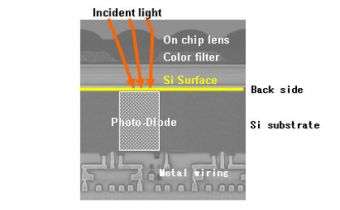
Cross sectional view of back-illuminated CMOS image sensor pixels.

Sony Corporation today announced the development of a back-illuminated CMOS image sensor (pixel size: 1.75µm square pixels, five effective mega pixels, 60 frames/s) with significantly enhanced imaging characteristics, including nearly twofold sensitivity and low noise. This improved performance has been achieved by illuminating the backside of the silicon substrate, in contrast to conventional CMOS image sensors based on front-illumination technology.

The newly developed CMOS image sensor achieves a signal-to-noise ratio of +8dB(+6dB sensitivity, -2dB noise) in comparison to existing Sony CMOS image sensors of the same pixel size. Sony will apply this back-illuminated CMOS technology in consumer digital video camcorders and digital still cameras to deliver an even higher quality image experience.

Conventionally, consumer digital video camcorders and digital still cameras have been required to combine high resolution capable of capturing every detail of the subject matter, and miniaturization oriented to portability. In order to meet these needs, image sensor development has focused on miniaturizing pixel size, while maintaining imaging characteristics. However, in addition to these ongoing requirements, in recent years demand for improved levels of minimum subject illuminance and rapid image capture has also increased. This has led to the requirement of image sensors with improved signal-to-noise ratio and other features capable of realizing improved overall picture quality.

Sony has retained the advantages of CMOS image sensors such as low power consumption and high-speed operation, while radically realigning their fundamental pixel structure from front-illumination to back-illumination to successfully develop a prototype, back-illuminated CMOS image sensor (pixel size: 1.75µm square pixels, five effective mega pixels, 60 frames/s) with improved sensitivity and noise reduction - the key factors to enhancing image quality.

With a conventional front-illumination structure, the metal wiring and transistors on the surface of the silicon substrate that form the sensor's light-sensitive area (photo-diode) impede photon gathering carried out by the on-chip lens, and this has also been an important issue in the miniaturization of pixels and widening optical angle response.

A back-illuminated structure minimizes the degradation of sensitivity to optical angle response, while also increasing the amount of light that enters each pixel due to the lack of obstacles such as metal wiring and transistors that have been moved to the reverse of the silicon substrate.

Shoot with low illumination (30 lux)

However, compared to conventional front-illuminated structures, back-illuminated structures commonly causes problems such as noise, dark current, defective pixels and color mixture that lead to image degradation and also cause a decrease in the signal-to-noise ratio.

To overcome this Sony has newly developed a unique photo-diode structure and on-chip lens optimized for back-illuminated structures, that achieves a higher sensitivity of +6dB and a lower random noise of -2dB without light by reducing noise, dark current and defect pixels compared to the conventional front-illuminated structure. Additionally, Sony's advanced technologies such as high-precision alignment have addressed any color mixture problems.

Sony has continued to advance the speed and picture quality of its CMOS image sensors, such as "Exmor", with its unique "Column-Parallel A/D Conversion Technique" and dual noise reduction, in addition to the imaging expertise it has accumulated throughout its history of CCD development. With the development of this new back-illuminated structure, Sony has realized a CMOS image sensor with even higher sensitivity and lower noise. Furthermore, the back-illuminated structure also expands device potential in areas such as speed and dynamic range by enabling multiple metal wiring layers and greater flexibility in the transistor structure. Going forward, Sony will continue its development of image sensors that combine ease-of-use, advanced image quality and cutting-edge pixel miniaturization.

Source: Sony

Explore further: Apple wants patent lawsuit to include Samsung Galaxy S4

add to favorites email to friend print save as pdf

Related Stories

Getting to the bottom of the zombie ant phenomenon

25 minutes ago

(Phys.org) —While unraveling a dramatic case of mind control, biologist David Hughes is taking calls from Hollywood—and gaining new insights into the role behavior plays in spreading disease.

100K Pathogen Genome Project maps first genomes

25 minutes ago

(Phys.org) —Striking a blow at foodborne diseases, the 100K Pathogen Genome Project at the University of California, Davis, today announced that it has sequenced the genomes of its first 10 infectious microorganisms, including ...

Meeting the 'grand challenge' of a sustainable water supply

5 minutes ago

Scientists and engineers must join together in a major new effort to educate the public and decision makers on a crisis in providing Earth's people with clean water that looms ahead in the 21st century. That's the focus of ...

Hydrogen atoms under the magnifying glass

15 minutes ago

To describe the microscopic properties of matter and its interaction with the external world, quantum mechanics uses wave functions, whose structure and time dependence is governed by the Schrödinger equation. ...

Explainer: Why are tornadoes so destructive?

34 minutes ago

Tornadoes are a part of life for people living in the Great Plains of the United States. In Oklahoma, a state that averages 62 tornadoes a year, people are prepared as best as they can be and are well warned.

Recommended for you

Pandora posts in-line 1Q loss, upbeat sales

10 hours ago

(AP)—Internet radio company Pandora reported higher-than-expected revenue in the latest quarter, with losses in line with analysts' forecasts, as the number of subscribers who pay for ad-free listening rose above 2.5 million.

Google Drive sports new view and scan enhancements

11 hours ago

(Phys.org) —Google Drive has a new look and functions. The makeover in Google Drive features scanning and interface enhancements that put the user into "card" mode. The enhancements make it easy for the ...

Inventor creates Card Beams with 3D printer

11 hours ago

What are card beams, you may ask? They are the building toy that allows you to build gravity-defying houses of cards with the help of friction, gravity, and two types of beams - the cap and the connector.

Solar Kettle allows for boiling water off the grid

12 hours ago

(Phys.org) —A company called Contemporary Energy has unveiled a new device it calls the Solar Kettle. It looks very much like a normal coffee thermos, but has flaps on one side that open to allow for collecting ...

Review: Google music plan solid, serendipitous

14 hours ago

Google's new music service offers a lot of eye candy to go with the tunes. The song selection of around 18 million tracks is comparable to popular services such as Spotify and Rhapsody, and a myriad of playlists ...

User comments : 0

More news stories

Solar Kettle allows for boiling water off the grid

(Phys.org) —A company called Contemporary Energy has unveiled a new device it calls the Solar Kettle. It looks very much like a normal coffee thermos, but has flaps on one side that open to allow for collecting ...

Google Drive sports new view and scan enhancements

(Phys.org) —Google Drive has a new look and functions. The makeover in Google Drive features scanning and interface enhancements that put the user into "card" mode. The enhancements make it easy for the ...

Controlling mood through the motions of mitochondria

(Medical Xpress)—Regulating the distribution of power in neurons is done by a system that makes the national electric grid look simple by comparison. Each neuron has several thousand mitochondria confined ...

A hidden population of exotic neutron stars

(Phys.org) —Magnetars – the dense remains of dead stars that erupt sporadically with bursts of high-energy radiation - are some of the most extreme objects known in the Universe. A major campaign using ...

A quantum simulator for magnetic materials

Physicists understand perfectly well why a fridge magnet sticks to certain metallic surfaces. But there are more exotic forms of magnetism whose properties remain unclear, despite decades of intense research. ...