IMEC obtains record conversion efficiency of 24.7% for GaAs solar cells on Ge substrate
Feb 25, 2008
IMEC obtains record conversion efficiency of 24.7% for GaAs solar cells on Ge substrate
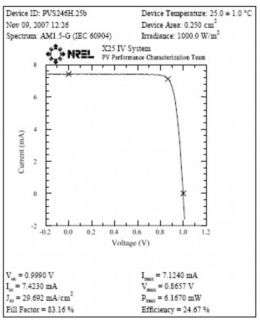
Performance characterization of IMEC’s GaAs cell, measured by NREL.

IMEC has realized a single-junction GaAs solar cell on a Ge substrate with a record conversion efficiency of 24.7%. The efficiency was measured and confirmed by NREL (National Renewable Energy Laboratory, US). GaAs solar cells are used in satellite solar panels and earth-based solar concentrators.

IMEC realized this record on a single-junction GaAs cell, grown epitaxially on a Ge substrate with an improved micro-defect distribution.

The record cell measures 0.25cm², and shows an efficiency of 24.7%, with an open-circuit voltage (Voc) of 999 mV, a short-circuit current (Jsc) of 29.7 mA/cm², and a fill factor of 83.2%. The cell was made under the ESA-IMAGER project. Umicore, a leading materials technology group, produced the Ge substrate through an optimized manufacturing technology, aimed at improving the intrinsic germanium crystal quality.

Improving the efficiency of this single-junction GaAs cell is a further step in the development of a hybrid monolithic/mechanically stacked triple-junction solar cell. This type of solar cells consists of stacks of solar cells made of different semiconductors, carefully chosen to absorb the solar spectrum as efficiently as possible.

Among the many possible combinations, IMEC focuses on stacked cells consisting of top cells with III-V materials and bottom cells made from Ge. With this combination, IMEC is targeting a conversion efficiency of 35% and more. The resulting stacks can be used in satellites and earth-based concentrators, where high-efficiency energy conversion is paramount.

Source: IMEC

Explore further: Google eyes emerging markets networks

add to favorites email to friend print save as pdf

Related Stories

CTRL+P: Printing Australia's largest solar cells

May 16, 2013

(Phys.org) —The printer has allowed researchers from the Victorian Organic Solar Cell Consortium (VICOSC) – a collaboration between CSIRO, The University of Melbourne, Monash University and industry partners ...

Recommended for you

Google eyes emerging markets networks

11 hours ago

Google has become deeply involved in a series of projects to build and operate wireless networks in emerging markets including sub-Saharan Africa and Southeast Asia, a report said Friday.

Facial-recognition technology proves its mettle

13 hours ago

(Phys.org) —In a study that evaluated some of the latest in automatic facial recognition technology, researchers at Michigan State University were able to quickly identify one of the Boston Marathon bombing ...

Mobile app to help fight against racism in France

14 hours ago

A French anti-racism association is launching a mobile application it hopes will help eradicate racist graffiti by enabling users to take photos of offensive tags, geo-locate them and get them removed.

User comments : 1

Adjust slider to filter visible comments by rank

Display comments: newest first

saucerfreak2012
not rated yet Feb 26, 2008
Well yee-haw! Let's get these doggies to market already!!! Can't wait till cells hit at least 40%, are durable, and affordable. I'll be the first in line.

More news stories

Google eyes emerging markets networks

Google has become deeply involved in a series of projects to build and operate wireless networks in emerging markets including sub-Saharan Africa and Southeast Asia, a report said Friday.

Drones may violate international law

(Phys.org) —As President Obama gives a speech on national security—including defending U.S. use of drones to combat terrorism—Leila Sadat, JD, international law expert and professor of law at Washington University in ...

Facial-recognition technology proves its mettle

(Phys.org) —In a study that evaluated some of the latest in automatic facial recognition technology, researchers at Michigan State University were able to quickly identify one of the Boston Marathon bombing ...

The long road to the 2000-watt society

The vision of a society in which each inhabitant of the earth manages to consume only 2000 watts has already been around for 15 years. During this time, there has been a steady increase in environmental awareness ...

Galaxies fed by funnels of fuel

(Phys.org) —Computer simulations of galaxies growing over billions of years have revealed a likely scenario for how they feed: a cosmic version of swirly straws.