How Cagey Electrons Keep Hydrated
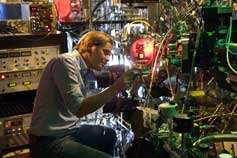
Water, despite its essential role in nature, remains a deeply mysterious substance. A long list of water's unusual properties tantalizes researchers even today, and scientists at the Stanford Synchrotron Radiation Laboratory (SSRL) and around the world are using x-rays to help address these questions. Working with SSRL scientist Anders Nilsson, researcher Dennis Nordlund and colleagues are turning up new clues, and their latest results are published in a recent issue of Physical Review Letters.
"Hydrated electrons" have been well-studied since the 1960s, and occur when free electrons become dissolved in water. Each water molecule is made up of two hydrogen atoms bound to an oxygen atom, and hydrated electrons form when a handful of water molecules congregate around a free electron, essentially trapping it in a cage of molecules.
Most agree that these cages consist of about six molecules. But the dynamics behind the process—how neighboring water molecules swing around, pointing one hydrogen atom inward to trap the electron—is not well understood.
Nordlund and colleagues, gathering data at Berkeley's Advanced Light Source and at MAX-Lab in Sweden, have for the first time measured how long an electron, having encountered a hydrogen atom of one water molecule, can stay in one place without hopping away, allowing other water molecules to swing into place and trap it.
Using x-rays to kick an electron free from an oxygen atom, in such a way that it remains close to its original water molecule, Nordlund’s group found that the electron is satisfied to wait about 20 femtoseconds before it hops away to interact with other molecules.
Although that’s inconceivably fast on a human timescale—a mere 20 quadrillionths of a second—that’s plenty long enough for the surrounding water molecules, all frenetically vibrating, to take notice of the free electron and move in to trap it.
"This is just one part of the puzzle," said Nordlund. "The final state of solvated electron and the overall timescale to get there is well-studied, but we don't know about what happens in between, like how the cages are formed, and on what timescale the initial part of the process occurs. This study adds to the information on the earliest stage, the actual trapping of the electron."
Knowing the timescales associated with how electrons become dissolved in water represents a further step toward creating a unified, precise model for describing the molecular behavior of water. At present, researchers must rely on a number of different molecular models to account for all of the strange properties of water. Unifying or replacing those models could impact society in ways at which today we may only guess—revolutionizing a range of fields from medicine to the search for alternative energy sources.
Source: by Brad Plummer, SLAC


