Velociraptor had feathers
Sep 20, 2007
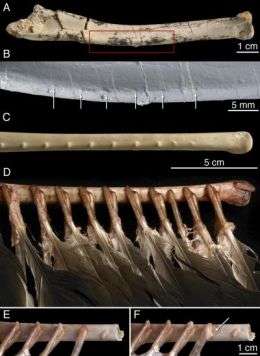
Quill Knobs on Velociraptor
(A) View of right ulna of Velociraptor IGM 100/981. (B) Detail from cast of red box in (A), with arrows showing six evenly spaced feather quill knobs. (C) View of right ulna of a turkey vulture (Cathartes). (D) Same view of Cathartes as in (C) but with soft tissue dissected to reveal placement of the secondary feathers relative to the quill knobs. (E) Detail of Cathartes, with one quill completely removed to reveal quill knob. (F) Same view as in (E) but with quill moved to the left to show placement of quill, knob, and follicular ligament. Follicular ligament indicated with arrow. Credit: Mick Ellison

A new look at some old bones have shown that velociraptor, the dinosaur made famous in the movie Jurassic Park, had feathers. A paper describing the discovery, made by paleontologists at the American Museum of Natural History and the Field Museum of Natural History, appears in the Sept. 21 issue of the journal Science.

Scientists have known for years that many dinosaurs had feathers. Now the presence of feathers has been documented in velociraptor, one of the most iconic of dinosaurs and a close relative of birds.

The fossil specimen that the group examined was a velociraptor forearm unearthed in Mongolia in 1998. They found on it clear indications of quill knobs—places where the quills of secondary feathers, the flight or wing feathers of modern birds, were anchored to the bone with ligaments. Quill knobs are also found in many living bird species and are most evident in birds that are strong flyers. Those that primarily soar or that have lost the ability to fly entirely, however, were shown in the study to typically lack signs of quill knobs.

“A lack of quill knobs does not necessarily mean that a dinosaur did not have feathers,” said Alan Turner, lead author on the study and a graduate student of paleontology at the American Museum of Natural History and at Columbia University in New York. “Finding quill knobs on velociraptor, though, means that it definitely had feathers. This is something we'd long suspected, but no one had been able to prove.”

Previous signs of feathers on dinosaurs had been restricted to fossils found in a particular kind of lake sediment that favored preservation of small-bodied animals.

The velociraptor in the current study stood about three feet tall, was about five feet long, and weighed about 30 pounds. Combined with its relatively short forelimbs compared to a modern bird, this indicated it lacked volant, or flight, abilities. The authors suggest that perhaps an ancestor of velociraptor lost the ability to fly, but retained its feathers. In velociraptor, the feathers may have been useful for display, to shield nests, for temperature control, or to help it maneuver while running.

“The more that we learn about these animals the more we find that there is basically no difference between birds and their closely related dinosaur ancestors like velociraptor,” said Mark Norell, a Curator in the Division of Paleontology at the American Museum of Natural History and co-author on the study. “Both have wishbones, brooded their nests, possess hollow bones, and were covered in feathers. If animals like velociraptor were alive today our first impression would be that they were just very unusual looking birds”.

Source: American Museum of Natural History

Explore further: First known monodactyl dinosaur adding knowledge to the evolution and biogeography of alvarezsauroids

add to favorites email to friend print save as pdf

Related Stories

Sex of early birds suggests dinosaur reproductive style

Jan 22, 2013

In a paper published in Nature Communications on January 22, 2013, a team of paleontologists including Dr. Luis Chiappe, Director of the Natural History Museum of Los Angeles County's (NHM) Dinosaur Institute, has discov ...

New raptor dinosaur takes a licking keeps on ticking

Sep 19, 2011

Raptor dinosaurs like the iconic Velociraptor from the movie franchise Jurassic Park are renowned for their "fear-factor." Their terrifying image has been popularized in part because members of this group possess a greatly ...

Archaeopteryx and the dinosaur-bird family tree

Sep 15, 2011

The magpie-sized Archaeopteryx had bird and dinosaur features and helped show that birds evolved from dinosaurs. However, recent research in the journal Nature questions its position in the dinosaur-bird family ...

Recommended for you

Prehistoric rock art maps cosmological belief

3 hours ago

It is likely some of the most widespread and oldest art in the United States. Pieces of rock art dot the Appalachian Mountains, and research by University of Tennessee, Knoxville, anthropology professor Jan ...

User comments : 0

More news stories

Prehistoric rock art maps cosmological belief

It is likely some of the most widespread and oldest art in the United States. Pieces of rock art dot the Appalachian Mountains, and research by University of Tennessee, Knoxville, anthropology professor Jan ...

The hidden agenda of Obama's opposition

Is the US Tea Party movement a racial backlash against President Obama? A new study by Angie Maxwell from the University of Arkansas, and Wayne Parent from Louisiana State University, assesses whether racial attitudes are ...

'Ugly' finding: Unattractive workers suffer more

People who are considered unattractive are more likely to be belittled and bullied in the workplace, according to a first-of-its-kind study led by a Michigan State University business scholar.

Metamorphosis of moon's water ice explained

Using data gathered by NASA's Lunar Reconnaissance Orbiter (LRO) mission, scientists believe they have solved a mystery from one of the solar system's coldest regions—a permanently shadowed crater on the ...