Coaching computer canines in clambering
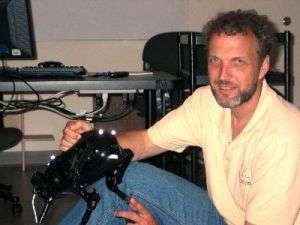
The mutts are metal, the size of toy poodles, with four pointy feet ending in little balls. They need to learn how to make their way on those little feet across a treacherous terrain of broken rocks. University of Southern California roboticist Stefan Schaal has just won renewal of a $1.5 million DARPA contract to train them to do so.
Schaal, an associate professor in the USC Viterbi School of Engineering department of computer science, began working on the problem more than a year ago.
Four- and six-legged robots have been walking around for years, he noted — but most just on smooth surfaces where wheels are a more efficient of getting around.
"What you really want legged robots for is to negotiate difficult terrain," he says. " This project is designed to push that envelop."
Boston Dynamics builds the 'bots, which come with an onboard computer chip connected to sensors.
The robot is continually aware of the location of its center of gravity.The strategy for walking, as explained in a paper Schaal presented at the 2007 IEEE International Conference on Robotics and Automation, was "to adjust a smooth walking pattern generator with the selection of every foot placement such that the center of gravity … follows a stable trajectory."
To do this, the robot calculates where and how it should proceed, "based on the current position, velocity, and acceleration" of its legs. If one effort fails, the dog learns from its mistakes and tries another route the next time.
After 15 months of experimentation — sending back mechanical dog bodies at a rate of about one per month, but saving each one’s digital electronic experience — Schaal's dogs can now move, but not very fast: traveling at 1.6 centimeters a second, a little faster than the old 1.2 cm/sec of the old Mars Sojourner robot.
The goal in the next phase of the study is to triple the speed and double the difficulty of the terrain - have the dogs not just traverse rocky ground, but climb rocky ground with a sharp slope.
If that can be achieved, he says, the programming will move over into bigger mechanical dogs.
Schaal is competing with five other labs at universities and R&D centers around the country. For the first part of the study, Schaal’s former graduate student Dimitris Pongas (CS Ph.D. 07) made significant contributions.
What about making them bark? "Once they can run, I’ll bark for them,” Schaal says.
View a .mov video of dogwalking at www-clmc.usc.edu/~sschaal/Litt … g-ExploreTiltedG.mov
Source: University of Southern California


