ZooKeys opens the gates to America's moth diversity
Feb 06, 2013
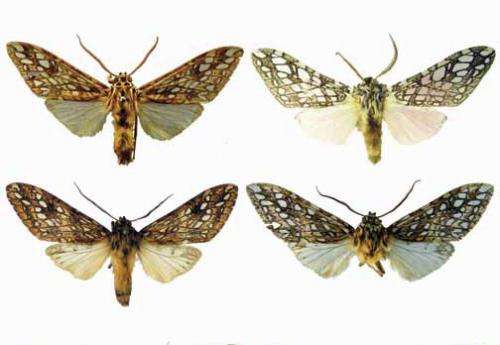
This picture shows examples of the pattern of some of the newly found Neotropical tigermoth species (Clockwise from top left: Lophocampa atriceps, Lophocampa hyalinipuncta, Lophocampa flavodorsata, Lophocampa sullivani) Credit: Dr. Benoit Vincent

Since its inception in 2009, the "Contributions to the systematics of New World macro- moths" series in ZooKeys has been playing an important role in publishing taxonomic changes and new discoveries concerning moth diversity in North America. With a total of 49 publications by 38 authors, this well-established series is among the topic leaders, alongside publications such as Canadian Staphylinidae.

Geographic coverage in Zookeys has previously focused primarily on the North American fauna (Canada, United States and Mexico). This issue marks a rapid acceleration in contributions concerning : its articles expand the geographic reach to regions from all over North and South America, the adjacent islands and territories.
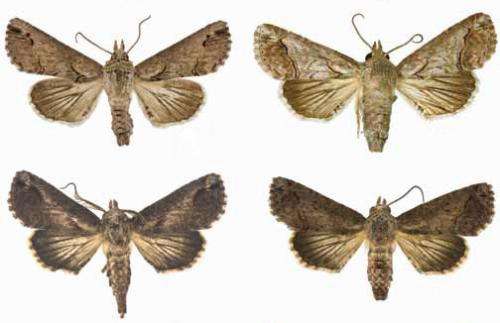
This picture shows some of the newly discovered moth species, among which is Paectes longiformis (bottom left), which could have great use in biocontrol Credit: Dr. Michael Pougue

The total of 27 new species described in this issue includes moths from North America, Venezuela, Brazil, Argentina and the Dominican Republic. Among the more interesting ones are 5 newly described additions to the particularly big family of Neotropical tigermoths. As the name suggests, they can be easily recognized by their wing decoration that imitates the fur pattern of a .

ZooKeys opens the gates to America's moth diversity
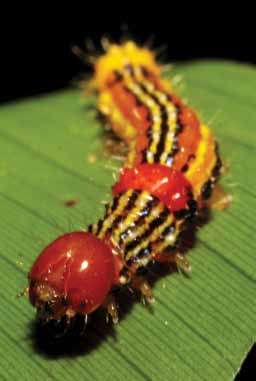
This picture shows the early stages of the new Dunama jessiebarronae species of Costa Rica Credit: Dr. Isidro A. Chacón

Another newly described species that could be of great interest was found near the Brazilian Airport, Salvador. Despite its modest looks, this animal could potentially be used for biological control in Florida against the invasive and problematic Brazilian peppertree, which is the natural habitat and food for these .

Explore further: Biocontrol research on Brazilian peppertree in Florida discovers new cryptic species

More information: Schmidt BC, Lafontaine JD (2013) Contributions to the systematics of New World macro-moths IV. In: Schmidt BC, Lafontaine JD (Eds) Contributions to the systematics of New World macro-moths IV. ZooKeys 264: 1. doi: 10.3897/zookeys.264.4687

add to favorites email to friend print save as pdf

Related Stories

American Oak Skeletonizer moth invades Europe

Nov 19, 2012

The North American Oak Skeletonizer, a very small moth, has invaded North West Europe since 1989, and feeds commonly on planted Northern Red Oaks in the Netherlands, Belgium and adjacent Germany. This is ...

Migratory moths profit from their journey

Sep 13, 2012

It isn't only birds that move south as autumn approaches. Some insects also live their lives on the same principle. A new study of migratory insects has just been published that shows that a considerably higher number of ...

Recommended for you

Scientists announce Top 10 New Species from 2012

3 hours ago

An amazing glow-in-the-dark cockroach, a harp-shaped carnivorous sponge and the smallest vertebrate on Earth are just three of the newly discovered top 10 species selected by the International Institute for ...

New cave-dwelling arachnids discovered in Brazil

15 hours ago

Two new species of cave-dwelling short-tailed whipscorpions have been discovered in northeastern Brazil, and are described in research published May 22 in the open access journal PLOS ONE by Adalberto Santos ...

Do songbirds hold key to stuttering?

20 hours ago

A tiny Australian songbird may hold the answer to discovering the biological source of stuttering, which affects 3 million Americans and is notoriously difficult to treat.

User comments : 0

More news stories

Unlocking secrets of cell reproduction

Research published in Open Biology today identifies, for the first time, nearly all the genes required for reproduction of a cell in a living organism.

Wildlife losses now stabilising

Efforts to conserve biodiversity in the UK, Belgium and Netherlands may be working, despite the widespread perception that wildlife is in terminal decline, a new study suggests.

Scientists announce Top 10 New Species from 2012

An amazing glow-in-the-dark cockroach, a harp-shaped carnivorous sponge and the smallest vertebrate on Earth are just three of the newly discovered top 10 species selected by the International Institute for ...

Weird science: Crystals melt when they're cooled

(Phys.org) —Growing thin films out of nanoparticles in ordered, crystalline sheets, to make anything from microelectronic components to solar cells, would be a boon for materials researchers, but the physics ...

Fast-acting mothers' milk for healthier babies

Human breastmilk responds quickly to protect the child when there is an infection in mothers or babies, according to new international research led by The University of Western Australia.