Nylons made from shrimps
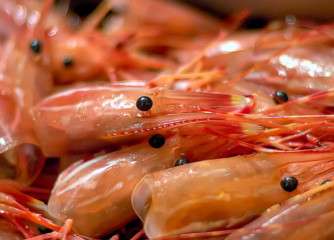
Scientists are investigating how shell waste from crustaceans could be turned into polymer precursors as a substitute to petroleum-derived solutions.
Shrimps and lobsters are among the most popular crustaceans. However, the shell waste produced by the seafood industry is a growing problem, with significant environmental and health hazards. For instance, specks of flesh left in the shells serve as an ideal growth media for pathogenic bacteria. This leads to the need to burn the shells, an environmentally costly activity given their low burning capacity.
In Europe alone, the statistical division of the Food and Agriculture Organization FAOSTAT estimates that more than 750,000 tons of crustacean shell waste is produced every year.
In many Asian countries, shrimp waste is converted to chitosan, a commercially valuable compound with a myriad of applications ranging from use as a biopesticide to biomedical solutions in tissue engineering, non-viral gene delivery and enzyme immobilisation. The problem is that European crustacean shells harbour higher levels of calcium carbonate, thus making the Asian approach unviable.
Now, an EU funded research project called ChiBio aims to convert crustacean shell waste into basic building blocks, or monomers, that would serve as precursors for plastics. Current industry standards rely on petroleum based sources to produce these materials. The project's main goal is to "develop an integrated biorefinery for processing chitin rich biowaste to gain biobased monomers for the polymer industry," says Lars Wiemann, who heads the project from the Fraunhofer Institute for Interfacial Engineering and Biotechnology, in Straubing, Germany. He believes that the protocol used in the project could also be applied to other novel biogenic materials, such as insect carapaces or fungi.
Until now, most shell waste processing approaches are focused on extracting chitosan. By contrast, the project is the first to take the process a step further. Its bio-refinery seeks to break down the chitin present in shells into its basic components, such as the sugar monomer glucosamine. These components can then be further processed, for example, into basic building blocks used in the synthesis of polymers such as nylon or polyester.
But, some question whether the approach may simply lead to additional challenges further along the road. "The efficient extraction and purification process and availability of chitin wastes, in the future, may [require] to actually raise chitin-rich crustaceans for making [quality] chitin-derivative products," Montarop Yamabhai, tells youris.com. He is an associate professor and the chair of the School of biotechnology at the Suranaree University of Technology, in NakhonRatchasima, Thailand.
Others warn that the project success hinges on its commercial viability. "The challenge is to be able to take the results of the project, make a commercially viable solution and address a widespread waste stream," says Michaela Archer, information programme leader at UK seafood industry public support body Seafish. The project team is well aware of such issues. "The polymer industry is very price competitive and final monomers, may they come from fossils or renewable, must be cheap," says Wiemann. He concludes: "If our process is too expensive in the end it won´t be competitive and not relevant for industrial uses."
More information: www.chibiofp7.fraunhofer.de/
Provided by Youris.com


