Researchers examine environmental stress in migratory birds
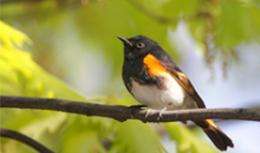
(Phys.org)—Small migratory male birds that winter in a stressful environment age faster than those that winter in a high-quality habitat, according to research stemming from a collaborative National Science Foundation grant between the University of Maine and Smithsonian Conservation Biology Institute.
The team of biologists, led by former postdoctoral researcher Frederic Angelier working under the direction of UMaine Professor of Biological Sciences Rebecca Holberton, focused on telomeres—the long, repetitive noncoding sequences of DNA at the end of chromosomes that protect chromosomes from degradation and play a role in the aging process.
The researchers found that telomeres of male American redstarts (Setophaga ruticilla) that winter in the arid Jamaican scrub habitat shortened significantly faster than telomeres of male American redstarts that winter in a lush Jamaican black mangrove forest.
The findings suggest birds' nonbreeding environment impacts the rate of telomere shortening and has important indirect effects on migratory bird population, the team says.
The researchers also found males with shorter telomeres are less likely to return to the nonbreeding territory the ensuing year than those with longer telomeres, confirming previous studies that telomere length is related to survival in vertebrates.
American redstarts generally arrive in the Font Hill Nature Preserve in Jamaica in mid-September, where they remain until spring migration in April or May.
The team's findings were published in the Jan. 31, 2013 edition of Functional Ecology.
Journal information: Functional Ecology
Provided by University of Maine


