Earth-directed CME released by long duration solar flare
Feb 11, 2013 by Scott Weissinger
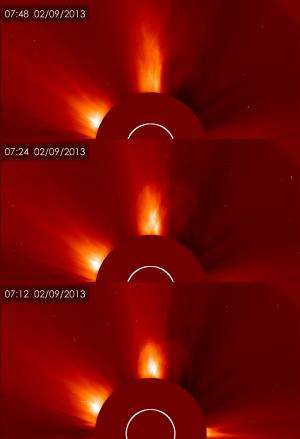
Three views over time of the coronal mass ejection (CME) released by the sun on Feb. 9, 2013 as seen by the Solar and Heliospheric Observatory (SOHO). Credit: ESA&NASA/SOHO

(Phys.org)—On Feb. 9, 2013 at 2:30 a.m. EST, the sun erupted with an Earth-directed coronal mass ejection or CME, associated with a long duration C2.4-class flare. Experimental NASA research models, based on observations from the Solar Terrestrial Relations Observatory (STEREO) and ESA/NASA's Solar and Heliospheric Observatory, show that the CME left the sun at speeds of around 500 miles per second, which is a fairly typical speed for CMEs. Historically, CMEs at this speed are usually benign.

Not to be confused with a solar flare, a CME is a solar phenomenon that can send solar particles into space and reach Earth one to three days later.

Earth-directed CMEs can cause a space called a geomagnetic storm, which occurs when they connect with the outside of the Earth's magnetic envelope, the magnetosphere, for an extended period of time. In the past, CMEs at this strength have had little effect. They may cause auroras near the poles but are unlikely to disrupt electrical systems on Earth or interfere with GPS or satellite-based communications systems.

NOAA's Center (http://swpc.noaa.gov) is the United States Government official source for space weather forecasts, alerts, watches and warnings.

Explore further: NASA sees a coronal mass ejection erupt from the sun

More information: To view past solar events, visit the Solar Event Archive.

add to favorites email to friend print save as pdf

Related Stories

NASA sees a coronal mass ejection erupt from the sun

Jan 31, 2013

On Jan. 31, 2013 at 2:09am EST, the sun erupted with an Earth-directed coronal mass ejection or CME. Experimental NASA research models, based on observations from the Solar Terrestrial Relations Observatory ...

Continuing Thanksgiving eruptions on the Sun

Nov 26, 2012

On Nov. 23, 2012, at 8:54 a.m. EST, the sun erupted with an Earth-directed coronal mass ejection or CME. Experimental NASA research models, based on observations from the Solar Terrestrial Relations Observatory ...

Sun shoots out two coronal mass ejections

Jan 24, 2013

On Jan. 23, 2013, at 9:55 a.m. EST, the sun erupted with an Earth-directed coronal mass ejection, or CME. Experimental NASA research models, based on observations from the Solar Terrestrial Relations Observatory ...

Sun produces two CMEs

Feb 07, 2013

In the evening of Feb. 5, 2013, the sun erupted with two coronal mass ejections or CMEs that may glance near-Earth space. Experimental NASA research models, based on observations from the Solar Terrestrial ...

NASA spacecraft observe a Thanksgiving CME

Nov 23, 2012

(Phys.org)—On Nov. 21, 2012, at 11:24 a.m. EST, the sun erupted with an Earth-directed coronal mass ejection or CME. Experimental NASA research models, based on observations from the Solar Terrestrial Relations ...

NASA spacecraft observe Nov. 20 solar eruption

Nov 20, 2012

On Nov. 20, 2012, at 7:09 a.m. EST, the sun erupted with a coronal mass ejection or CME. Not to be confused with a solar flare, a CME is a solar phenomenon that can send solar particles into space and can ...

Recommended for you

NASA's IRIS mission readies for a new challenge

26 minutes ago

(Phys.org) —The time draws near. NASA is getting ready to launch a new mission, a mission to observe a largely unexplored region of the solar atmosphere that powers its dynamic million-degree outer atmosphere and drives ...

Building a better team—on Mars

20 hours ago

Sometime in the next quarter-century, NASA plans to send the first humans to Mars, a mission that will push the boundaries of teamwork for a handful of astronauts who will spend as long as three years together ...

User comments : 0

More news stories

NASA's IRIS mission readies for a new challenge

(Phys.org) —The time draws near. NASA is getting ready to launch a new mission, a mission to observe a largely unexplored region of the solar atmosphere that powers its dynamic million-degree outer atmosphere and drives ...

Eco database to map landscape projects

Environmental projects which map some of the most important benefits we get from nature have been brought together for the first time in an online database, following national survey work by researchers in the University ...

Coral reefs 'ruled by earthquakes and volcanoes'

(Phys.org) —Titanic forces in the Earth's crust explain why the abundance and richness of corals varies dramatically across the vast expanse of the Indian and Pacific Oceans, a world-first study from the ...

Coccoliths thrive despite ocean acidification

Ocean acidification is damaging some marine species while others thrive, say scientists. An international team studied the effect of ocean acidification on plankton in the North Sea over the past forty years, ...