Research team discovers third type of volcanic eruption
Jan 21, 2013 by Bob Yirka report
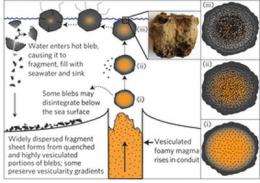
Explanatory schematic of the Tangaroan eruption style. Credit: Nature Geoscience (2013) doi:10.1038/ngeo1709

(Phys.org)—A team of researchers from New Zealand's Victoria University has discovered what its members believe to be, a third type of volcanic eruption. In their paper published in the journal Nature Geoscience, they describe a type of eruption that is neither explosive nor effusive.

On land, when a volcano erupts, it does so in either a violent fiery explosion, or as a seeping flow of hot . Until now, scientists have believed the same was true for eruptions that occur under the oceans. In this new effort, the researchers have found evidence that some underwater volcanoes erupt in a way that is neither – instead they erupt in a way that is in-between.

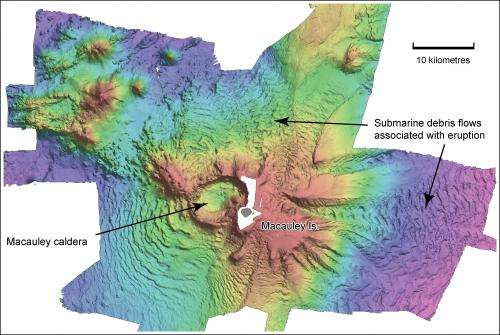
The came about as the team was studying pumice from a that occurred in the Macauley volcano – far beneath the waves in the southwest Pacific Ocean. They noted that the samples they had sported evenly spread bubble on the inside, and not so even near their surface – a pattern not generally found with rock spewed from explosive volcanoes. Bubbles form in pumice as gases inside try to escape – it generally happens when is blasted from its source.

Macauley volcano. Courtesy of National Oceanography Centre & National Institute of Water and Atmospheric Research

After more analysis and some out-of-the-box thinking, the team deduced that their pumice sample came to its unique characteristics due to something that happens under the sea. They suggest that had the volcano erupted on land, it would have blown its top, but because of the incredible pressure exerted by the weight of the ocean above it, it wasn't able to do so. Instead, it grew slowly into a mushy mousse-like mound that rose and grew slowly from the volcano, then broke apart, creating small balloons of material they team calls "blebs." Because of the gas in them, they are lighter than the so they tend to rise to the surface. As they rise, they continue to form bubbles inside, which lead to the evenly spread patterns the team found in their sample. But on their surface, the blebs are cooled by the ocean water, which leads to the odd shape of the bubbles near their surface. The team calls this third kind of eruption "Tangaroan" – a combination of the name of their ship and the Maori god of the sea.

Explore further: Bizarre rock 'ice shelf' found in Pacific

More information: Highly vesicular pumice generated by buoyant detachment of magma in subaqueous volcanism, Nature Geoscience (2013) doi:10.1038/ngeo1709

Abstract
Many submarine caldera volcanoes are blanketed with deposits of highly vesicular pumice, typically attributed to vigorous explosive activity. However, it is challenging to relate volcanic products to specific eruptive styles in submarine volcanism. Here we document vesicularity and textural characteristics of pumice clasts dredged from the submarine Macauley volcano in the Kermadec arc, southwest Pacific Ocean. We find that clasts show a bimodal distribution, with corresponding differences in vesicle abundances and shapes. Specifically, we find a sharp mode at 91% vesicularity and a broad mode at 65–80%. Subordinate clasts show gradients in vesicularity. We attribute the bimodality to a previously undocumented eruptive style that is neither effusive nor explosive. The eruption rate is insufficient to cause magma to fragment explosively, yet too high to passively feed a lava dome. Instead, the magma foam buoyantly detaches at the vent and rises as discrete magma parcels, or blebs, while continuing to vesiculate internally. The blebs are widely distributed by ocean currents before they disintegrate or become waterlogged. This disintegration creates individual clasts from interior and rim fragments, yielding the bimodal vesicularity characteristics. We conclude that the generation and widespread dispersal of highly vesicular pumice in the marine environment does not require highly explosive activity.

Press release

Related Stories

Bizarre rock 'ice shelf' found in Pacific

Aug 10, 2012

A huge cluster of floating volcanic rocks covering almost 26,000 square kilometres (10,000 square miles) has been found drifting in the Pacific, the New Zealand navy said Friday.

Recommended for you

Strong earthquake at exceptional depth

22 hours ago

This morning at 05:45 CEST, the earth trembled beneath the Okhotsk Sea in the Pacific Northwest. The quake, with a magnitude of 8.2, took place at an exceptional depth of 605 kilometers. Because of the great ...

Marine forecasting on the horizon for Indian Ocean Rim

22 hours ago

Nearly all of the member countries of the Indian Ocean Rim Association for Regional Cooperation (IOR-ARC) will attend the week-long workshop to further cooperation and understanding on international ocean ...

Russia evacuates drifting Arctic research station

May 23, 2013

Russia has ordered the urgent evacuation of the 16-strong crew of a drifting Arctic research station after ice floe that hosts the floating laboratory began to disintegrate, officials said Thursday.

User comments : 6

Adjust slider to filter visible comments by rank

Display comments: newest first

julianpenrod
2.4 / 5 (8) Jan 21, 2013
Just another example of the imprecision of "science". They claim this to be a "third type of volcanic eruption". Then they describe it as essentially just the explosive type, but under special conditions, namely, the immense pressure of overlying seawater. A phenomenon the same as other phenomenon elsewhere, but occurring under special conditions is not a new type of phenomenon! If they want, evidently, at least to an extent, self servingly, give it the name Tangaroan, they still should not typify it as a "new type of eruption".
rkolter
not rated yet Jan 21, 2013
A single volcano is offered as an example, but if there are other volcanos that erupt in a similar manner, I would think it qualifies as a type. I do think that "Lava Lamp" evokes a better mental image than "Tangaroan".
VendicarD
4 / 5 (4) Jan 21, 2013
There is at least one other kind of eruption that these silly geologists haven't figured out yet.

It is the invisible, evidence free eruption type that those 3 million invisible active volcanoes that Denialist Tards have been claiming live under the ocean employ.

Some denialists think they are caused by near surface resonance of dilithium crystals placed under the ocean by space aliens looking for an way to heat the earth's surface and increase the number of earth women wearing string bikinis.

I commend them for their space alien efforts.
Caliban
5 / 5 (2) Jan 21, 2013
Just another example of the imprecision of "science". They claim this to be a "third type of volcanic eruption". Then they describe it as essentially just the explosive type, but under special conditions, namely, the immense pressure of overlying seawater. A phenomenon the same as other phenomenon elsewhere, but occurring under special conditions is not a new type of phenomenon! If they want, evidently, at least to an extent, self servingly, give it the name Tangaroan, they still should not typify it as a "new type of eruption".


I think what they are getting at is that virtually all undersea volcanoes are of the basaltic lava variety, which has a much lower dissolved gas content than the typical land based volcano, which are dominantly of the rhyolitic lava type, which contains much higher amounts of dissolved gases, and is hence very much more explosive.

So, here we have an example of an undersea volcano driven by what is characteristically land-type volcano's magma.
Caliban
5 / 5 (1) Jan 21, 2013
Perhaps this --or a similar volcano-- was responsible for that pumice raft of a couple sqare kilometer area which was found floating off the coast of Australia last year.
Torbjorn_Larsson_OM
5 / 5 (1) Jan 22, 2013
Hot!

Caliban, thanks for the context.

@jp: Ooh, the conspirationist "science"! Useful - not. Likely - not. Trolling - yes.

We can all see they make an attribution, that needs to be tested. No one, except religionists and/or conspirationists, hands out absolute "fact".

More news stories

Galaxies fed by funnels of fuel

(Phys.org) —Computer simulations of galaxies growing over billions of years have revealed a likely scenario for how they feed: a cosmic version of swirly straws.

Source of life running out: water scientists

The majority of people on Earth people will face severe water shortages within a generation or two if pollution and waste continues unabated, scientists warned at a conference in Bonn Friday.

Dark, massive asteroid to fly by Earth on May 31

It's 1.7 miles long. Its surface is covered in a sticky black substance similar to the gunk at the bottom of a barbecue. If it impacted Earth it would probably result in global extinction. Good thing it is ...

Drones may violate international law

(Phys.org) —As President Obama gives a speech on national security—including defending U.S. use of drones to combat terrorism—Leila Sadat, JD, international law expert and professor of law at Washington University in ...