Survival of the fittest: Ocean acidification produces winners and losers
Jan 21, 2013

(Phys.org)—As atmospheric carbon dioxide levels continue to increase, the ocean absorbs more carbon dioxide. This absorption comes at a cost, since it makes the ocean more acidic. An acid ocean will affect all marine species, but the potential severity of these effects is the subject of debate.

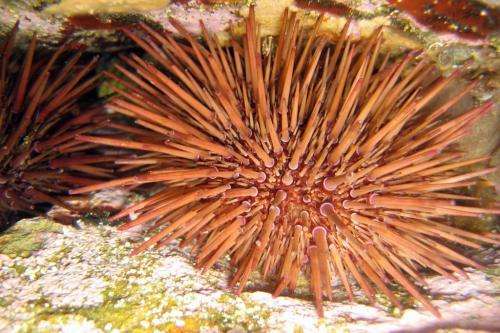
Most research on has focused on the response of pooled groups of animals. A recent study published in the journal by a research team at Macquarie University has examined the responses of individual animals. They used the common purple sea urchin (Heliocidaris erythrogramma) to test if some individuals benefit from a more acidic ocean.

The Macquarie team, led by PhD researcher Peter Schlegel, examined the effect of CO2-induced pH changes on sperm swimming behaviour and fertilisation success. While ocean acidification generally decreases sperm activity and , some individuals actually perform better under the more acidic conditions that will characterise near-future oceans.

"Our results suggest that some individuals will exhibit enhanced fertilisation in acidified oceans, supporting the concept of 'winners' and 'losers' of climate change at an individual level", said Schlegel.

It also suggests that adaption to the changed conditions is already underway. Selection for individuals that can reproduce under more acidic conditions may happen quickly, particularly since the selection occurs during the critical life phase of spawning and fertilization. The effects observed in sea urchins may apply to diverse marine species, all of which will undergo intense selection as the oceans acidification.

Explore further: Sunken WWII ships may pollute US waters

More information: The research paper can be found online www.plosone.org/article/info%3Adoi%2F10.1371%2Fjournal.pone.0053118

add to favorites email to friend print save as pdf

Related Stories

Carbon dioxide poses risk to marine life survival

Aug 06, 2008

(PhysOrg.com) -- Climate change and the subsequent acidification of the world's oceans will significantly reduce the successful fertilisation of certain marine species by the year 2100, an international team ...

Acidic oceans could aid photosynthesis

May 18, 2009

(PhysOrg.com) -- Groundbreaking Victoria University research shows that ocean acidification may have no negative effect on tropical corals and local sea anemones - in fact it may improve photosynthesis.

Recommended for you

Unraveling the Napo's mystery

2 hours ago

In the United States, rivers and their floodplains are well-documented and monitored. Ecuador's largest river, however, remains largely mysterious. Research led by Michigan State University is helping the ...

Hong Kong launches plan to tackle waste crisis

2 hours ago

Hong Kong on Monday launched a ten-year plan to reduce waste by 40 percent per person as part of efforts to catch up with other leading Asian cities and avert a looming environmental crisis.

User comments : 0

More news stories

Slow earthquakes: It's all in the rock mechanics

(Phys.org) —Earthquakes that last minutes rather than seconds are a relatively recent discovery, according to an international team of seismologists. Researchers have been aware of these slow earthquakes, ...

Unraveling the Napo's mystery

In the United States, rivers and their floodplains are well-documented and monitored. Ecuador's largest river, however, remains largely mysterious. Research led by Michigan State University is helping the ...

Practice makes perfect? Not so much

Turns out, that old "practice makes perfect" adage may be overblown. New research led by Michigan State University's Zach Hambrick finds that a copious amount of practice is not enough to explain why people ...

Lab sets a new record for creating heralded photons

(Phys.org) —Entanglement, by general consensus of physicists, is the weirdest part of quantum science. To say that two particles, A and B, are entangled means that they are actually two parts of an inseparable ...

Non-wetting fabric drains sweat

(Phys.org) —Waterproof fabrics that whisk away sweat could be the latest application of microfluidic technology developed by bioengineers at the University of California, Davis.