Nano-lens microscopes can detect viruses, other objects at nanoscale
Jan 21, 2013 by Matthew Chin
UCLA's new nano-lens microscopes can detect viruses, other objects at nanoscale
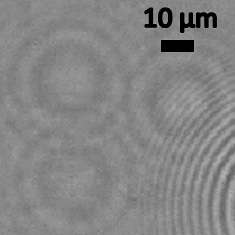
Nano-lens image of H1N1 flu virus: Lens-free pixel super-resolved holographic detection of individual influenza A (H1N1) viruses. Scale bar shows 10 micrometers.

(Phys.org)—By using tiny liquid lenses that self-assemble around microscopic objects, a team from UCLA's Henry Samueli School of Engineering and Applied Science has created an optical microscopy method that allows users to directly see objects more than 1,000 times smaller than the width of a human hair.

Coupled with computer-based computational reconstruction techniques, this portable and cost-effective platform, which has a wide field of view, can detect individual viruses and nanoparticles, making it potentially useful in the diagnosis of diseases in point-of-care settings or areas where medical resources are limited.

is one of the current gold standards for viewing . This technology uses a beam of electrons to outline the shape and structure of nanoscale objects. Other –based techniques are used as well, but all of them are relatively bulky, require time for the preparation and analysis of samples, and have a limited field of view—typically smaller than 0.2 square millimeters—which can make viewing particles in a sparse population, such as low concentrations of viruses, challenging.

To overcome these issues, the UCLA team, led by Aydogan Ozcan, an associate professor of electrical engineering and bioengineering, developed the new platform by using nanoscale lenses that stick to the objects that need to be imaged. This lets users see single viruses and other objects in a relatively inexpensive way and allows for the processing of a high volume of samples.
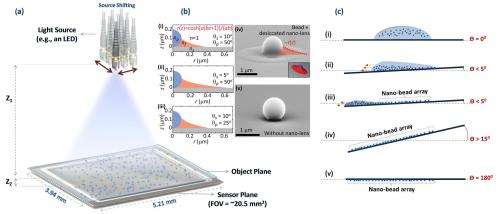
Using the nano-lens microscope. (A) The experimental setup. (B) Numerical model and scanning electron microscope images of the bead only, and bead-nano-lens configuration. (C) Steps of the sample preparation.

"This work demonstrates a high-throughput and cost-effective technique to detect sub–100-nanometer particles or viruses over very large sample areas," said Ozcan, who is also a member of the California Institute and holds a faculty appointment in the department of surgery at the David Geffen School of Medicine at UCLA. "It is enabled by a unique combination of and computational imaging."

The team also included lead authors Onur Mudanyali and Euan McLeod, both UCLA postdoctoral scholars in the Ozcan BioPhotonics Research Laboratory; Wei Luo, Alon Greenbaum and Ahmet F. Coskun, UCLA graduate-student members of Ozcan's lab; and Yves Hennequin and Cedric P. Allier, collaborators from CEA-Leti, a research institute based in France.

At scales smaller than 100 nanometers, optical microscopy becomes a challenge because of its weak light-signal levels. Using a special liquid composition, nanoscale lenses, which are typically thinner than 200 nanometers, self-assemble around objects on a glass substrate.
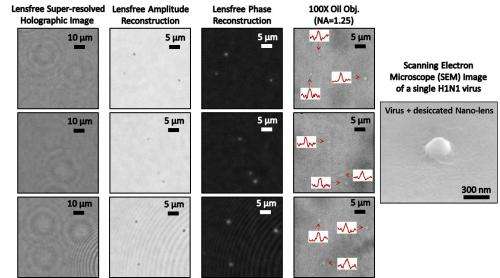
Left three columns: Lens-free pixel super-resolved holographic detection of individual influenza A (H1N1) viruses. For comparison, right column: Bright field oil immersion objective lens images of H1N1 viruses, and a single scanning electron microscope image of an H1N1.

A simple light source, such as a light-emitting diode (LED), is then used to illuminate the nano-lens object assembly. By utilizing a silicon-based sensor array, which is also found in cell-phone cameras, lens-free holograms of the nanoparticles are detected. The holograms are then rapidly reconstructed with the help of a personal computer to detect single nanoparticles on a glass substrate.

The researchers have used the new technique to create images of single polystyrene nanoparticles, as well as adenoviruses and H1N1 influenza viral particles.

While the technique does not offer the high resolution of electron microscopy, it has a much wider field of view—more than 20 square millimeters—and can be helpful in finding nanoscale objects in samples that are sparsely populated.

The research is published online in the journal Nature Photonics.

Explore further: High-resolution microscopy without a lens

More information: For more information on the Ozcan BioPhotonics Research Group, visit innovate.ee.ucla.edu . Also see bigfoot.ee.ucla.edu/ and biogames.ee.ucla.edu .

Related Stories

High-resolution microscopy without a lens

Sep 05, 2012

(Phys.org)—Over the past several years, major advances have been made at UCLA in the field of lens-less computational imaging technology, particularly in the design of lens-free holographic microscopes, which, because of ...

Through a Sensor, Holographically

Apr 26, 2011

(PhysOrg.com) -- The power and resolution of lens-based optical microscopes have improved by orders of magnitude since their invention around 1595. Nevertheless, relying on a high-magnification lens for image ...

Recommended for you

An environmentally friendly battery made from wood

7 hours ago

Taking inspiration from trees, scientists have developed a battery made from a sliver of wood coated with tin that shows promise for becoming a tiny, long-lasting, efficient and environmentally friendly energy ...

Sound waves precisely position nanowires

7 hours ago

(Phys.org) —The smaller components become, the more difficult it is to create patterns in an economical and reproducible way, according to an interdisciplinary team of Penn State researchers who, using ...

Hybrid nanostructures: Getting to the core

9 hours ago

Material scientists expect the new multifunctional properties of hybrid nanostructures will transform the development of high-performance devices, including batteries, high-sensitivity sensors and solar cells. ...

3D printing tiny batteries

Jun 18, 2013

(Phys.org) —3D printing can now be used to print lithium-ion microbatteries the size of a grain of sand. The printed microbatteries could supply electricity to tiny devices in fields from medicine to communications, ...

World's most powerful microscope ready for research

Jun 18, 2013

(Phys.org) —The world's most powerful microscope, which resides in a specially constructed room at the University of Victoria, has now been fully assembled and tested, and has a lineup of scientists and businesses eager ...

User comments : 0

More news stories

Sound waves precisely position nanowires

(Phys.org) —The smaller components become, the more difficult it is to create patterns in an economical and reproducible way, according to an interdisciplinary team of Penn State researchers who, using ...

An environmentally friendly battery made from wood

Taking inspiration from trees, scientists have developed a battery made from a sliver of wood coated with tin that shows promise for becoming a tiny, long-lasting, efficient and environmentally friendly energy ...

Hybrid nanostructures: Getting to the core

Material scientists expect the new multifunctional properties of hybrid nanostructures will transform the development of high-performance devices, including batteries, high-sensitivity sensors and solar cells. ...

Sweet solutions for detecting disease

Based at the Institute of Chemistry in the Slovak Academy of Sciences, Ján Tkáč's research combines glycomics – the study of sugars in organisms – with biochip sensors based on nanoparticles and nanotubes. ...

US doctors' group labels obesity a disease

(HealthDay)—In an effort to focus greater attention on the weight-gain epidemic plaguing the United States, the American Medical Association has now classified obesity as a disease.