Dance of water molecules turns fire-colored beetles into antifreeze artists
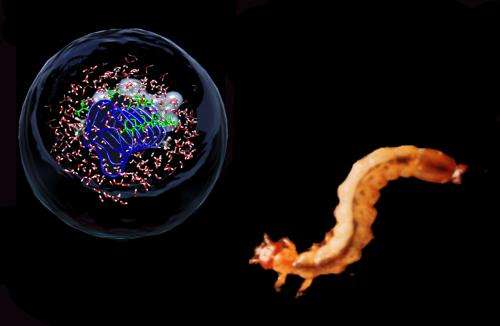
Certain plants and animals protect themselves against temperatures below freezing with antifreeze proteins. How the larva of the beetle Dendroides canadensis manages to withstand temperatures down to -30 degrees Celsius is reported by an international team of researchers led by Prof. Dr. Martina Havenith from the Department of Physical Chemistry II at the Ruhr-Universität in the journal PNAS.
Together with American colleagues, the RUB-researchers showed that interactions between the antifreeze proteins and water molecules contribute significantly to protection against the cold. Previously, it was assumed that the effect was only achieved through direct contact of the protein with ice crystals. The team obtained the results through a combination of terahertz spectroscopy and molecular dynamics simulations.
The structure of the fire beetle antifreeze proteins resembles a triangular prism. The ice binding surface of the "prism" contains many exposed side chains, as fragments of the amino acid threonine protrude from the surface here. These side chains bind ice crystals. Up until now, it was assumed that the antifreeze proteins only interact locally with nano ice crystals and thus prevent the formation of larger ice crystals. The international group of researchers showed, however, that this interaction also takes place between proteins and ice crystals over longer distances via water molecules, which also contributes to the freeze-protection.
Close to the ice binding surface, the scientists observed a much slower movement of the water molecules, which differed significantly from the water movements on the non-ice-binding sides of the protein and of free water. The lower the temperature, the slower the water moved. "We suspect that the calmer water movement on the binding surface of the protein facilitates the docking of the nano ice crystals," Martina Havenith speculated. In accordance with this, the researchers found little change in the movement of the water molecules in an inactive mutant of the antifreeze protein.
The antifreeze proteins of the fire-coloured beetle are ten to one hundred times more active than those of Arctic and Antarctic fish that need to protect themselves against temperatures of -1.9 degrees Celsius. The insects achieve this high antifreeze activity through the combination of the two strategies: direct interaction between proteins and ice and interaction via water molecules.
"The special role of water in natural antifreeze is an excellent example demonstrating that when looking at the function of a biomolecule, you not only have to consider its 3D structure, but also its entire environment - especially the solvent; in this case water," Prof. Havenith said. This topic is the focus of the cluster of excellence RESOLV, which was launched on the 1st November 2012 at the RUB and whose spokesperson is Martina Havenith. The current studies were funded by the Volkswagen Foundation.
More information: K. Meister, S. Ebbinghaus, Y. Xu, J.G. Duman, A.L. DeVries, M. Gruebele, D.M. Leitner, M. Havenith (2012): Long-range protein-water dynamics in hyperactive insect antifreeze proteins, PNAS, DOI: 10.1073/pnas.1214911110
Journal information: Proceedings of the National Academy of Sciences
Provided by Ruhr-Universitaet-Bochum


