Hailstones reveal life in a storm cloud
Jan 23, 2013
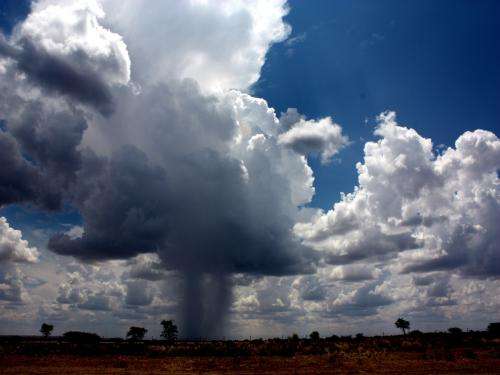
This image shows a storm cloud building up in Namibia. Storm clouds often contain hailstones, which in temperate regions can reach the ground. Credit: Nina Ražen

It isn't life on Mars, but researchers have found a rich diversity of microbial life and chemicals in the ephemeral habitat of a storm cloud, according to a study published January 23 in the open access journal PLOS ONE by Tina Šantl Temkiv and colleagues from Aarhus University, Denmark.

The researchers analyzed hailstones recovered after a storm in May 2009 and found that they carried several typically found on plants and almost 3000 different compounds usually found in soil. However, the hailstones had very few soil-associated bacteria or chemicals that would usually occur in plants. Three of the discovered were found in most of the hailstones studied, and may represent 'typical' cloud inhabitants, the study reports.

According to the authors, this selective enrichment of certain plant bacteria and soil chemicals in the hailstones reveals how specific processes during the lifetime of a cloud may impact certain bacteria more than others. They suggest that these processes could affect the long-distance transport and geographical distribution of microbes on Earth.

"When we started these analyses, we were hoping to arrive at a merely descriptive characterization of the bacterial community in an unexplored habitat. But what we found was indirect evidence for life processes in the atmosphere, such as bacterial selection and growth," says Ulrich Gosewinkel Karlson, leader of the aeromicrobiology research group at Aarhus University.

Explore further: Desert farming forms bacterial communities that promote drought resistance

More information: Santl-Temkiv T, Finster K, Dittmar T, Hansen BM, Thyrhaug R, et al. (2013) Hailstones: A Window into the Microbial and Chemical Inventory of a Storm Cloud. PLOS ONE 8(1): e53550. doi:10.1371/journal.pone.0053550

add to favorites email to friend print save as pdf

Related Stories

The role of bacteria in weather events

May 24, 2011

Researchers have discovered a high concentration of bacteria in the center of hailstones, suggesting that airborne microorganisms may be responsible for that and other weather events. They report their findings today at ...

Bacterial community inside the plant root

Aug 03, 2012

(Phys.org) -- Soil is the most species-rich microbial ecosystem in the world. From this incredible diversity, plants specifically choose certain species, give them access to the root and so host a unique, ...

Plant perfumes woo beneficial bugs

Apr 24, 2012

Scientists funded by the Biotechnology and Biological Sciences Research Council (BBSRC) have discovered that maize crops emit chemical signals which attract growth-promoting microbes to live amongst their roots. This is the ...

Some trees 'farm' bacteria to help supply nutrients

Jul 29, 2010

Some trees growing in nutrient-poor forest soil may get what they need by cultivating specific root microbes to create compounds they require. These microbes are exceptionally efficient at turning inorganic minerals into ...

Recommended for you

Researcher admits mistakes in stem cell study

May 23, 2013

A blockbuster study in which US researchers reported that they had turned human skin cells into embryonic stem cells contained errors, its lead author has acknowledged. ...

Scientists discover how rapamycin slows cell growth

May 23, 2013

University of Montreal researchers have discovered a novel molecular mechanism that can potentially slow the progression of some cancers and other diseases of abnormal growth. In the May 23 edition of the prestigious journal ...

Unlocking secrets of cell reproduction

May 23, 2013

Research published in Open Biology today identifies, for the first time, nearly all the genes required for reproduction of a cell in a living organism.

What the smallest infectious agents reveal about evolution

May 22, 2013

Radically different viruses share genes and are likely to share ancestry, according to research published in BioMed Central's open access journal Virology Journal this week. The comprehensive phylogenomic analysis compar ...

User comments : 0

More news stories

Galaxies fed by funnels of fuel

(Phys.org) —Computer simulations of galaxies growing over billions of years have revealed a likely scenario for how they feed: a cosmic version of swirly straws.